Hello, this is Gangnam Leon Dental Clinic🙂
National Health Insurance coverage for implants
is a system designed to reduce the financial burden
on older adults experiencing discomfort due to tooth loss.
However, before receiving actual treatment,
there are often many confusing points and questions
about the conditions and extent of coverage.
In particular, implant treatment is not simply a matter of placing a tooth.
The components of an implant
and the treatment process may vary depending on the patient’s condition,
which can make it difficult to determine
the scope of insurance coverage.
In this post, we will organize everything in one place,
from the basic structure of an implant
to National Health Insurance eligibility requirements,
coverage, out-of-pocket payment rates, bone grafting,
the implant treatment process,
and frequently asked questions.
📌Summary of National Health Insurance Benefits for Implants
1️⃣ Patients aged 65 or older with at least one remaining natural tooth
2️⃣ Benefits available for up to two implants over a lifetime
3️⃣ Out-of-pocket payment: approximately 30% of the total treatment cost
4️⃣Bone grafting is not covered
Implants?
: Basic Structure of an Implant
An implant is a treatment that replaces a missing tooth
by placing an artificial tooth root in the jawbone
and connecting a prosthesis on top of it.
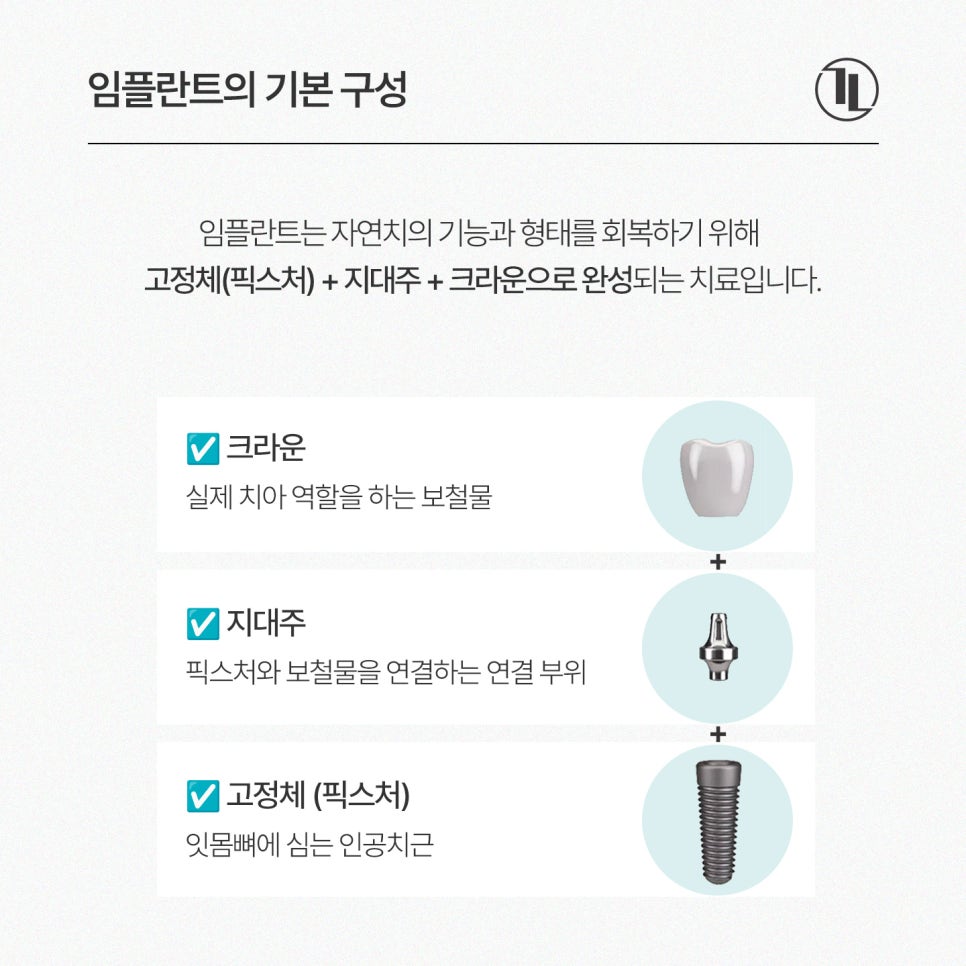
An implant generally consists of
three key components:
the implant fixture (root), the abutment (connection part),
and the crown (prosthesis).
These three parts replace the missing tooth
from the bone to the chewing surface,
helping restore function and appearance.
👉 Understanding the basic structure of an implant
can help you understand the materials, cost,
and maintenance methods.
National Health Insurance Benefits for Implants
: Eligibility and Scope of Coverage
National Health Insurance benefits for implants
are a system established to reduce the treatment burden
for National Health Insurance subscribers aged 65 or older
or their dependents.
However, not all implant treatments
are covered by insurance,
so let’s examine the eligibility requirements and scope of coverage.
🔖Eligibility for Implant Insurance Coverage
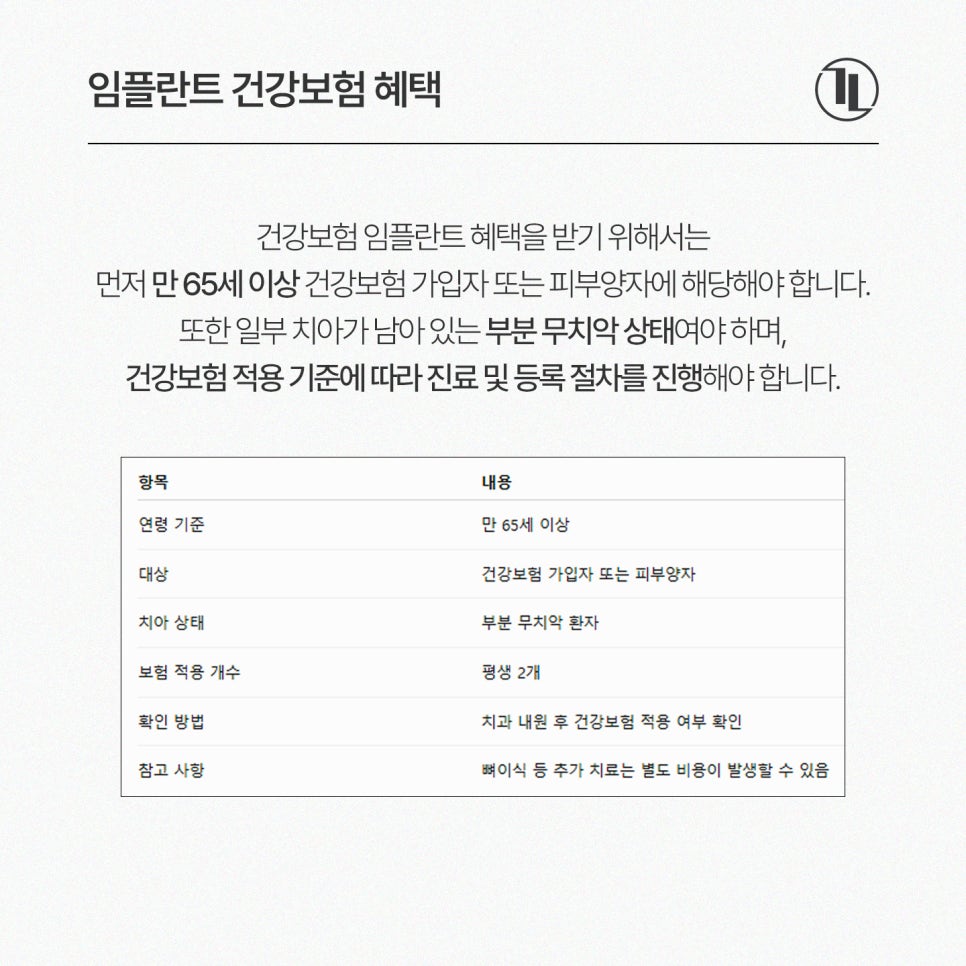
Patients aged 65 or older who are National Health Insurance subscribers or dependents
and have at least one remaining natural tooth
👉 Patients aged 65 or older with partial tooth loss
🔖Number Covered by Insurance
Up to two over a lifetime
🔖Scope of Coverage
🔖Out-of-Pocket Payment
Approximately 30% of the total treatment cost
(*Additional costs may arise depending on the treatment plan and whether additional procedures are required.)
🔖Maintenance
-
Within three months after prosthesis placement, only the examination fee is charged
-
More than three months after prosthesis placement:
Maintenance related to prosthetic restoration is not covered/
Treatment and surgery for periodontal disease around the implant are covered
Therefore, additional procedures outside the scope of insurance coverage,
such as bone grafting and sinus lift surgery,
are classified as non-covered services.
➕
In the following cases, even patients aged 65 or older
are not eligible for insurance coverage,
and the entire procedure is provided as a non-covered service.
📌Entire Procedure Not Covered
✅ The patient has complete tooth loss
✅ The implant is placed in the cheekbone by passing through the maxilla
✅ A one-piece implant material is used
✅ A crown material other than PFM or zirconia is used
✅ The number of implants exceeds the insurance limit (two)
When Bone Grafting Is Needed
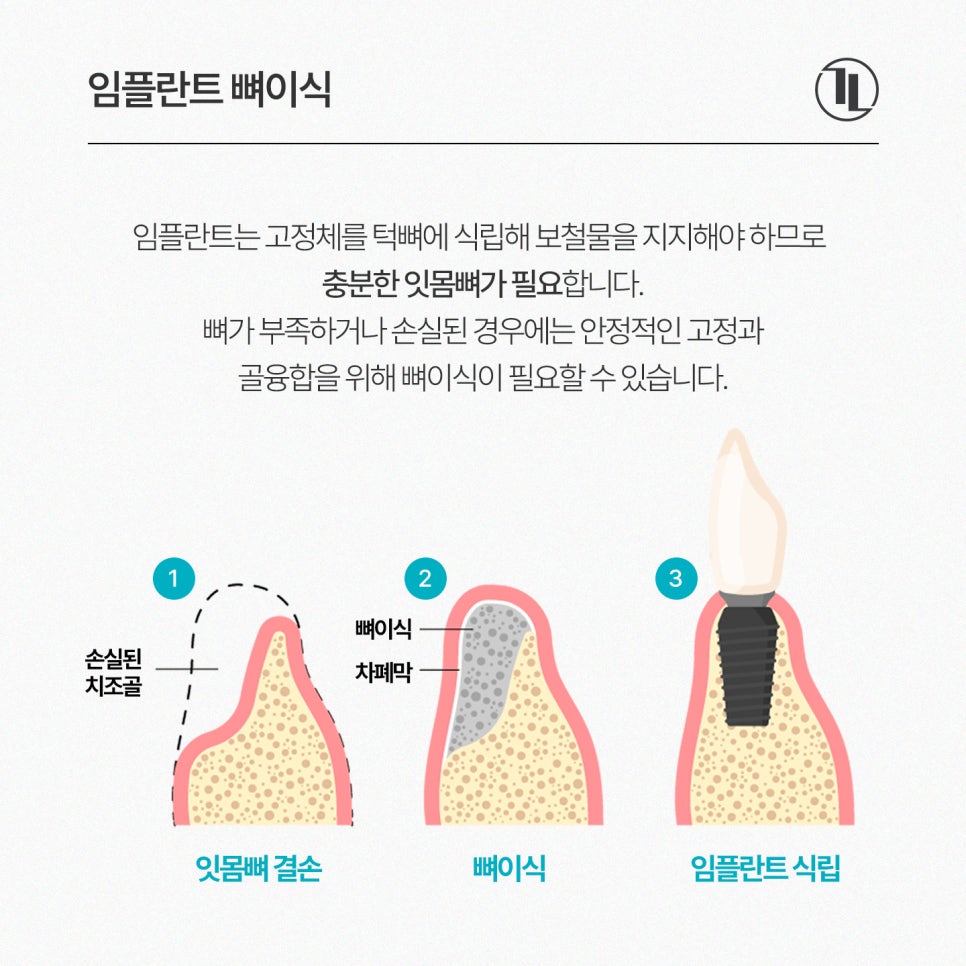
Sufficient jawbone is needed
to place an implant.
This is because the implant fixture must be placed in the jawbone
and firmly secure the rest of the prosthesis,
similar to a natural tooth root.
For long-term stability,
the bone must integrate properly with the fixture,
so healthy bone is important.
Therefore, bone grafting may be recommended
when the bone is thin or has experienced significant loss.
📌Bone Grafting May Be Needed
✅ When the height or width of the jawbone is insufficient
✅ When a sinus lift is needed
✅ When there is significant bone loss
As mentioned above,
even if bone grafting becomes necessary during implant treatment,
it is not covered by National Health Insurance.
Therefore, when planning implant treatment,
check whether bone grafting will be needed
and review the related budget in advance.
Implant Treatment Process
The length of implant treatment
varies depending on the patient’s oral condition.
It usually takes several months,
and the duration may differ
depending on the patient’s bone condition.
A typical implant treatment period
takes approximately 3–6 months.
If bone grafting or a sinus lift is required,
the treatment period may be longer.
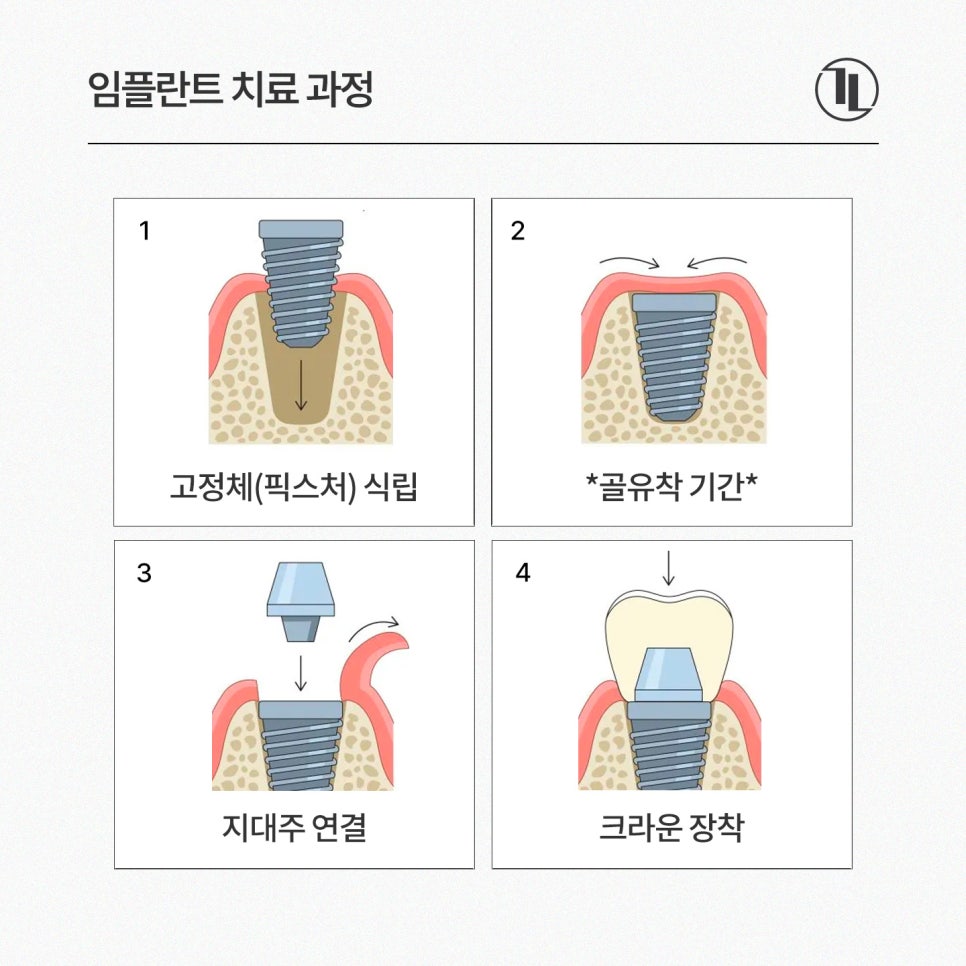
① Diagnosis and Treatment Planning
The condition of the jawbone is evaluated through
an oral examination and radiographic imaging (panoramic X-ray, CT, etc.),
and the implant placement site and treatment plan are determined.
② Fixture Placement
After administering local anesthesia,
the fixture, which serves as the root,
is placed in the jawbone.
Depending on the patient’s condition,
this may be performed at the same time as tooth extraction.
**③ Osseointegration Period
This is the process in which the placed fixture
firmly integrates with the jawbone.
It generally takes several months,
and the duration may vary depending on the bone condition.
④ Abutment Connection
Once osseointegration is complete,
the abutment is connected to the fixture.
The abutment serves to connect the implant
with the final prosthesis (crown).
⑤ Crown Placement
The crown made while considering
the patient’s tooth color and bite is placed.
Ultimately, function and appearance similar to those of natural teeth
are restored.
📌Cases in Which Treatment Takes Longer
-
When recovery is needed after tooth extraction
-
When the jawbone is insufficient
-
When bone grafting is needed
-
When management of a systemic disease is required
National Health Insurance for Implants
FAQ
Q. Are implants not covered by National Health Insurance for people under 65?
National Health Insurance coverage for implants
is generally available to those aged 65 or older.
Q. If the crown is made of metal, gold, or PFG
instead of PFM or zirconia,
is it not covered by insurance?
If a crown other than PFM or zirconia is used,
the entire procedure is provided as a non-covered service.
Q. Does implant treatment take a long time?
The duration of implant treatment varies depending on the patient’s bone condition
and the scope of treatment,
but it generally takes several months.
After the fixture is placed in the jawbone,
a process called osseointegration,
in which it firmly integrates with the bone
(usually taking 2–3 months), is required,
so the final prosthesis cannot be placed immediately.
In addition, if the gum condition is poor
and additional treatment such as bone grafting is needed,
the treatment period may be longer.
To achieve stable function and results,
treatment must proceed after allowing sufficient time for healing.
In some cases, immediate placement or immediate prosthesis placement
may be possible,
but this is limited to certain cases that meet the necessary conditions.
National Health Insurance coverage for implants
is a useful system that can reduce the financial burden
resulting from tooth loss.
Implant treatment consists of a fixture, abutment, and crown,
and costs can vary considerably depending on
the crown material and whether additional treatment such as bone grafting is needed.
To make the most of National Health Insurance benefits,
it is important to establish a treatment plan suited to you
through an accurate diagnosis and consultation before treatment.





Previous image
Next image