Hello, this is Gangnam Leon Dental Clinic🙂
Recently, many people who are considering orthodontic treatment have been asking questions such as, “Can teeth really move effectively with Invisalign?”
“Isn’t it less effective than traditional braces?”
Because Invisalign uses clear orthodontic appliances that are not easily noticeable,
it is an orthodontic method with significant aesthetic advantages.
However, when you are about to begin treatment, you may have many questions:
Will it be effective, how long will treatment take, and will it be painful?
Can all types of orthodontic problems be treated?
Today, we will organize the information that people considering Invisalign may want to know, one point at a time.
What Is Invisalign?
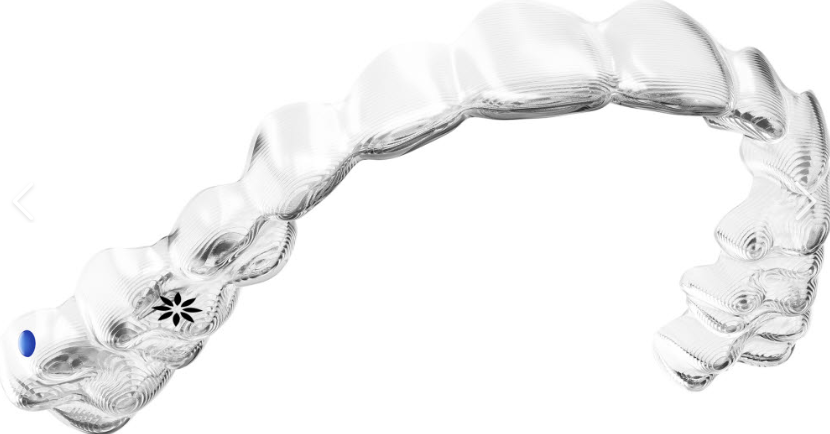
Invisalign is an orthodontic treatment that uses clear orthodontic appliances
to gradually move the teeth into their planned positions.
Traditional bracket orthodontics involves attaching brackets and wires to the teeth, so the appliances are clearly visible.
In contrast, Invisalign uses clear, plastic appliances,
so they are relatively less noticeable.
In addition, Invisalign uses digital oral scans to check the current positions of the teeth,
plans how the teeth will move during treatment,
and then produces orthodontic appliances in multiple stages.
In other words, treatment does not involve using one appliance continuously. Instead, the appliance is replaced with a new one according to each stage of tooth movement.
Is Invisalign Really Effective?
This is probably the point you are most curious about.
To give you the conclusion first, effective orthodontic treatment with Invisalign is possible if an appropriate case is selected, an accurate treatment plan is followed, and the appliances are worn properly.
Invisalign is not necessarily less effective than traditional bracket orthodontics.
However, it is important to understand that not every malocclusion can be treated in exactly the same way with Invisalign alone.
The appropriate orthodontic method must be determined after comprehensively evaluating not only the alignment of the teeth, but also the bite between the upper and lower teeth,
the relationship between the jawbones,
and the amount of tooth movement required.
Therefore,
rather than thinking,
“Because it is Invisalign, it is less effective,”
it is more important to confirm:
“Is my dental condition suitable for Invisalign treatment?”
When Is Invisalign Effective?
① When the teeth are crooked
If the front teeth slightly overlap or the teeth are unevenly aligned,
Invisalign can be used to adjust their positions.
② When there are crowded or overlapping teeth
Orthodontic treatment with Invisalign may be possible depending on the severity of the crowding and the direction in which the teeth are positioned.
However, the more severe the crowding, the more important it is to plan how to secure enough space to move the teeth.
③ When there are gaps between the teeth
When spaces exist between the teeth, Invisalign can also be used to move the teeth and reduce those spaces.
④ When the front teeth protrude
After evaluating the angle and position of the front teeth and their relationship with the lips, an appropriate treatment plan can be established to improve protruding front teeth.
⑤ When the teeth have shifted again after orthodontic treatment
Even if you received orthodontic treatment in the past, your teeth may move again if you did not wear your retainers properly. In such cases, retreatment with Invisalign may be considered.
Are There Also Cases That Are Difficult to Treat with Invisalign?
Yes, there are.
No matter how much Invisalign has advanced, not every malocclusion can be treated in the same way.
For example,
✔️ Severe skeletal malocclusion
✔️ Cases in which the position of the jawbone itself needs to be significantly improved
✔️ Cases requiring very severe tooth rotation or movement
✔️ Cases requiring a large amount of tooth movement
✔️ Cases in which patient cooperation is difficult
In such cases, the treatment method must be determined carefully.
Especially when there is a significant skeletal problem, it may be difficult to achieve the desired result simply by moving the teeth.
Therefore, whether Invisalign is suitable is not determined simply by looking at whether the teeth are crooked. It is decided after comprehensively evaluating an oral examination, X-rays, the bite, and other factors.
How Can You Improve the Effectiveness of Invisalign?
With Invisalign, the patient’s cooperation has a significant impact on the treatment outcome.
With bracket orthodontics, the appliances are attached to the teeth, so the patient cannot remove them at will.
Invisalign, however, can be removed personally whenever necessary.
Therefore, if you frequently leave the appliances out or do not wear them for enough time, a difference may arise between the planned tooth movement and the actual tooth movement.
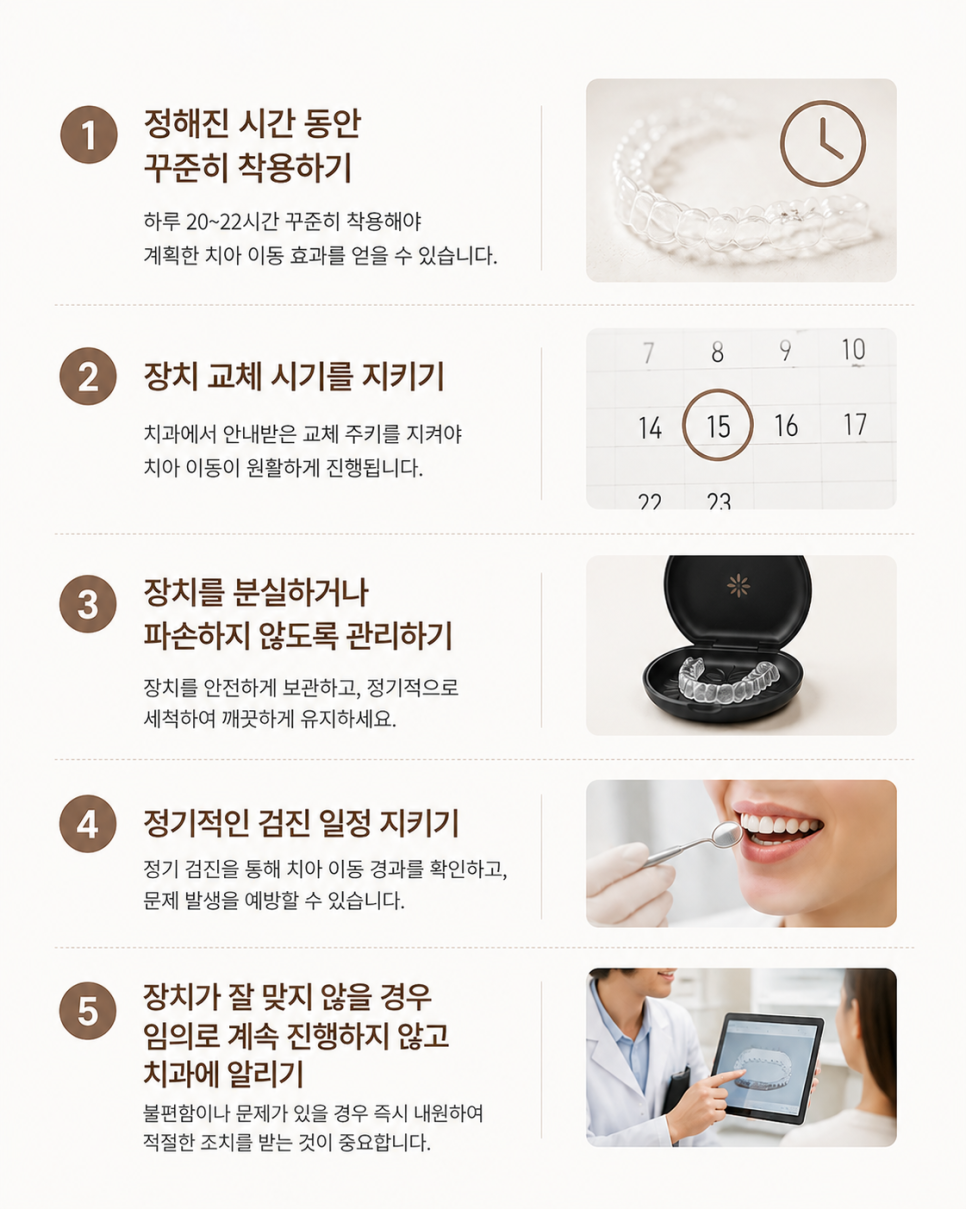
In particular, repeatedly leaving the appliances out while thinking, “It should be okay just for today,”
can affect the treatment duration, so caution is needed.
What Are the Advantages of Invisalign?
✔️ It is not easily noticeable
This is one of Invisalign’s greatest advantages.
Because clear appliances are used,
there is less of an aesthetic burden compared with conventional metal brackets.
This is also why many adults who want to begin orthodontic treatment while working consider Invisalign.
✔️ It can be removed when necessary
The appliances can be removed when eating or brushing your teeth.
Compared with traditional orthodontic appliances, there is less concern about food becoming stuck around the appliances,
and you can maintain your usual oral hygiene routine.
✔️ There are relatively fewer food restrictions
Because the appliances are removed while eating,
there is less concern about food choices compared with bracket orthodontics.
However, after eating, it is best to brush your teeth or otherwise clean your mouth before putting the appliances back in.
✔️ Treatment can be planned digitally
Another advantage is that the current condition of the teeth can be checked using oral scans and other tools,
and the treatment process can be planned digitally.
Disadvantages and Precautions of Invisalign
Invisalign has many advantages, but it also has disadvantages.
✔️ You must manage your wearing time yourself.
The ability to remove the appliances
can actually become a disadvantage.
If you are unable to wear the appliances properly on your own,
treatment may take longer than the planned duration.
✔️ The appliances may be lost.
There are cases in which people remove the appliances while eating and then lose them.
When the appliances are removed,
it is a good idea to develop the habit of storing them in their designated case.
✔️ You may initially feel that there is something in your mouth.
When you first wear the appliances or switch to a new set,
you may feel pressure or a sense of foreignness.
Depending on the person, speech may also temporarily feel awkward.
In most cases, the discomfort gradually decreases as you adjust.
✔️ Additional appliances may be necessary.
As treatment progresses, a difference may develop between the planned tooth movement and the actual tooth movement.
In such cases, additional orthodontic appliances may be produced so that treatment can continue.
How Long Does Invisalign Treatment Take?
We also often receive the question, “Does Invisalign treatment finish in just a few months?”
However, the treatment duration varies from person to person.
The duration may differ between cases involving only a simple improvement in the alignment of the front teeth and cases involving improvement of the overall tooth alignment and bite.
In addition,
✔️ How misaligned the teeth are
✔️ How far the teeth need to be moved
✔️ Whether tooth extraction is necessary
✔️ The extent of the bite problem
✔️ How consistently the appliances are worn
and other factors can affect the treatment duration.
Therefore, there is no fixed rule that “Invisalign always finishes in a certain number of months.”
The most accurate approach is to estimate the treatment duration based on the individual’s dental condition.
Does Invisalign Hurt?
Many people are also concerned about pain when starting orthodontic treatment.
Because Invisalign is also an orthodontic treatment that actually moves the teeth,
it does not mean that you will feel absolutely nothing.
When wearing a new set of appliances,
you may feel pressure or a dull, achy sensation in your teeth,
and temporary discomfort may occur as the teeth move.
However, the degree of pain varies considerably from person to person,
and in general, many people gradually adjust while wearing the appliances.
Invisalign has attracted the attention of many people because it is not easily noticeable and can be removed.
However, it is not appropriate to assume that “because it is clear orthodontic treatment, it is equally effective for everyone.”
What is important is to accurately diagnose the patient’s teeth and bite,
and establish a treatment plan suited to those conditions.
Even if the treatment plan is carefully established,
it may be difficult to achieve the desired result if the patient does not wear the appliances properly.
Therefore, if you are considering Invisalign,
rather than simply comparing prices or types of appliances,
it is a good idea to also confirm whether Invisalign is suitable for your dental condition,
how the treatment will proceed,
and approximately how long the treatment is expected to take.
Ultimately, the factors that determine the effectiveness of Invisalign are not simply “whether or not the orthodontic appliance is clear,” but rather:
Accurate diagnosis + an appropriate treatment plan + the patient’s consistent wearing and care

Previous image
Next image