| This post contains a plastic surgeon’s opinion on what makes a clinic good at middle-aged eye surgery. If you are looking for a plastic surgery clinic that can offer reasonable costs, minimize side effects, and achieve good results, you may find this information practically helpful. |

Hello.
I’m Ban Hogyung, a board-certified plastic surgeon whose specialty is eye surgery and whose strongest skill is revision eye surgery.
“Doctor, you’re young, but your work is really excellent.”
That’s something I often hear from patients old enough to be my parents. But I’m 40 this year, I have two children, and my eldest is already in 5th grade.
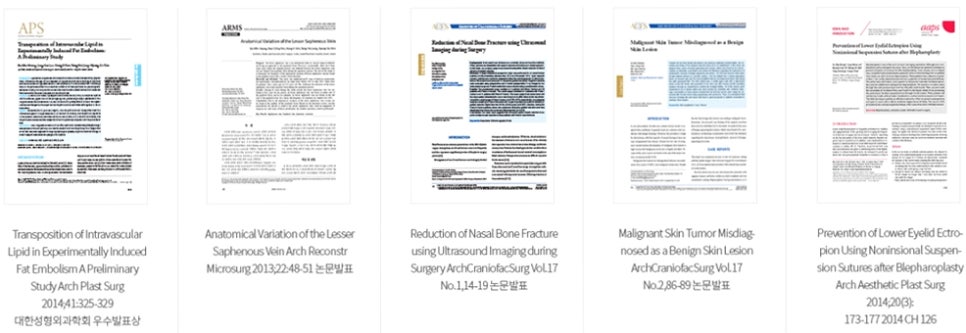
Because I’ve built a reputation for handling failed eye surgery revisions well—strictly speaking, for being good at revision surgery—I’m confident in my skills. I may not look it(?), but after clinic hours I keep studying and researching regularly (I’ve published more than five papers).
So even among plastic surgery clinics in Gangnam, I can offer eye surgery at a relatively reasonable cost. (Part of the reason is that I also keep the price lower so people will recommend us to others.)
First of all, good anesthesia makes things comfortable for the patient and for me. I can focus entirely on the surgery, and because unnecessary tissue damage and bleeding are minimized during the procedure, the surgery becomes simpler, allowing me to work quickly and precisely.
Still, it’s strange: when buying things, people search like hyenas for the lowest price, but when it comes to surgery, the higher the cost, the more plausible the reason seems.
In particular, children looking for a clinic that does middle-aged eye surgery well for their parents—such as lower eyelid surgery or lower blepharoplasty—often get confused. I completely understand wanting to spend generously on surgery as a gift of filial piety for your parents.
Above all, some clinics that focus only on under-eye fat surgery charge more as the patient’s age increases.
But there are also plastic surgery clinics where the surgical fee is the same regardless of age. (Ours is like that too.)
As a plastic surgeon who focuses on eye surgery, I’ll say this clearly: there is an appropriate price for eye plastic surgery. If it’s too cheap, there is a reason; if it’s excessively expensive, you are simply paying unnecessary costs.
In the end, staying within a reasonable range is the smartest choice.
https://blog.naver.com/rush_724/223737127404
So by now, you may understand that there’s no need to force yourself into expensive surgery and bear the burden unnecessarily.
The real issue is: how can you tell whether a clinic is actually good at middle-aged eye surgery?
I’ll explain that in detail in the next section.
A Clinic That Does Middle-Aged Eye Surgery Well
For middle-aged and older adults, it’s rare that the only problem is under-eye fat.
Under-eye fat repositioning is a procedure many celebrities have discussed on TV afterward, and more than being a “plastic surgery” procedure that changes the underlying appearance, it is closer to an “anti-aging” procedure. That’s why the barrier to entry for patients is not very high.
Even men who want to avoid looking obviously “worked on” seek it out, and that says a lot.
Maybe that’s why?
Over the past few years, many clinics specializing only in under-eye fat repositioning have opened.
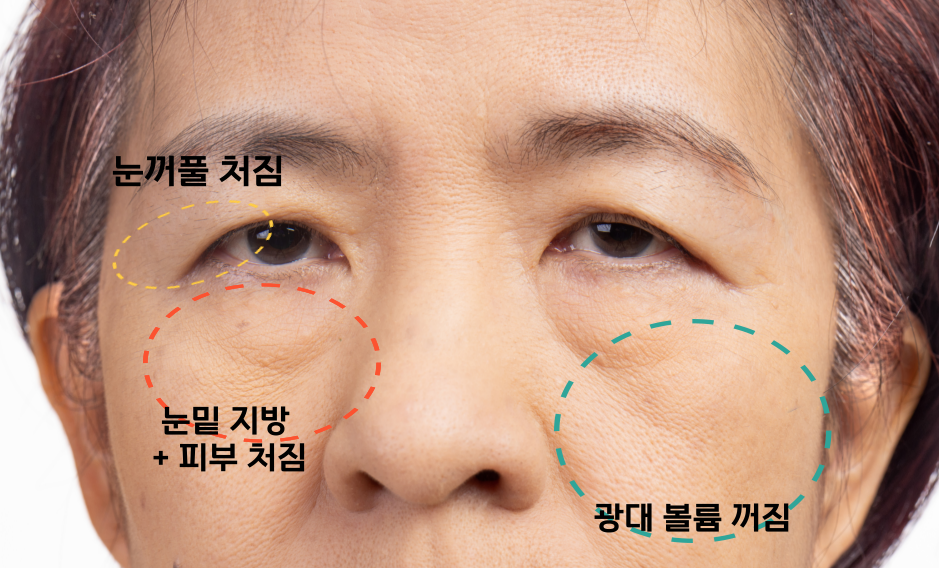
But for middle-aged and older patients, while they may think protruding and hollow under-eye fat are the biggest issues, an actual diagnosis sometimes shows that sagging of the upper eye area is the bigger problem.
Many patients are concerned only about the under-eye area, but after examination, the eyelids may actually be drooping, or the lack of volume in the cheekbone area may be making the under-eye area look even more sunken.
If you only correct the under-eye fat when the eyelids are already drooping, the eyes may look smaller or the overall impression may look heavy. In such cases, combining it with upper blepharoplasty (surgery to correct sagging eyelids) is necessary to achieve balanced results.
Also, in people in their 50s and older, fat protrusion and skin sagging often occur together.
If you only reposition the fat at that point, the sagging skin remains and wrinkles may become even more noticeable.
What kind of case is that?
Yes, exactly. In those cases, lower blepharoplasty should be performed together to achieve a naturally younger-looking result.
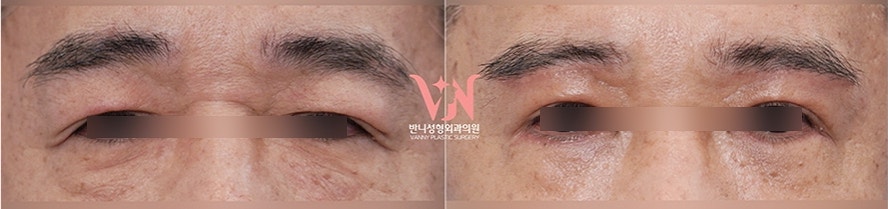 Left - Before surgery
Right - After lower blepharoplasty and brow lift
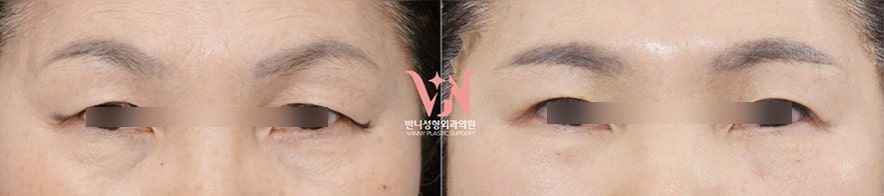 Left: Before surgery
Right: After lower blepharoplasty and brow lift
Not only that, but after lower eyelid surgery, another issue soon becomes noticeable.
Because the under-eye area looks firmer and younger, the sagging of the upper eye area stands out relatively more.
That’s why many people begin worrying about upper eyelid sagging not long after under-eye surgery, and in the end, most decide on additional surgery.

In the past, upper blepharoplasty was considered the appropriate option in these cases, but these days, as times have changed, brow lift surgery is often a more natural alternative.
Especially if you want to keep the double eyelid line while only tidying up sagging skin, a brow lift may be the better choice. I’ll explain this in more detail in a future post!

In other words, age-related eye changes in middle-aged and older adults are not limited to under-eye fat alone; several issues often occur together. So rather than fixing just one area, it’s important to restore overall balance.
Therefore, for middle-aged eye surgery, it’s better to look for a plastic surgery clinic that handles under-eye fat repositioning, lower blepharoplasty, upper blepharoplasty, and brow/forehead lifts, rather than a clinic that focuses on only one type of surgery.
That way, you can get an accurate diagnosis of the current eye-aging issues and find the right solution.
But there are many clinics that perform under-eye fat repositioning, lower blepharoplasty, upper blepharoplasty, and brow/forehead lifts—so naturally, you’ll want to go to one that is truly skilled at them.
How to Judge the Skill of an Eye Surgery Clinic
Because under-eye fat repositioning, upper and lower blepharoplasty, and lifting procedures all depend on different factors to determine the quality of the result, it would be difficult to explain everything here, so please understand.
Speaking specifically about lower blepharoplasty, which is more commonly performed in middle-aged and older patients, the key is accurately calculating how much sagging skin should be removed.
Problems arise if too much is removed or too little is removed.
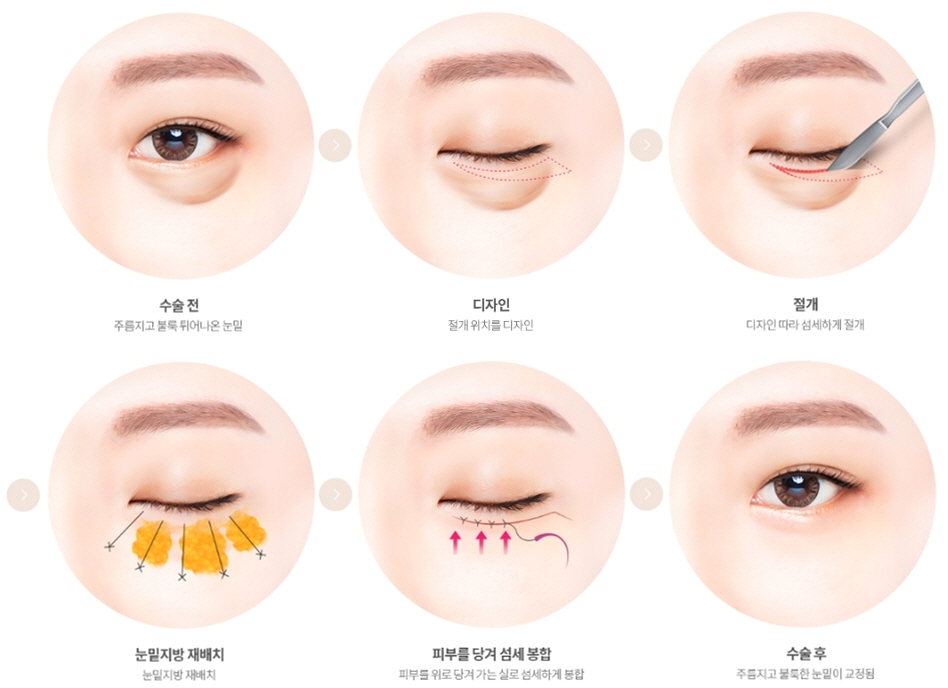 Lower blepharoplasty procedure
The skin is connected to the muscles under the eyes, and the lower eyelid must naturally stay in close contact with the eye in a specific position. If too much under-eye skin is removed, the force supporting the eyelid weakens, which can cause ectropion, where the eye is pulled downward. In severe cases, the eye may not close properly, or dry eye problems may occur.
On the other hand, if too little skin is removed to prevent ectropion, sagging under the eyes remains. In that case, even after surgery, the loose skin is still there, making it difficult to achieve the youthful effect patients expect.
But since it’s better to leave some sagging than to have the eye turn outward after surgery, some surgeons deliberately remove a bit conservatively and finish the operation that way.
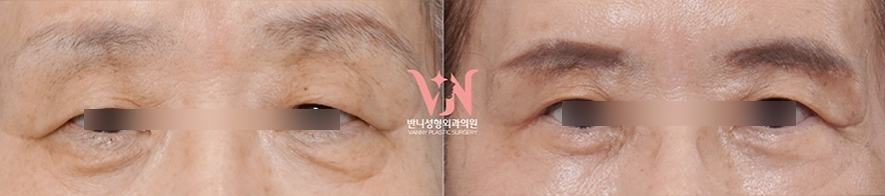 Left - Before surgery
Right - After lower blepharoplasty and brow lift
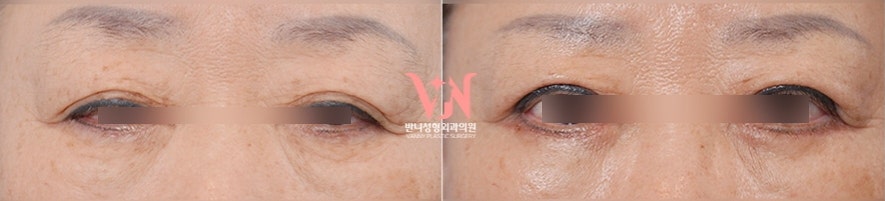 Left: Before surgery
Right: After lower blepharoplasty and upper blepharoplasty
So, what matters most in lower blepharoplasty?
Yes, it’s accurately measuring the amount of skin to remove.
To do this, the patient should open their mouth wide and look upward during surgery, and the skin should be measured and then removed. This helps prevent removing too much or, on the other hand, too little.
However, the problem is that many clinics do not go through this process and simply remove a rough amount.
In the end, that leads to undercorrection, leaving the sagging skin behind.
Therefore, when choosing a clinic for lower blepharoplasty, ask just one question during the consultation:
"How do you measure the amount of skin to remove?"
And if they give vague answers such as, “We remove just the right amount safely,” “Removing too much can cause side effects, so we only remove a little,” or “We adjust it while we’re operating,” then you should avoid that clinic.
A truly skilled clinic measures accurately and removes the right amount so that the eye does not turn outward and no sagging remains.
Today’s Conclusion
In many cases, eye surgery for middle-aged and older adults cannot be solved with under-eye fat repositioning alone.
That’s because as aging progresses, various factors act together, such as drooping eyelids, reduced skin elasticity, and weakened muscles and tissues.
Therefore, rather than deciding based only on the visible symptoms, the most important thing is to receive an accurate diagnosis of the underlying cause and find the right solution accordingly.
For this reason, a clinic that can comprehensively consider under-eye fat, lower blepharoplasty, upper blepharoplasty, and brow/forehead lifts is preferable to one that insists on only one method.
In addition, because the under-eye area can have not only protruding fat or sagging skin but also issues with the skin itself, it is a good idea to consult a clinic that can also provide dermatology care.
In such cases, combining treatments like under-eye lifting laser, Eye Rejuran, and Juvelook can lead to a more natural and satisfying result.
And please remember this.
There is an appropriate price for eye surgery.
If it’s too cheap, there is a reason; if it’s too expensive, you’re simply paying unnecessary costs.
Finding a skilled clinic within a reasonable price range is the smartest choice.
That’s why you can’t help but like me—this was Ban Hogyung.
Thank you.
[Recovery period: Only 2 days needed for under-eye fat repositioning surgery]
https://blog.naver.com/rush_724/223747252948