Hello, I’m Kim Seon-min, running a dental clinic near Nonhyeon Station that focuses on laminate treatment. Today, I’d like to speak honestly about laminate and tooth reduction.
① “Don’t you have to grind down all the teeth for laminate?” – The Most Common Question
"I heard you have to shave down a lot of the tooth for laminate. What if I regret it later?"
This is a question I hear very often in the treatment room. TV, YouTube, and online communities are full of ‘frightening’ stories about laminate. Anxiety grows as images of teeth shaved down by more than half, or laminate coming off, are shared in a sensational way.
In fact, many people are interested in laminate, but once they come to the dental clinic, most start by worrying about whether it is really okay. I completely understand that.
Today, as a dentist specializing in laminate at a clinic near Nonhyeon Station, and as a clinician who performs laminate procedures every day, I’d like to give you an honest explanation. Without exaggeration or concealment.
One thing I’d like to mention in advance is that some of the information circulating online includes stories from 10 or 20 years ago. Also, not every case applies to everyone. So I hope this article helps you organize accurate information.
② What exactly is laminate?
The official name for laminate is Porcelain Laminate Veneer. It is an esthetic prosthetic procedure in which a thin ceramic or resin “shell” is attached to the front surface of a tooth using a special adhesive.
Let me explain a little more simply.
📱 Think of a smartphone screen protector. The original screen (the tooth) is left almost as it is, and a thin protective layer is added on top to improve appearance and durability.
💅 It is similar to a gel nail tip. It is the same idea as changing the shape and color by bonding a thin artificial tip rather than grinding down the nail itself.
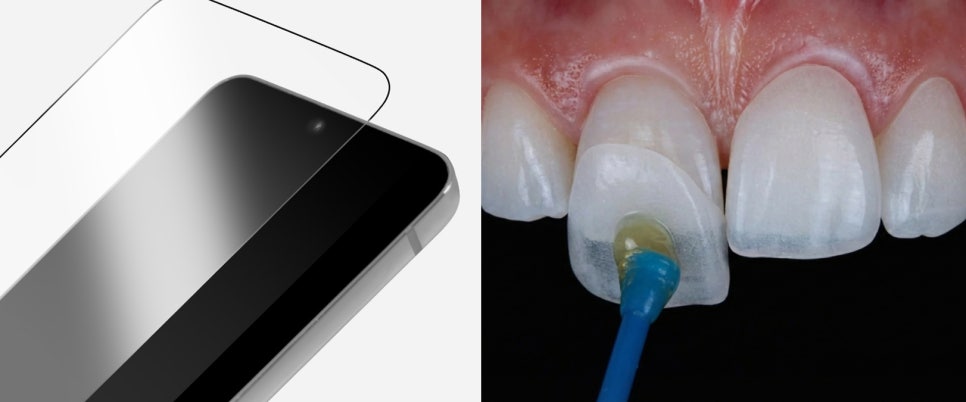
Screen protector = laminate
So, how thin is it really?
| Comparison item | Thickness |
|---|
| Contact lens | About 0.1 mm |
| Porcelain laminate | About 0.3–0.7 mm |
| 1-won coin | About 1.5 mm |
The thickness of porcelain laminate is about 0.3–0.7 mm, which is slightly thicker than a contact lens but less than half the thickness of a 1-won coin. As a rule, tooth reduction should be performed with a no-preparation approach whenever possible. Only when truly necessary is minimal reduction carried out, and even then it is limited to about 0.3–0.5 mm, staying as much as possible within the enamel range.
The main effects that can be achieved with laminate are as follows.
-
Improve the color of discolored teeth
-
Close spaces between gapped teeth
-
Restore chipped or worn tooth shape
-
Adjust tooth size and length
-
Create translucency and gloss
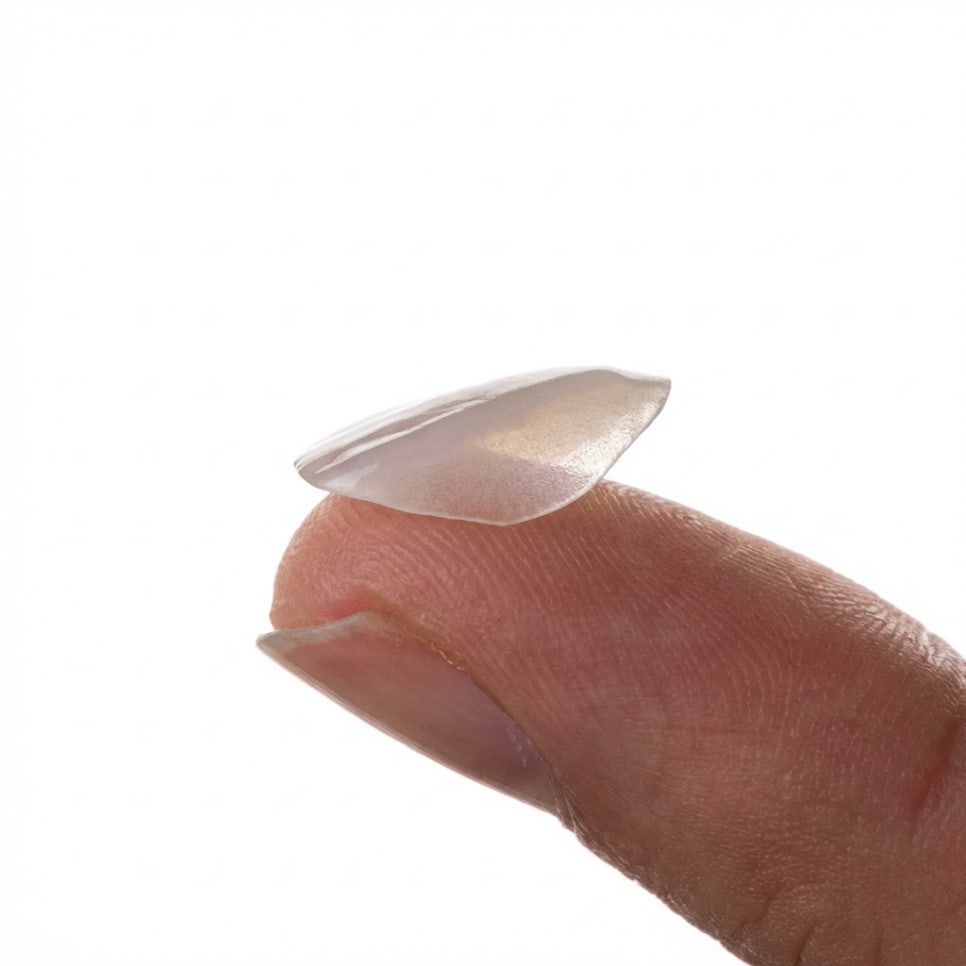
Laminate
③ Common misconceptions about laminate, corrected
A lot of the information about laminate circulating online is half right and half wrong. Let’s go through it one by one.
Misconception 1: “If you get laminate, you have to shave down a lot of the tooth”
In the past, there was a time when more reduction was done. But nowadays, the principle is to avoid preparation as much as possible, and even when needed, only minimal reduction is performed. Even when reduction is done, it is on a level thinner than an eggshell.
Misconception 2: “Laminate breaks or falls off easily”
This is both true and false. It is true that early resin laminate had weaker durability. However, modern porcelain laminate has been reported to last more than 20 years with proper care. That said, it can be a risk factor for people who clench or grind their teeth or often bite hard foods.
Misconception 3: “Once you do it, there is no turning back”
This is also both true and false. If tooth reduction has been performed, it is difficult to return completely to the original state. However, with minimal reduction, retreatment or replacement is fully possible, and that is exactly why “minimal reduction” is so important.
Misconception 4: “Anyone can get it”
No. If you have severe bruxism, significant enamel loss, severe malocclusion, or gum disease, other treatments should come first before laminate.
To help you understand, let’s compare it with a crown.
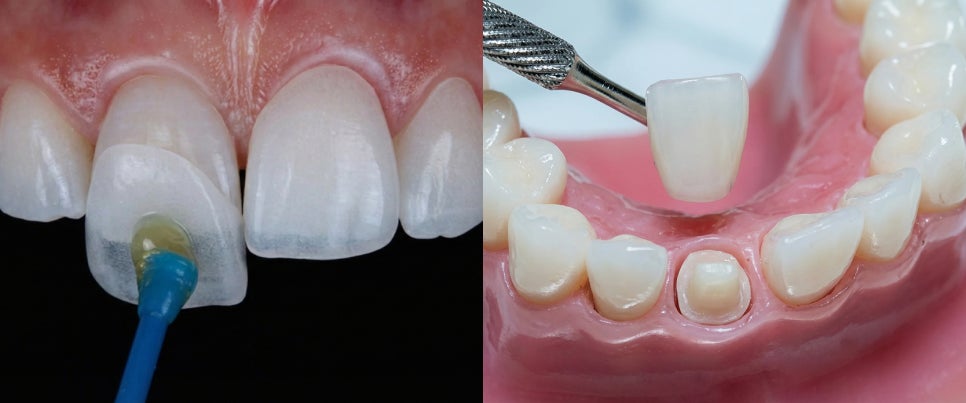
(left) Laminate (right) Crown
| Crown | Laminate |
|---|
| Analogy | A remodeling project that completely demolishes a house and rebuilds it | An interior job that attaches pretty tiles to the exterior wall |
| Amount of reduction | Significant reduction of the entire tooth | No preparation or minimal reduction only on the front surface |
| Tooth preservation | Less | More |
| Scope of application | Covers the entire tooth | Covers only the front surface of the tooth |
In other words, laminate is a procedure that changes the appearance while preserving the internal tooth structure as much as possible.
④ Laminate is effective for these people
✅ Cases where laminate is suitable
-
People with severe tooth discoloration that cannot be solved with whitening
-
People with gaps between the front teeth
-
People whose front teeth are slightly chipped or worn
-
People whose tooth shape or size is uneven
-
People who want a mild improvement in alignment without orthodontic treatment
-
People who want to improve their overall smile line
❌ Cases where other treatment is needed first
| Condition | Recommendation |
|---|
| Severe cavities or gum disease | Treat first, then consider laminate |
| Severe bruxism | Possible, but a stabilization appliance (night guard) must be used together |
| Severe malocclusion | Orthodontic treatment is recommended first |
| Extremely thin or lost enamel | Consider alternatives such as crowns |
🕐 What about lifespan and maintenance?
Porcelain laminate generally lasts an average of 10–15 years, and can last more than 20 years with good care.
The factors that most affect longevity are the patient’s oral care habits and regular checkups.

⑤ This is important for laminate without regret
"The most important thing in laminate is not ‘technique’ but ‘planning.’"

Accurate diagnosis is important for laminate
It is no exaggeration to say that sufficient diagnosis and planning before the procedure determine 80% of the result. Whether the procedure is appropriate for my teeth, how much reduction is needed, and whether the expected result is realistic — these three things must be checked before treatment. That is how you avoid regret. This is the most important part.
Rather than deciding based only on a low price, I recommend carefully comparing the material used (porcelain or resin), the quality of the lab, and the dentist’s experience in esthetic prosthetics.
⑥ Closing – Before beautiful teeth, a healthy decision comes first
To summarize today’s content, laminate is an esthetic prosthetic procedure that creates a natural and beautiful smile by minimally shaping the teeth. When performed under proper diagnosis and planning, it can maintain satisfying results for a long time.
I have one sincere piece of advice.
I do not recommend making an impulsive decision.
It is not too late to decide after receiving consultations from several places and comparing them carefully.

When you visit for a laminate consultation, it is helpful to prepare these things.
If you have any questions, feel free to contact us anytime. Just a consultation alone may resolve many of your concerns. This has been Kim Seon-min from Ceramic Dental Clinic, wishing you the day when your smile becomes your confidence 😊