Wouldn’t orthodontic treatment in your 50s feel a little awkward? That may have been true in the past, but these days more and more people in their 50s—and even in their 60s and 70s—are getting orthodontic treatment. From the perspective of someone who treats many middle-aged orthodontic cases near Hakdong Station, I’d like to speak honestly today about orthodontic treatment in your 50s.
"Isn’t orthodontic treatment something you do when you’re a student?"
"If I get braces at this age, won’t my teeth become loose?"
"Isn’t it a bit strange to wear braces after 50...?"
Have you ever thought this way? You may have heard things online or from people around you like, “When you get older, your gums and bone weaken, so orthodontics makes your teeth fall out,” or “Orthodontics only works while bones are still growing.” Because there is so much unverified information, it’s only natural to worry.
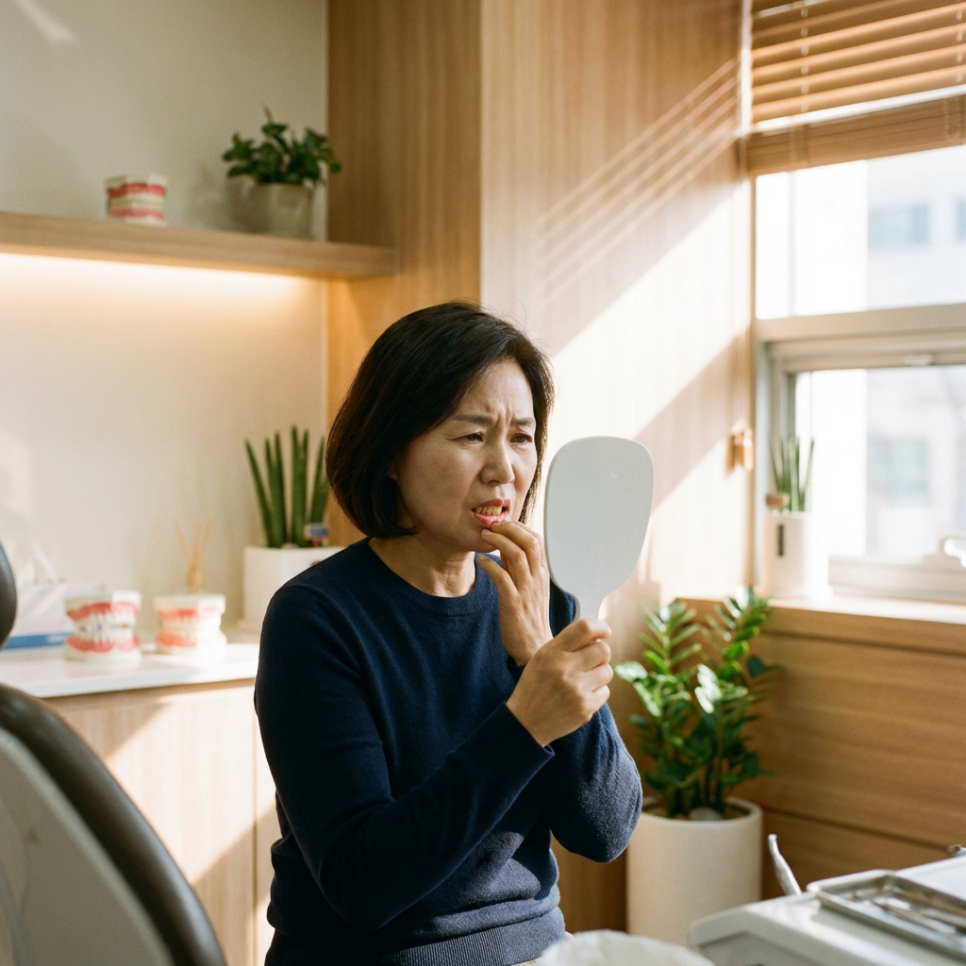 Orthodontic treatment in middle age is becoming more common these days
In actual consultations, I can tell that many patients in their 50s hesitate at first. Some came in with their child for orthodontic treatment and became curious about it themselves; others came for implants and were surprised to hear that orthodontics should come first. They may laugh and say, "What kind of braces at this age?" but their eyes show anticipation.
What I’ve learned over years of practice, though, is that there are far more people who say, "Why didn’t I do this sooner?" than people who regret getting orthodontic treatment in their 50s.
Today, as a specialist in orthodontics, I’ll honestly explain whether treatment in your 50s is really possible, how it differs from treatment for younger patients, and what you need to be careful about.
What exactly is orthodontic treatment in your 50s?
Adult orthodontics refers to orthodontic treatment for fully grown adults to improve tooth alignment, how the upper and lower teeth fit together (the bite), and aesthetics. The important point here is that there is no age limit. If your gums and jawbone are healthy, treatment is absolutely possible in your 50s and 60s as well.
To put it simply, it’s similar to transplanting a tree in a garden. A young tree in its teens has shallow roots, so it can be moved easily, but even an older tree in its 50s can be transplanted if the soil around the roots (the jawbone) is healthy. It just needs to be done more carefully and more slowly.
There are two main purposes for orthodontic treatment in your 50s.
| Category | Description | Example |
|---|
| Aesthetic orthodontics | Improving crooked, spaced, or unattractive teeth when smiling | Gaps in the front teeth, crowded teeth, etc. |
| Functional / pre-prosthetic orthodontics | Creating space for implants or bridges, or straightening tilted teeth | When adjacent teeth have tipped after a molar was lost, etc. |
There are also a variety of appliances that can be used.
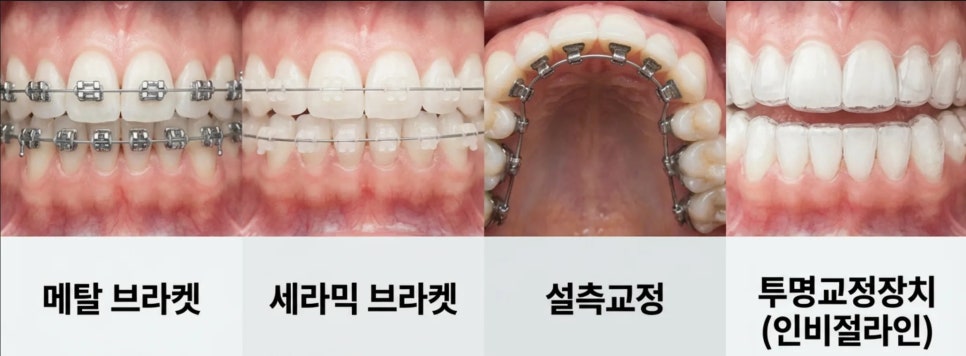
| Appliance type | Features | Preference in the 50s |
|---|
| Metal brackets | Traditional metal appliance, allows precise control | Moderate |
| Ceramic (clear) brackets | Similar to tooth color, less noticeable | High |
| Lingual braces | Attached to the inside of the teeth, invisible from the outside | High |
| Clear aligners | Removable, minimal disruption to daily life | Very high |
Most patients in their 50s prefer aesthetic appliances, and clear aligners in particular are popular among office workers and people with active social lives because they interfere less with daily routines.
For reference, the average adult orthodontic treatment period is about 1 year and 6 months to 2 years and 6 months, while partial orthodontic treatment takes about 6 months to 1 year. According to statistics from the American Association of Orthodontists (AAO), about 25% of adult orthodontic patients are over 40, and in Korea as well, consultations for orthodontic treatment among people in their 50s and older have been steadily increasing over the past five years.
Three common misconceptions about orthodontic treatment in your 50s
Misconception 1: "Teeth don’t move when you get older"
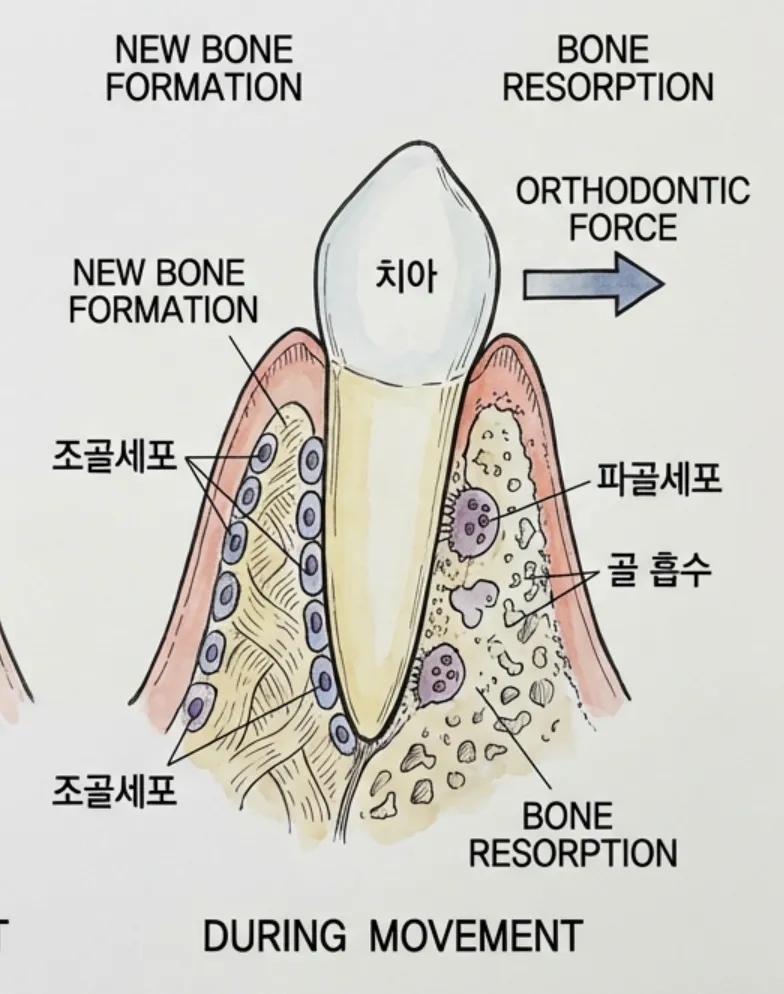 The principle behind tooth movement
That’s not true. Teeth move because the jawbone undergoes remodeling, with bone being resorbed on one side and newly formed on the other. This biological mechanism works regardless of age. It is true, however, that the movement may be slower than in teenagers, so treatment may take longer. It’s not that teeth don’t move; it’s that it may take more time.
Misconception 2: "If you get braces, your teeth will become loose and fall out"
That’s partly true and partly false.
It is normal for teeth to feel slightly loose during orthodontic treatment as they move. Once treatment is over, they become firm again. However, if excessive force is applied while gum disease is present, bone loss may worsen. The key point is that the problem is not orthodontic treatment itself, but orthodontic treatment performed without managing gum disease.
Misconception 3: "Clear aligners are enough; metal braces aren’t necessary"
Clear aligners can be effective for mild to moderate dental issues, but in cases such as severely crowded teeth, major molar movement, or significant bite discrepancies between the upper and lower teeth, fixed appliances (brackets and wires) allow more precise control. People in their 50s often have complex issues, so appliance selection needs to be made more carefully.
Simply put, if clear aligners are a navigation app, fixed braces are like having a professional driver behind the wheel. If the road is simple, the navigation app may be enough, but for a complicated mountain road, you need an experienced driver.
Additional factors that must be considered in orthodontic treatment in your 50s
| Consideration | Explanation |
|---|
| Presence of gum disease | About 80% of Koreans in their 50s have gum disease. This must be checked |
| Existing prosthetic restorations | Crowns and bridges affect how appliances are attached and the treatment plan |
| Missing teeth | A decision is needed on whether to close the space with orthodontics or keep it open for an implant |
| Existing implants | Implants that have already been placed cannot be moved by orthodontics |
⚠ Please note:
If a clinic says, without any consultation, that "people in their 50s only need clear aligners," or conversely says, "You’re too old for orthodontic treatment," it’s a good idea to be cautious in both cases.
Retention after treatment is also very important
Adults are more prone than teenagers to teeth drifting back to their original position (relapse). That’s why after orthodontic treatment is completed, it is recommended to use both a fixed retainer—a thin wire attached to the inside of the teeth—and a removable clear retainer. In practice, we recommend wearing retainers for life.
The most important thing in orthodontic treatment in your 50s
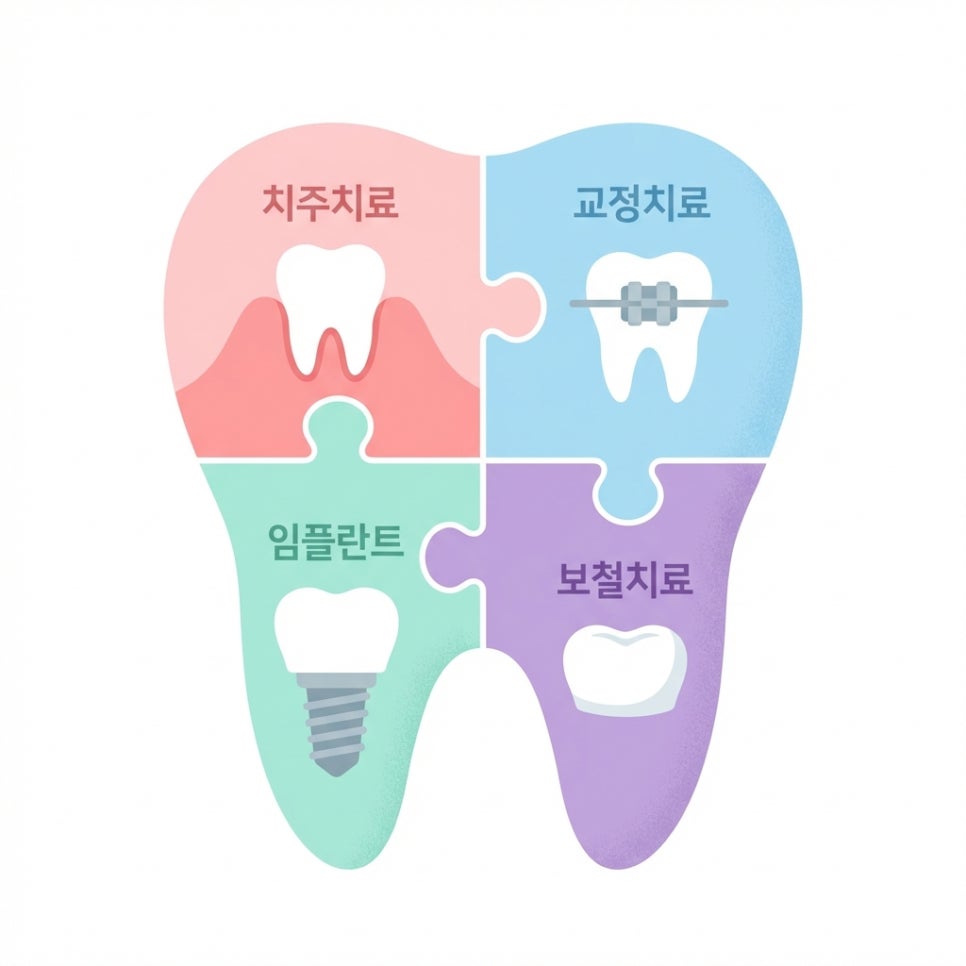
The most important thing in orthodontic treatment in your 50s is not "how to move the teeth," but "what needs to be addressed before moving the teeth." Orthodontics is just one piece of the overall treatment puzzle, and a comprehensive plan that includes gum treatment, prosthetics, and implants determines the outcome.
When consulting patients over 50, we always begin with a detailed periodontal examination (measuring gum pocket depth and checking the condition of the jawbone). We use CT scans to assess the jawbone in three dimensions, and if necessary, we complete gum treatment before starting orthodontics.
 Even during treatment, we monitor the gum condition every 2 to 3 months and adjust the pace by using light orthodontic force so as not to strain the jawbone. We aim for "safe completion" rather than "fast completion."
The goal of orthodontic treatment in your 50s is not simply "beautiful teeth." It is to create an oral environment where you can chew comfortably and smile with ease for the next 40 to 50 years. That is the true value of orthodontic treatment in your 50s, in my view.
Age is just a number; dental health lasts a lifetime
To summarize today’s article:
- Orthodontic treatment in your 50s is absolutely possible if your gums and jawbone are healthy
- It has great value not only for aesthetic improvement, but also as functional orthodontics for implants and prosthetics
- However, unlike younger patients, checking gum health, using light orthodontic force, and making a comprehensive treatment plan are essential
I do not recommend making an impulsive decision based only on online reviews. On the other hand, it would be a shame to give up just because of age. It is not too late to decide after getting an accurate examination.
📋 What to bring to an orthodontic consultation in your 50s
- A list of medications you are currently taking (blood pressure medication, osteoporosis medication, diabetes medication, etc.)
- Your previous dental treatment history (crowns, implant locations, etc.)
- Notes on the areas that are most uncomfortable or concerning to you
If you’re wondering, "Can I get orthodontic treatment in my 50s?" please feel free to start with a consultation. We will review the examination results and honestly tell you whether treatment is possible, how long it may take, and which method is appropriate.
We always support your healthy smile. 😊 If you have any questions, feel free to ask anytime in the comments or by phone.