Hello, this is the director of Ceramic Dental Clinic, Sinsa Station Dental Clinic. Today, I’d like to talk in detail about implant aftercare, which many people are curious about.
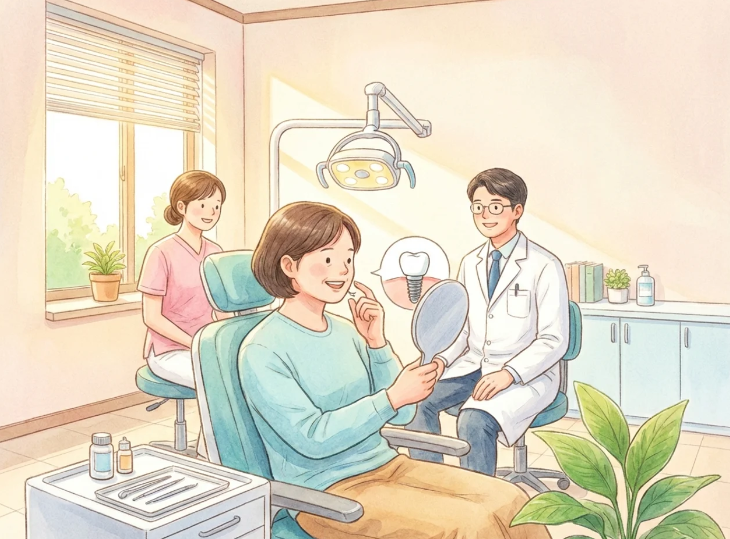
An implant is an artificial tooth, so it doesn’t get cavities, and once you get one, you can use it for life, right?
I hear this very often in the clinic. Many people also think, “It’s not even a natural tooth, so what do you need to take care of? I paid a lot of money for it, so isn’t it just strong on its own?”
On the other hand, some people feel anxious after seeing posts on YouTube or online communities saying, “My implant came out after just three years,” or “The bone around the implant melted away.” And right after surgery, many people are overly cautious, asking, “When can I eat?” or “Can I brush my teeth?”
In fact, what matters more than ‘placing’ an implant is ‘taking care of it after placement.’ Today, I’ll organize step by step how to keep implants healthy for a long time.
To care for an implant properly, you need to understand its structure first
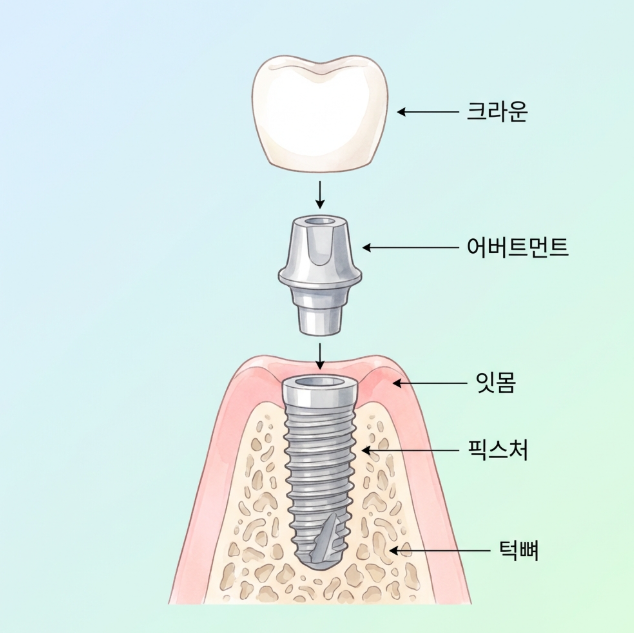
To manage it well, it helps to know what an implant is made of. An implant is broadly composed of three parts.
| Component | Role | Building analogy |
|---|
| Fixture | Titanium screw placed into the bone | A pillar pile driven into the ground |
| Abutment | The post connecting the fixture and the prosthesis | A building column |
| Crown | The visible prosthesis (tooth-shaped) | A roof |
No matter how strong the pile is, if the surrounding ground collapses, the building will lean. In the same way, an implant can last a long time only when the surrounding jawbone and gums are healthy.
So how are natural teeth different from implants? Natural teeth have a cushioning tissue called the periodontal ligament, which helps defend against bacteria and absorb chewing impact. Implants do not have this tissue.
To put it simply, if a natural tooth is a car with shock absorbers, an implant is like a cart running without suspension. The function is excellent, but that means the driver (the patient) has to pay more attention to the road conditions (care).
The success rate of implants is very high, around 95–98%, but that assumes proper care as a prerequisite. With good management, they can be used for more than 20 years.
The first 2 weeks after implant surgery: early care determines the outcome
The period right after implant surgery is when the most delicate care is needed. How you manage it during this time can greatly affect the course afterward.
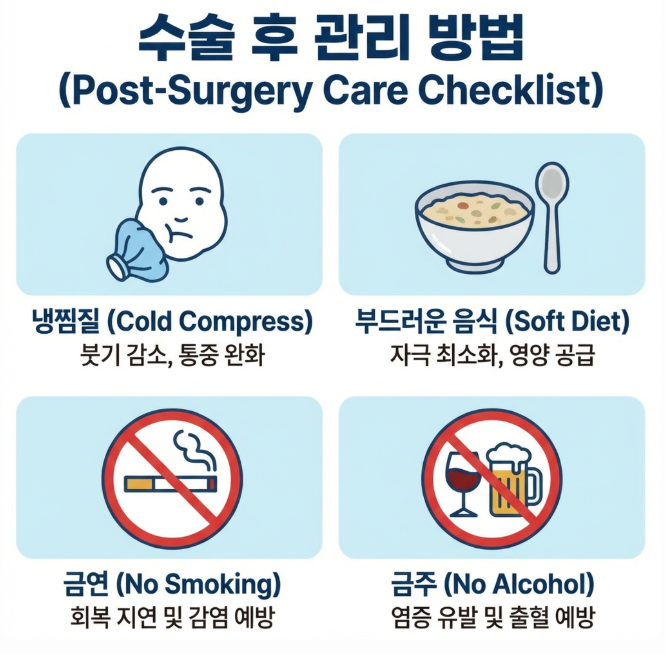
There are many things you should avoid after an implant
Key rules for the first 48 hours after surgery
Apply a cold compress to the cheek on the surgical side for 15 minutes, then rest for 15 minutes, and repeat. Swelling or bruising is a normal reaction, so there’s no need to worry too much. Usually, swelling is worst on the second or third day and then gradually goes down.
If you were given gauze, bite down firmly on it for about 2–3 hours. It’s normal for a small amount of blood to be mixed with saliva for about 2 days, so don’t worry.
For meals, eat soft foods such as porridge, soup, or tofu on the opposite side of the surgery. Avoid hot, spicy, or irritating foods.
For brushing, you can brush the other teeth as usual, except for the surgical area. Use the prescribed mouth rinse for the surgical site.
Absolute prohibitions, please remember these.
| Prohibited item | Reason |
|---|
| Using a straw | Negative pressure may prevent bleeding from stopping |
| Smoking | Reduced blood flow interferes with osseointegration, increasing failure rates 2–3 times |
| Drinking alcohol | Increases inflammatory response |
| Strenuous exercise | Increased blood pressure worsens bleeding and swelling |
Osseointegration period (3–6 months): the time when the implant becomes one with the bone
If you get through the early care period well right after surgery, now comes the osseointegration period. Osseointegration refers to the process in which the titanium fixture and the jawbone firmly fuse together.
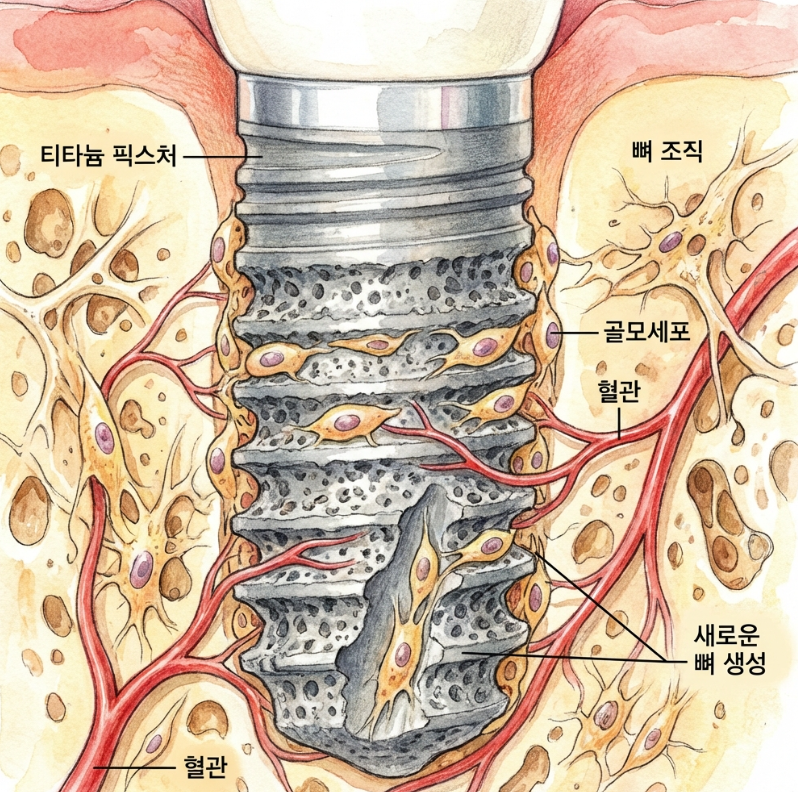
Just as you should not place heavy loads on concrete before it has fully hardened, you should not apply excessive force before the bone and implant have fully bonded. Even if you have a temporary tooth, it is best to avoid hard foods.
And once again, smoking is the biggest enemy during this period as well. That’s because nicotine reduces blood flow and severely interferes with osseointegration.
Long-term care after prosthesis placement: follow these rules and you can use it for more than 20 years
Once osseointegration is complete and the final prosthesis (crown) has been placed, this is when the real long haul begins. The secret to using implants for a long time is actually not that complicated.
Proper brushing + auxiliary tools + regular checkups — these three are enough.
Proper brushing method
I recommend the modified Bass technique. It involves tilting the bristles at a 45-degree angle to the border between the gums and teeth and brushing with small vibrations. The key is to carefully clean the gumline around the implant. If that feels too difficult, just clean thoroughly with the feeling that you are brushing the root well.
Auxiliary oral hygiene products
Just as a car needs more than a wash and also needs engine oil changes, brushing alone may not be enough. Especially if your oral condition was not good before, please make sure to use the following auxiliary tools together.
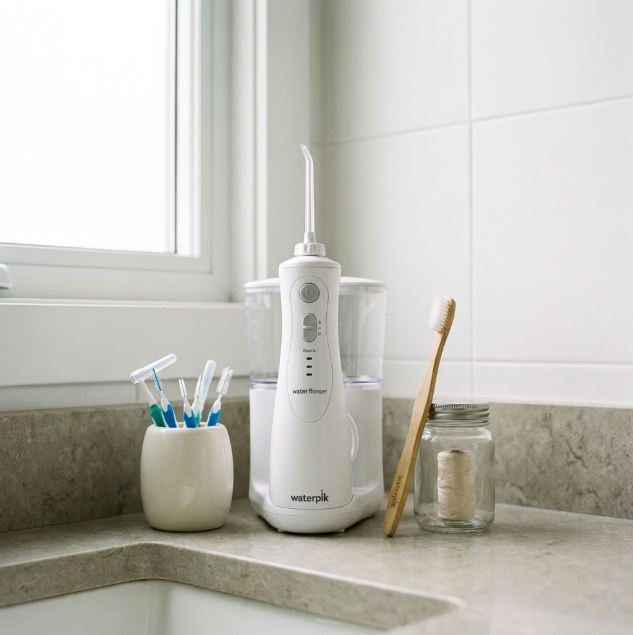
| Auxiliary tool | Role | Usage tip |
|---|
| Interdental brush | Most effective for cleaning between implants and adjacent teeth | Choose the right size to use (too small reduces effectiveness) |
| Dental floss / super floss | Cleans under prostheses | Especially useful for bridge-type prostheses |
| Water flosser | Removes residue with a stream of water | Use as a supplement to interdental brushes |
Regular checkup schedule
Please visit the dental clinic at least once every 6 months to 1 year. It is important to monitor changes in bone levels through professional cleaning (scaling) and radiographic exams.
Also, behaviors such as biting ice, chewing hard candy, or using your teeth to open bottle caps are absolutely prohibited. Implant prostheses (crowns) are made of ceramic, so they can break under excessive impact.
Since implants don’t get cavities, can you relax?
The implant itself is artificial, so it does not get cavities. That is true. But the gums and bone around the implant can develop peri-implantitis. This is the biggest cause of implant loss.
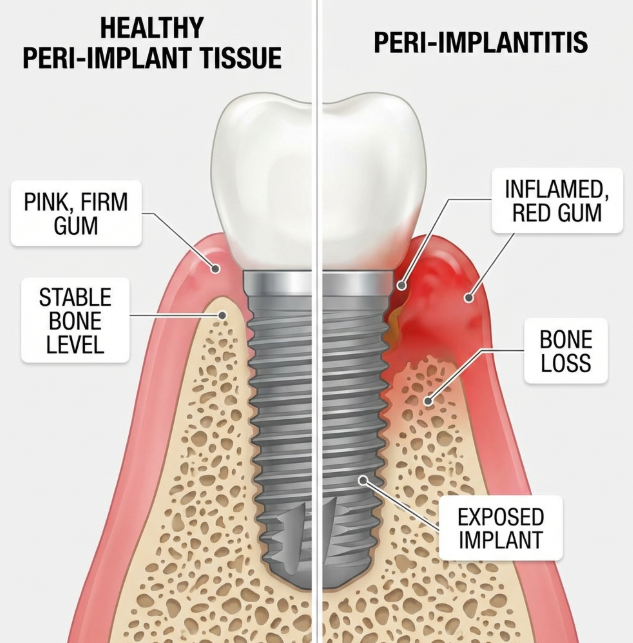 The left side is a healthy implant, and the right side is an implant with peri-implantitis (gum disease)
What is peri-implantitis?
When bacteria invade the gums around an implant, inflammation occurs → the bone melts away → the implant becomes loose → in the worst case, it is lost. This is almost the same process as periodontal disease around a natural tooth.
Shocking statistic: peri-implantitis has been reported in about 22–43% of implant patients (based on international academic literature).
If it is found at the early stage of ‘peri-implant mucositis,’ it can be reversed. But peri-implantitis that has progressed to the bone is very difficult to reverse. It is like discovering a leak in the outside wall of a house early and fixing it easily, but if left unattended, the interior pillars rot and the entire house has to be rebuilt.
If any of these apply to you, you should come to the dental clinic right away. Some places online say that implants are ‘semi-permanent,’ but that leaves out the premise of ‘with proper care.’ Please remember that an implant without care may struggle to last even 5–10 years.
An implant is not the end of ‘placing’ it — it is the beginning
Once you have an implant, that is the real beginning from now on. Since it is a tooth obtained at a significant cost, with a little attention it can stay with you for a long time, just like a natural tooth.
 Please feel free to contact us anytime if you have questions. A small question can affect the lifespan of an implant.
We will be a dental clinic that stays with you to the very end, even after placement.