Hello, this is the director of Ceramic Dental Clinic near Hakdong Station.
Many patients come to us because uneven front teeth make them feel less confident when they smile. We also often hear the question, “Braces take too long, so I can’t even consider them. Is there another option?” In cases like this, veneers can be a good alternative.
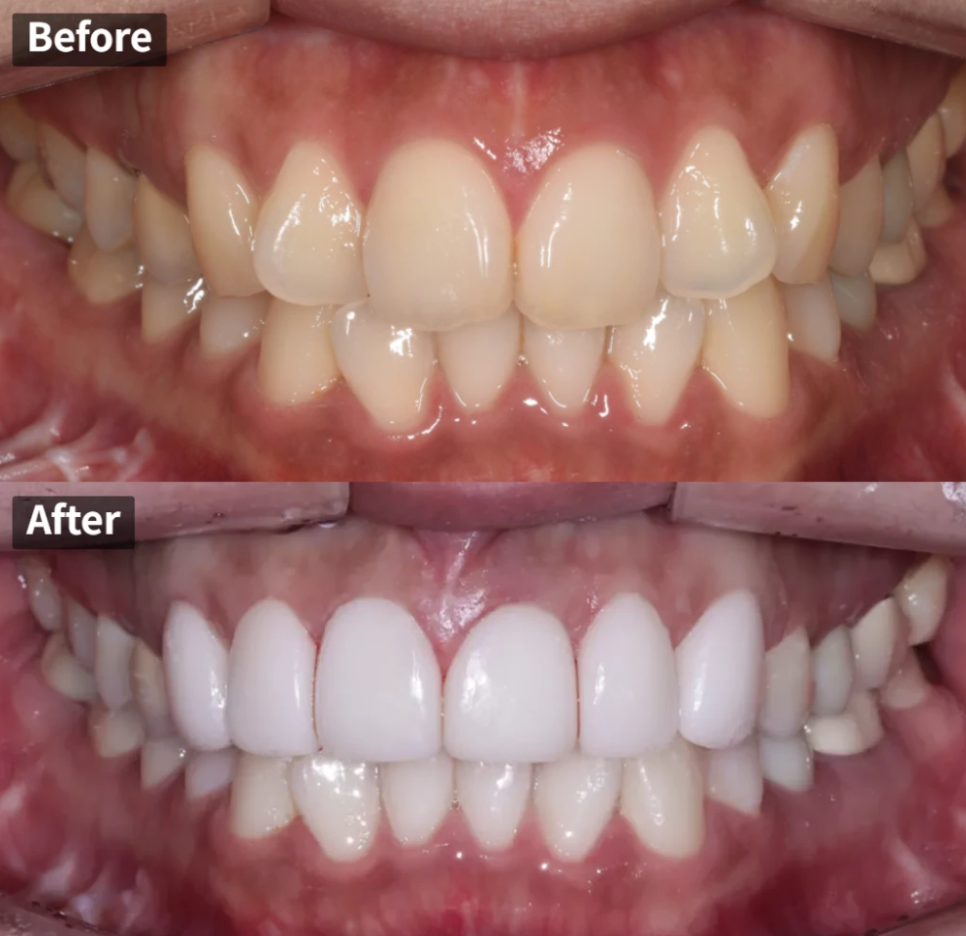
The case I’m introducing today is a woman in her early 30s. With crooked front tooth alignment and an asymmetrical gum line, we improved her alignment, color, shape, and gum line all at once through veneers + gum contouring. Let’s take a closer look at what kind of changes are possible in a relatively short period of time.
Initial Analysis: Facial and Intraoral Evaluation
First, we carefully analyzed the patient’s overall facial balance and intraoral condition.
Facial evaluation:
The upper, middle, and lower proportions of the face were generally balanced, and the occlusal plane (the surface where the upper and lower teeth meet), based on the line connecting the pupils, was also generally parallel. However, a mismatch between the midline (the center line of the face and teeth) was observed, and the left jaw muscle area appeared slightly more developed than the right.
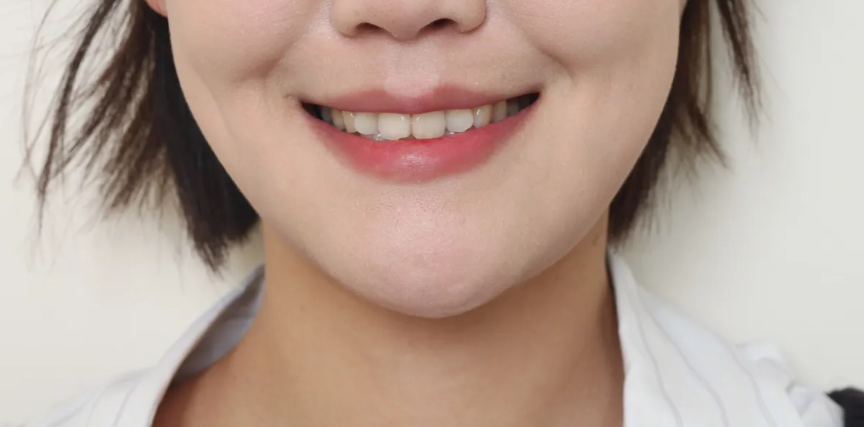
Initial facial photo – evaluating overall facial proportions, midline, and occlusal plane
Intraoral findings:
Next, we examined the inside of the mouth in detail.
From the front, the most noticeable finding was that the lateral incisors (the second front teeth) were significantly rotated. In addition, the overall proportion of the so-called six anterior teeth was poor, which appeared to be due to the upper jaw having a V-shaped, narrow form. The incisal edges of the front teeth were also uneven and irregular.
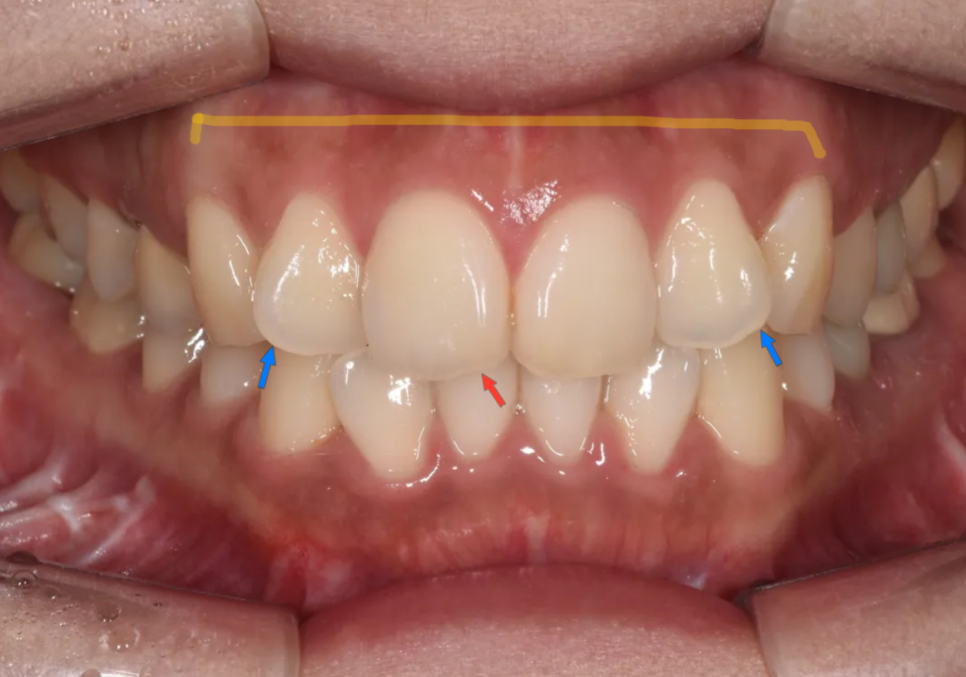
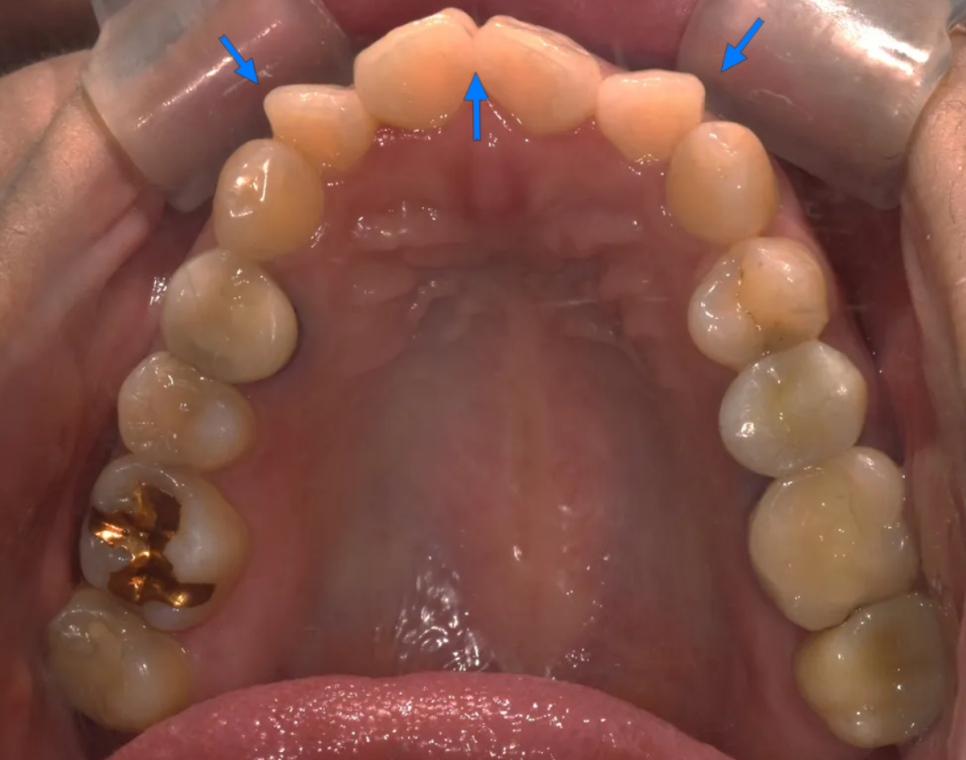
There were also several other issues, such as an asymmetrical gum line and very tight biting between the upper and lower front teeth. The lower front teeth were also actually crooked, but for this case we decided to treat only the upper teeth first.
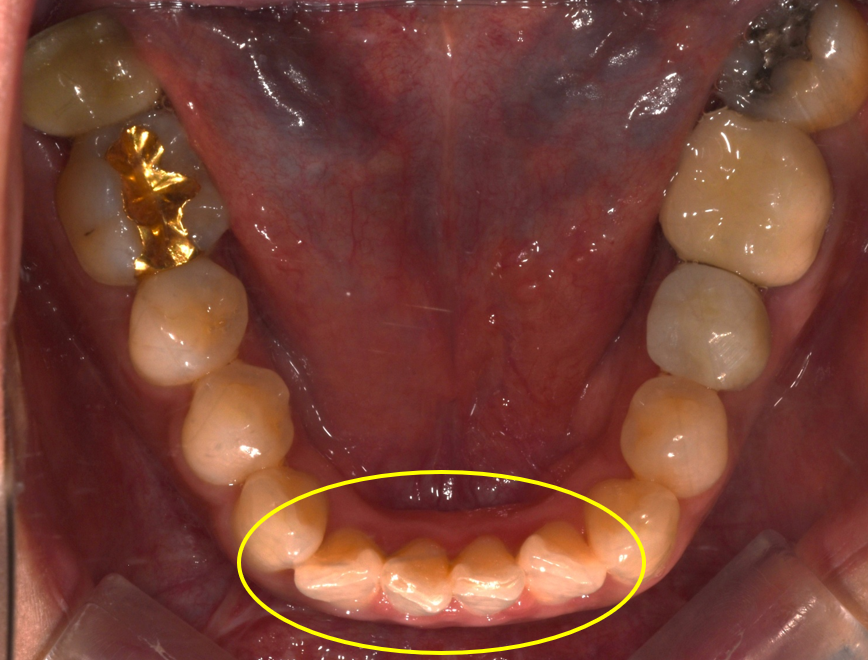
The lower teeth are also crooked, but we decided not to include them in this procedure.
To summarize all the existing problems, they are as follows:
| Item | Detailed findings |
|---|
| Tooth alignment | Crowding with rotation and overlap of the four upper front teeth (both central incisors and both lateral incisors) |
| Proportion of the six front teeth | The upper jaw is narrow and V-shaped, causing narrow spacing between the front teeth and unattractive size, shape, and proportion |
| Gum line | Asymmetrical gum line around the right lateral incisor, left central incisor, and left lateral incisor |
| Incisal edges (front tooth tips) | Uneven tip shape on both central incisors, with some chipping and wear |
| Occlusion (bite) | The upper and lower front teeth bite very tightly, so some reduction of the lower teeth may be necessary |
| Lower front teeth | Crowding is also present in the lower front teeth, but only the upper teeth were treated this time |
| Right upper first premolar | The porcelain on the buccal side of an existing porcelain-fused-to-metal crown was chipped (planned for replacement later) |
Patient Requests and Consultation Details
The patient’s requests during consultation were summarized as follows.
| | Desired outcome |
|---|
| ① | To improve the crooked front teeth and make them look aligned |
| ② | To improve the uneven gum shape |
| ③ | To have whiter, brighter teeth |
She did not want orthodontic treatment because of personal circumstances such as her place of residence and the treatment duration. She decided to replace the existing crown on the right upper first premolar later, and to undergo whitening for the lower teeth at a later time.
What Are Veneers? – Procedure Principle and Advantages
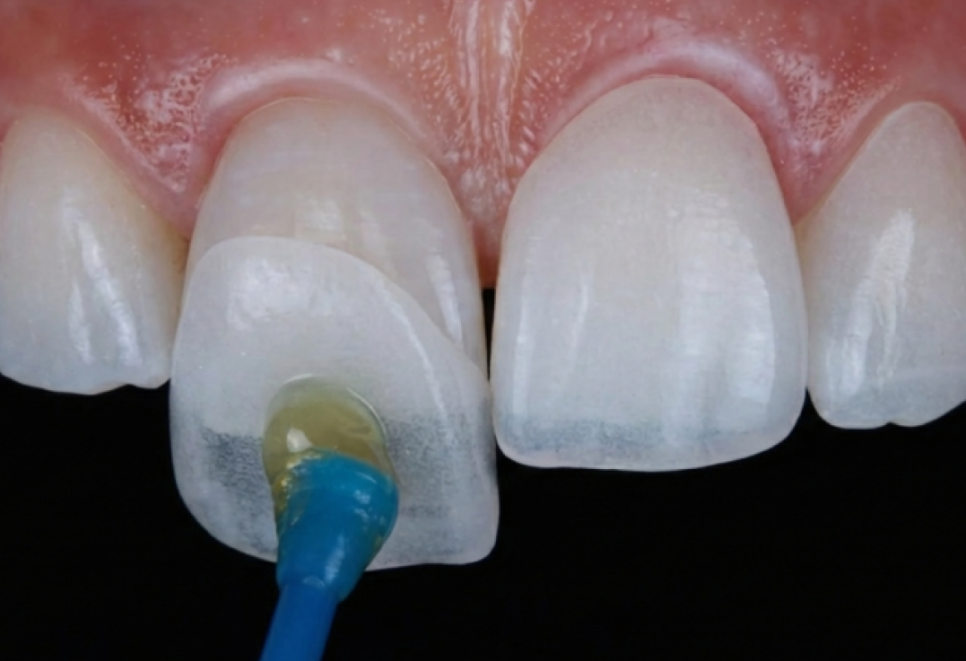
Before getting into the treatment itself, let me briefly explain what veneers are.
Porcelain Laminate Veneer is an esthetic prosthetic method in which a thin porcelain shell is bonded to the front surface of a tooth. Simply put, it is similar to attaching a thin porcelain nail to the tooth.
| Advantages | Explanation |
|---|
| No-prep / minimal-prep | The tooth is not shaved down, or only a very small amount is removed (about 0.3–0.7 mm). This is favorable for nerve preservation |
| Combined improvement | Color, shape, size, and alignment can all be improved at the same time |
| Orthodontic alternative | If tooth crowding is mild to moderate, alignment can be improved with veneers alone without braces |
| Natural esthetics | It can reproduce translucency and tones similar to natural teeth, allowing for very natural-looking results |
Criteria for Choosing Orthodontics vs. Veneers in Patients with Crowding
In fact, when teeth are crowded, the standard approach is to do orthodontic treatment first and then proceed with veneers. This is advantageous in terms of occlusion and the amount of tooth reduction, and it also tends to have a better long-term prognosis.
However, not every patient can choose orthodontics. There are cases where it is difficult because of where they live, the treatment period (usually 1–2 years), or personal circumstances. In such cases, if the crowding is mild or moderate, veneer treatment alone can be sufficient.
In this case as well, the protrusion caused by the crowding was not severe, so we decided to proceed with veneers alone.
Procedure Result: Before & After
These are the results after completing veneers on the six upper front teeth and gum contouring.
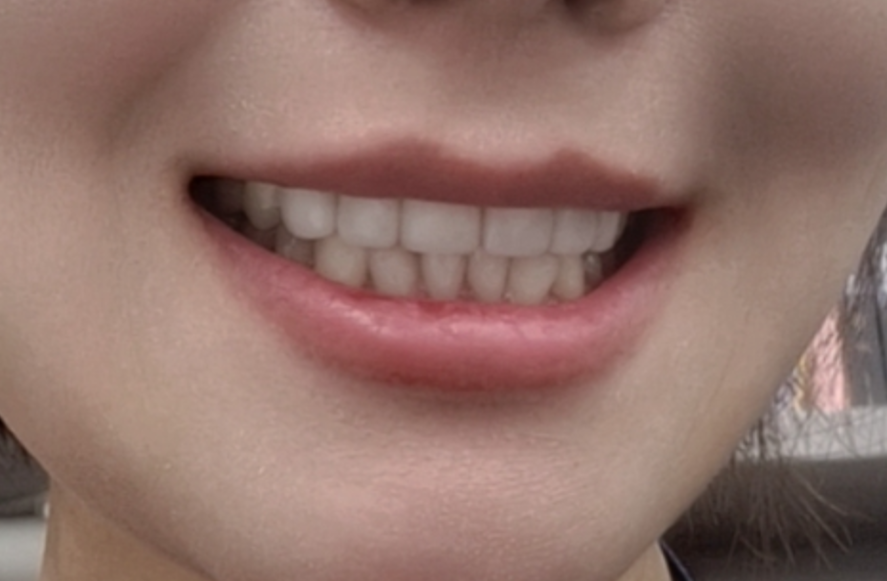
A selfie sent directly by the patient after treatment – a natural smile line can be seen
| Improvement item | Before | After |
|---|
| Tooth alignment | Four front teeth rotated and overlapping | A neat front tooth line achieved ✅ |
| Gum line | Left-right asymmetry | A symmetrical and harmonious line ✅ |
| Tooth color | Natural tooth color | Brighter, natural tone ✅ |
| Incisal edges (front tooth tips) | Chipping, wear, irregularity | Natural and even incisal edge line ✅ |
| Midline | Mismatch | Improved ✅ |
| Sensitivity after procedure | - | Not observed (minimal-prep effect) ✅ |
Compared with before treatment, you can see a major overall improvement in alignment, color, gum line, and the shape of the incisal edges. Above all, the fact that there was no post-procedure sensitivity shows that the minimal-prep principle was faithfully followed.
Considerations for Veneer Treatment
To summarize this case:
Because the patient’s tooth crowding was not severe, veneer treatment alone was enough to produce a highly satisfying result. Except for the protruding areas, treatment was performed with minimal reduction to preserve the nerves safely, and no post-procedure sensitivity was observed.
However, there is an important point to keep in mind. When crowding is severe, orthodontic treatment first may be much more advantageous in terms of occlusion and long-term prognosis. Veneers are not suitable for every crowding case.
Combining gum contouring was also a very important point in this case. By improving not only the teeth but also the gum line at the same time, we were able to maximize the overall esthetic effect. The patient’s satisfaction was very high, and this was also a case that received good feedback in the actual review.
As you can see, if you have combined concerns about alignment, color, and the gum line, there is a way to solve them all at once by combining veneers and gum contouring. We recommend receiving a thorough consultation and diagnosis at an experienced dental clinic while following the no-prep/minimal-prep principle. Careful analysis and treatment planning before treatment ultimately lead to satisfying results.
If you have any questions about esthetic treatment for front teeth, please feel free to contact us anytime for a consultation. Thank you.