There are occasionally patients who come to us wanting to replace a front tooth crown they had done before. They were satisfied at the time of treatment, but for one reason or another, they no longer like it as time has passed. Today, I’d like to share in detail the aesthetic prosthodontic treatment process for a patient who visited us due to dissatisfaction with an existing restoration.
This patient had already completed orthodontic treatment, but was worried because she did not like the color and shape of the front tooth crown. In this post, I will explain the entire process step by step, from the initial examination and analysis to the treatment plan and final results.
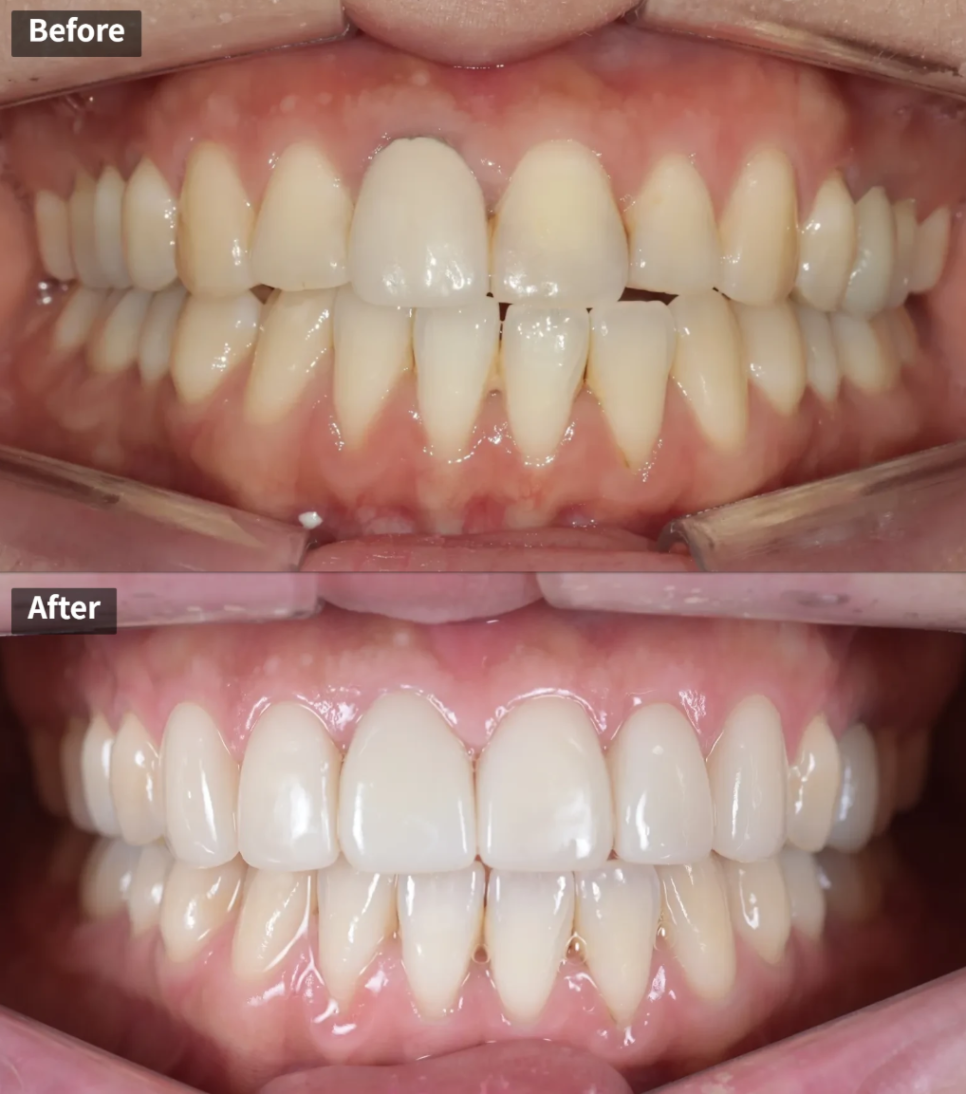
The patient’s concern
This patient was a 33-year-old woman who traveled a long distance from another region for aesthetic prosthodontic treatment. She had previously completed orthodontic treatment at another dental clinic, and after orthodontics, a PFM crown had been placed on the upper right front tooth (central incisor).
Her main concern was that the color and shape of the existing crown did not match the surrounding teeth. In particular, she felt self-conscious because the front teeth appeared protruded, and she strongly hoped to restore a natural and harmonious smile line.

Initial facial photo – a slight asymmetry of the left and right lips is also observed when smiling.
Initial examination – intraoral condition and problem analysis
I will organize the issues identified during the initial examination one by one. There were more than expected.
| Problem item | Details |
|---|
| Upper right front tooth PFM crown | Poor gingival margin fit, color mismatch with surrounding teeth, excessive contour (protrusion) |
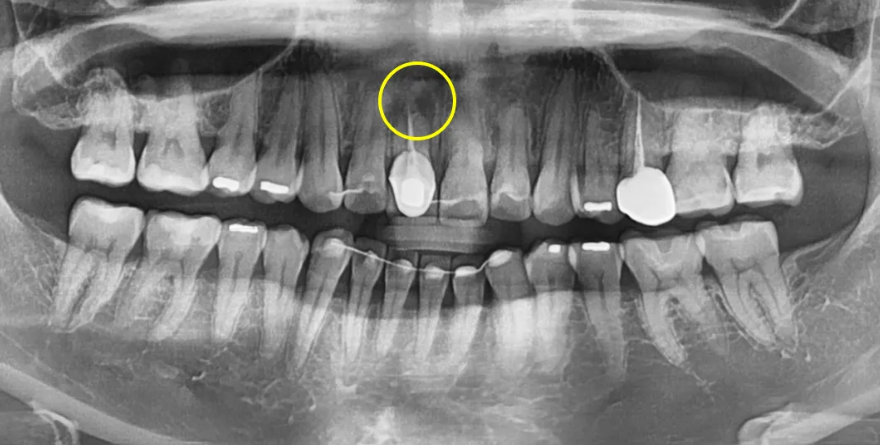
| Periapical lesion | A periapical lesion was identified on the radiograph of the upper right front tooth (no current symptoms) |
| Secondary caries | Secondary caries found around existing resin fillings in the upper right lateral incisor and the upper left front teeth (central incisor and lateral incisor) |
| Midline discrepancy | The upper front tooth midline does not match the facial midline |
| Protrusion of front teeth | Slight forward inclination of the upper right and left front teeth (central incisors) |
| Asymmetric gingival line | The gingival height of the upper right and left lateral incisors is asymmetric |
| Space between upper and lower teeth | A visible vertical space from the front view |
What was somewhat concerning at first was that a lesion was seen at the root tip of the upper right front tooth on the radiograph. Fortunately, there were no current symptoms, so we proceeded first with remaking the crown and explained that extraction may be necessary later if symptoms develop.
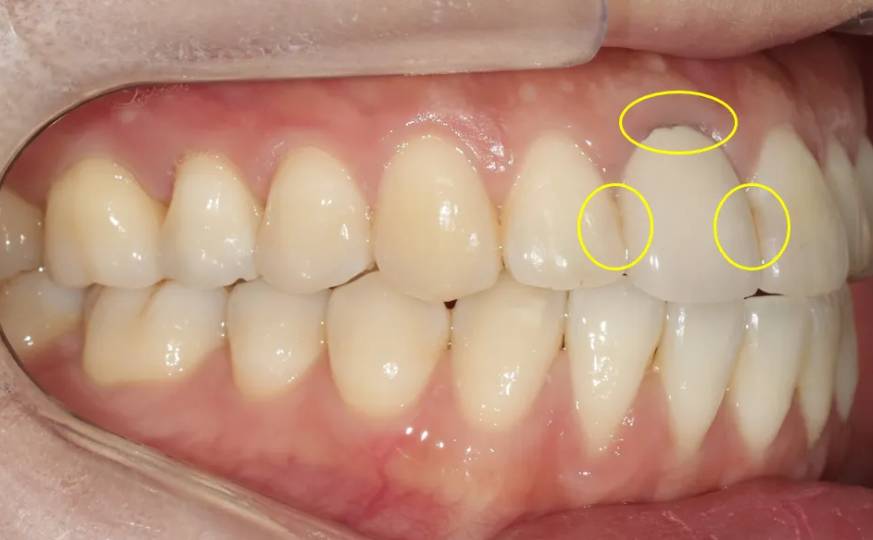
Next, the most noticeable feature in terms of tooth shape was that the margin of the existing crown (marked in yellow) was not aesthetically pleasing. This is also one of the limitations of the PFM treatment the patient had received. In addition to the unattractive margin, because of the nature of the restoration, no light passes through it, so the nearby gums can also appear slightly bluish, as if bruised.
The second issue was the visible floating space between the teeth. This could mean it was difficult to close during orthodontic treatment, or that even if it had been closed immediately after orthodontics, a slight recurrence of spacing may have occurred. In either case, it is undeniable that it is unaesthetic.
Lastly, secondary caries was found between the teeth. Since the patient had already decided on laminate veneers, treatment could proceed by removing the decay at the same time as the veneer treatment. For reference, several additional areas of secondary caries were also found that are not visible in this photo.
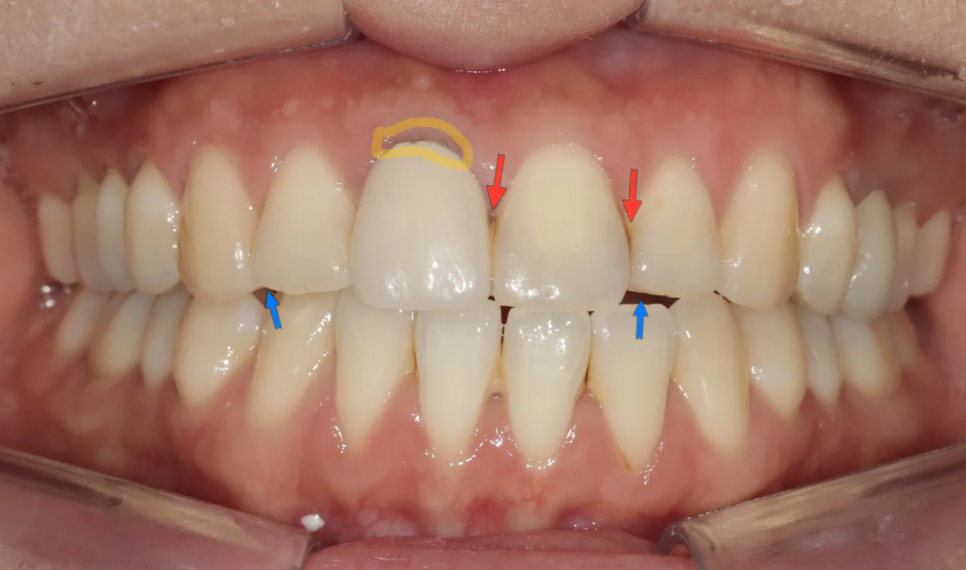
Multiple problems are seen together, including poor PFM crown margin fit, secondary caries, midline discrepancy, and asymmetric gingival lines.
The existing PFM crown on the upper front tooth showed a clearly protrusive appearance due to excessive contour, especially when viewed from the side or from below. This was also the part that bothered the patient the most.
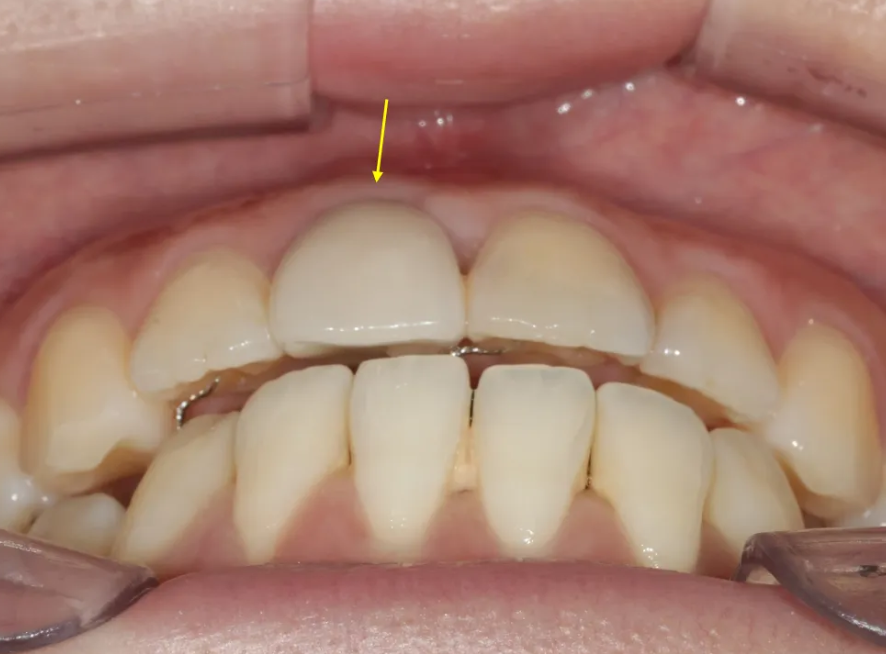
The existing crown looks especially protruded compared with the adjacent teeth
The same problem can be seen once more in the side view. A little more decay is also visible between the teeth.
What is a PFM crown, and why does it need to be replaced?
A PFM crown is a restoration covered with porcelain over a metal substructure. PFM is short for “Porcelain-Fused-to-Metal,” and more than 20 years ago, it was widely used as a representative method for aesthetic prosthodontics.
However, since it is a relatively older technique, PFM crowns have several aesthetic limitations. Because there is metal inside, they lack translucency compared with natural teeth, and as the gums recede over time, the metal line may become exposed at the gingival margin. In addition, the margin—the border where the gum and crown meet—often becomes unsuitable, reducing aesthetics.
PFM has metal inside, whereas all-ceramic crowns have no metal at all.
| Comparison item | PFM crown | All-ceramic crown |
|---|
| Substructure | Metal | Ceramic |
| Translucency | Low (metal blocks light) | High (similar to natural teeth) |
| Gingival margin | Metal line may be exposed | Natural-looking margin |
| Color reproduction | Limited | Very similar to natural teeth |
| Biocompatibility | Average | Excellent |
In this case as well, the PFM crown on the upper right front tooth showed poor margin fit, color mismatch with the surrounding teeth, and excessive contour (protrusion), so replacement with an all-ceramic crown was necessary.
What is a laminate veneer?
A laminate veneer (porcelain veneer) is a procedure in which a thin porcelain shell, about 0.3–0.5 mm thick, is bonded to the front surface of the tooth. Unlike a crown, which covers the entire tooth, a laminate veneer preserves the tooth very well because little to no tooth reduction is needed, or if any is done, it is minimal and mainly on the front surface.
The concept of a laminate veneer procedure, bonding a thin ceramic shell to the front surface of a tooth
The biggest advantage of laminate veneers is that they can improve the shape, size, color, and alignment of the teeth at the same time. In particular, in aesthetic treatment for front teeth, natural and beautiful results can be expected. In this patient’s case, removing the secondary caries around the existing resin fillings and then proceeding with laminate veneers made it possible to achieve both health recovery and aesthetic improvement at the same time.
Treatment plan – a patient-specific approach
What this patient wanted can be summarized as follows.
-
Replace the existing PFM crown on the upper right front tooth with an all-ceramic crown
-
Improve the aesthetics of the remaining five upper front teeth with laminate veneers
-
Improve symmetry of the gingival line on both upper lateral incisors
-
Minimize protrusion and create a natural appearance
Accordingly, the following specific treatment plan was established.
| | Tooth involved | Procedure |
|---|
| Crown remaking | Upper right front tooth (central incisor) | Remove existing PFM → reinforce core if needed → all-ceramic crown (minimize contour) |
| Gingival margin setting | Upper right front tooth | Considering thin gingival type, margin set 0.5 mm below the gum for aesthetics |
| Gingival contouring | Both upper lateral incisors | Achieve left-right symmetry of the gingival line |
| Laminate veneers | Remaining five upper front teeth | Rebalance size ratios, correct midline, close vertical spaces |
In particular, regarding the periapical lesion of the upper right front tooth, since there were no current symptoms, we first proceeded with crown remaking and explained in advance that extraction may be necessary if symptoms appear in the future. Clear communication with the patient about all possible situations that may arise before treatment is very important.
Treatment results – Before & After
These are the results after all treatment was completed. The upper right front tooth was finalized with an all-ceramic crown, and the remaining five upper front teeth were completed with laminate veneers.
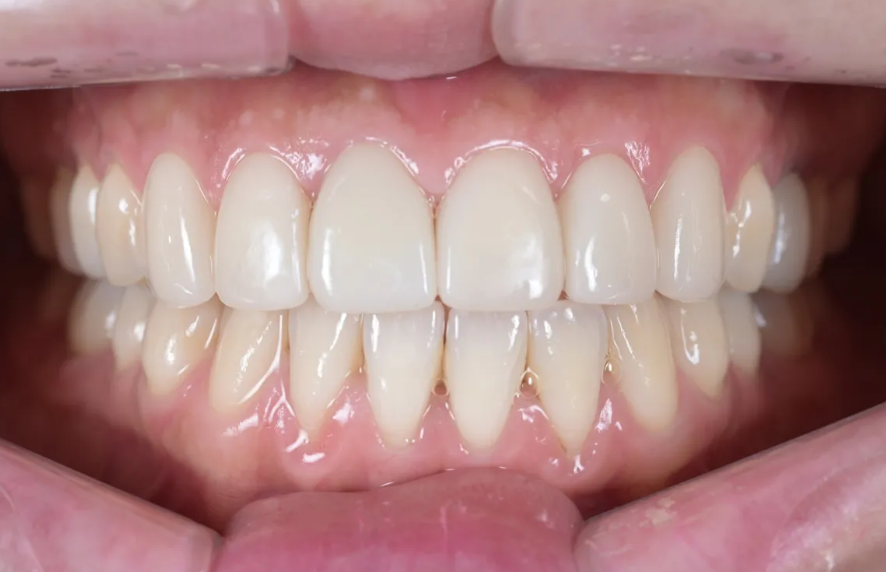
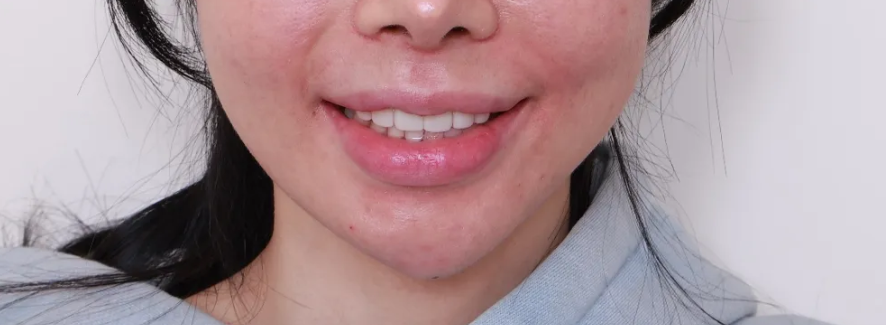
The unnatural color and protrusion of the existing PFM crown disappeared, and a natural smile line that blends perfectly with the surrounding teeth was completed. Through gingival contouring, a symmetrical gingival line on both sides was secured, further enhancing the aesthetics of the restorations.
Post-procedure precautions and maintenance
To maintain the good results of aesthetic prosthodontic treatment for a long time, post-procedure care is very important. Please be sure to remember the following.
⚠️ Important precautions to follow
-
If you have bruxism, wearing a night guard is recommended: Laminate veneers and all-ceramic crowns are vulnerable to excessive bite force (bruxism, clenching). We strongly recommend wearing a mouth guard to protect the restorations from unconscious grinding during sleep.
-
Be careful with hard foods: You must avoid using the front teeth to bite hard foods such as ice and nuts.
-
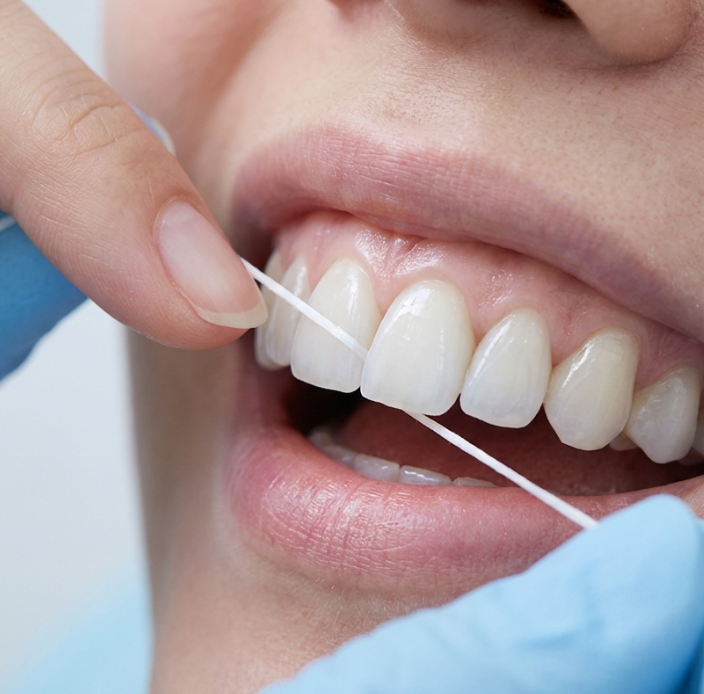
Proper oral hygiene: It is important to keep the area around the restorations clean at all times through toothbrushing and flossing.
✅ Regular checkups are essential
-
Please have regular checkups every 6 months to monitor the condition of the restorations and the health of the gums.
-
In particular, in this case, the periapical lesion of the upper right front tooth currently has no symptoms, but regular follow-up through checkups is essential. If symptoms develop in the future, retreatment of the root canal or extraction followed by implant placement may be necessary.
Aesthetic prosthodontic treatment is not simply making and placing a restoration; it is a delicate process that comprehensively considers facial harmony, tooth proportions, and the gingival line. The best results are achieved when there is close communication between the patient and the dentist.
If you are concerned about a combination of issues such as aesthetic dissatisfaction with an existing PFM crown, protrusion of the front teeth, or asymmetric gums, I recommend creating a treatment plan that suits you through a professional consultation. Thank you.