Swelling after an extraction is not so much a “bad sign” as it is a “sign that you are healing well.” Surprising, right? Swelling can make it seem like something serious has happened, but it actually occurs because the body sends blood and healing cells to the area all at once to help close the wound.
So the issue is not “whether it swells,” but “how much it swells and how long it lasts.” If you are looking in the mirror and searching because you are wondering, “Is this really normal?” you can take a moment to breathe.
The information below is organized according to how many days have passed since the extraction. As a reference, facial swelling after having teeth extracted for orthodontic treatment is generally known to be part of the natural healing process in most cases.
Why does swelling occur? — It is healing, not damage

An extraction ultimately creates a “wound” in the gums and bone. When our body develops a wound, it concentrates blood, immune cells, and materials needed for healing in that area to fill and protect it. During this process, fluid temporarily collects in the surrounding tissues, and that is the “swelling” we can see.
In other words, swelling is more of a sign that the healing process is underway.
Of course, swelling itself is uncomfortable. You may worry about how your face looks, feel soreness or tightness, and find that it seems difficult to open your mouth fully. However, swelling alone does not necessarily mean that something has gone wrong. What matters is the “degree” and the “timing.” Knowing how much swelling and how many days are commonly expected can help ease your anxiety.
Progress over time — When is swelling worst, and when does it usually go down?
This is what many people are most curious about.
“What if it swells more tomorrow?”
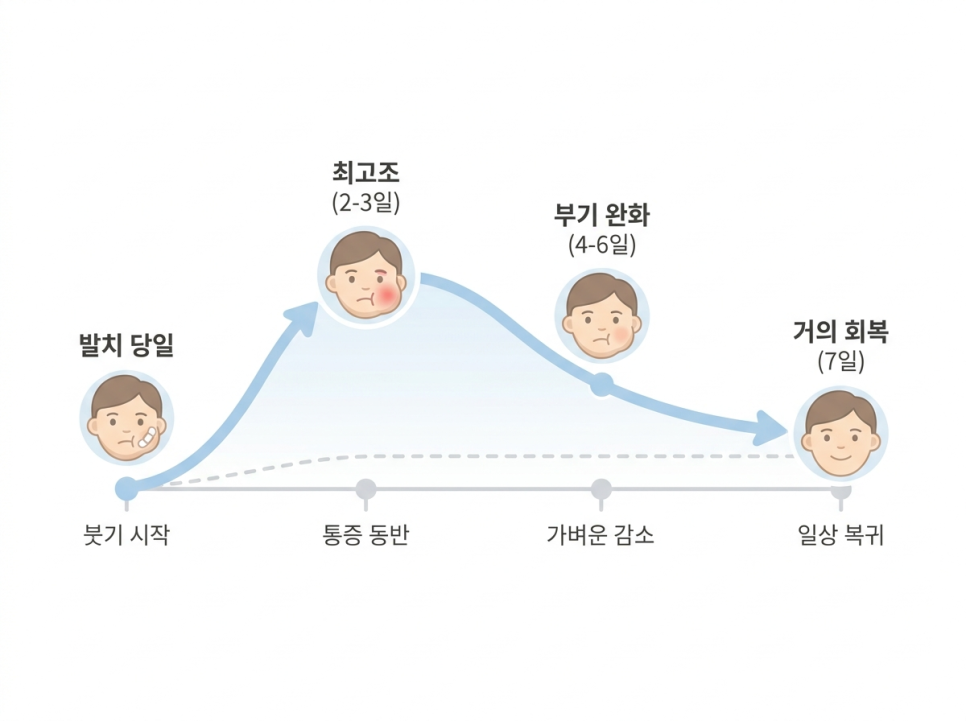
There is one fact that may help you feel more at ease. Swelling is generally known to tend to be worst on the second or third day after an extraction, rather than on the day of the extraction itself. So even if it looks more swollen the next day, that alone does not mean that the condition is getting worse. Here is a timeline:
| Timing | Common progression |
|---|
| Day of extraction | Swelling begins; bleeding and soreness may occur |
| 48–72 hours (days 2–3) | Peak swelling — the time when it looks most swollen |
| Days 4–6 | Swelling gradually decreases; bruising may become visible |
| Around 1 week | Generally known to be the time when swelling becomes noticeably reduced |
Bruising, soreness or tightness, and slight discomfort when opening the mouth may accompany the swelling. Bruises often become lighter as their color changes over time. However, this is only the general pattern, and there can be significant individual differences in the amount of swelling and how quickly it subsides. It may vary depending on the location and number of teeth extracted, the difficulty of the procedure, and your individual constitution.
How to reduce swelling a little faster
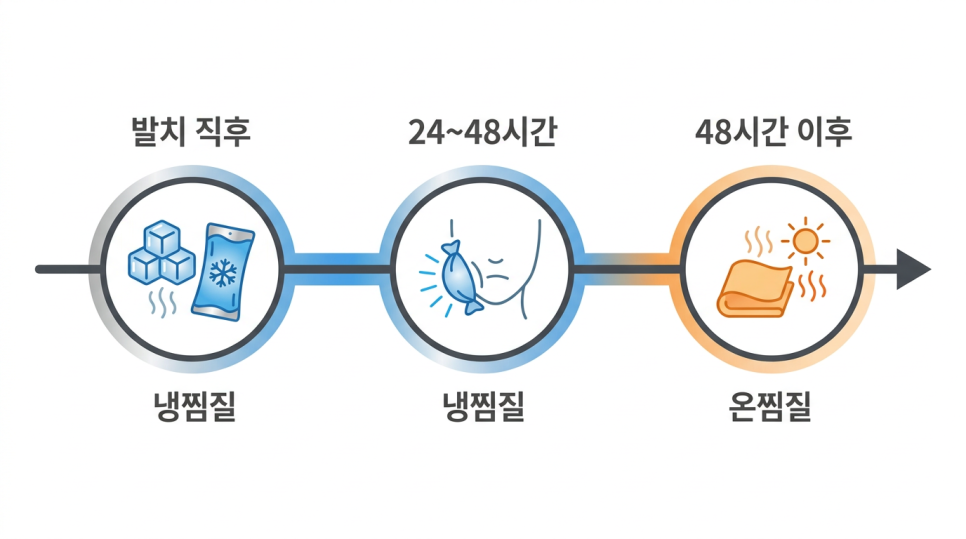
It can be frustrating if there is nothing you can do except wait. So here are generally recommended care methods. The key is the “timing” of cold and warm compresses. This is often the most confusing part. Use cold and warm compresses differently depending on the timing.
| Timing | What to use | Method |
|---|
| 24–48 hours after extraction | Cold compress | Place ice in a plastic bag, wrap it in a towel, and apply it to the cheek. Repeat 10–20 minutes on / 10–20 minutes off |
| After 48 hours | Switch to a warm compress | It is generally recommended to switch to a warm compress |
Use cold for the first two days, then warm compresses afterward. Remember this order.
Applying ice directly to the skin can cause frostbite, so always wrap it in a towel or something similar before use.
Here are some other helpful lifestyle habits:
-
It is recommended to sleep with your pillow higher than usual. Keep your head higher than your heart!
-
Take prescribed medications, such as antibiotics and analgesic anti-inflammatory drugs, as directed. It is better not to stop or skip them on your own.
-
Do not repeatedly touch the treated area with your tongue or fingers.
You should also avoid the following as much as possible for about one month:
These activities may stimulate blood flow or delay recovery, so it is recommended to avoid them for about a month after the procedure.
Do not ignore these signs
Most swelling subsides over time, but several signs should be distinguished from ordinary swelling.
First, when dry socket is suspected.
Pain usually gradually decreases after an extraction, but
- If the pain becomes worse instead after 2–3 days have passed since the extraction,
-
If the bone appears to be exposed instead of being covered by the blood clot that should cover the wound, and
-
If there is a bad odor coming from your mouth,
it may be dry socket. In this case, professional treatment is definitely necessary.
Second, signs that may indicate an infection or another problem.
-
Pus,
-
A fever of 38°C or higher,
-
Difficulty opening the mouth,
-
Difficulty swallowing food or saliva.
If you notice these symptoms, the safest option is to contact the clinic where you received treatment immediately. The clinic that performed the procedure knows your condition and progress most accurately.
In closing
To summarize, swelling after an extraction is generally more of a sign that healing is underway. It is generally known to peak around days 2–3 and subside around the one-week mark.
If you had the extraction today, this is the time to focus on cold compresses and elevation.
If two days have passed, it is time to consider switching to warm compresses.
If three or four days have passed but the pain is actually getting worse, review the warning signs above once again.
Swelling almost always favors time. You do not need to be too impatient. This has been Ceramic Dental Clinic ^^