Have you ever spread out your calendar and flipped through week after week, saying, “Let’s do it this week”?
Important presentations, deadlines, business trips—there was no empty week. It may not be the dental visit itself that feels intimidating; sometimes, what happens afterward is the bigger concern. How much swelling there will be and how long it will take before you can move around normally—those things really matter when you are busy.
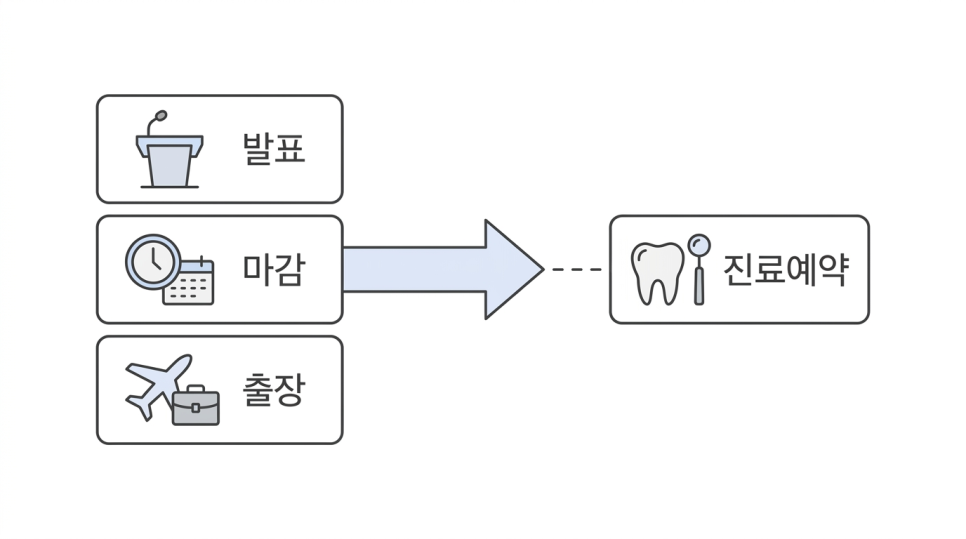
When people honestly explain why they have been postponing dental treatment, surprisingly many say something like this:
> “I couldn’t schedule it because I didn’t know how many days recovery would take.”
Would you need to take time off work? If so, how many days? Would you be able to attend your next meeting? Could you have the procedure the day before a presentation? Decisions with no clear timeline are bound to be postponed.
So the question changes. It is not, “Should I get an implant or not?” but rather, “What exactly causes that recovery period?”
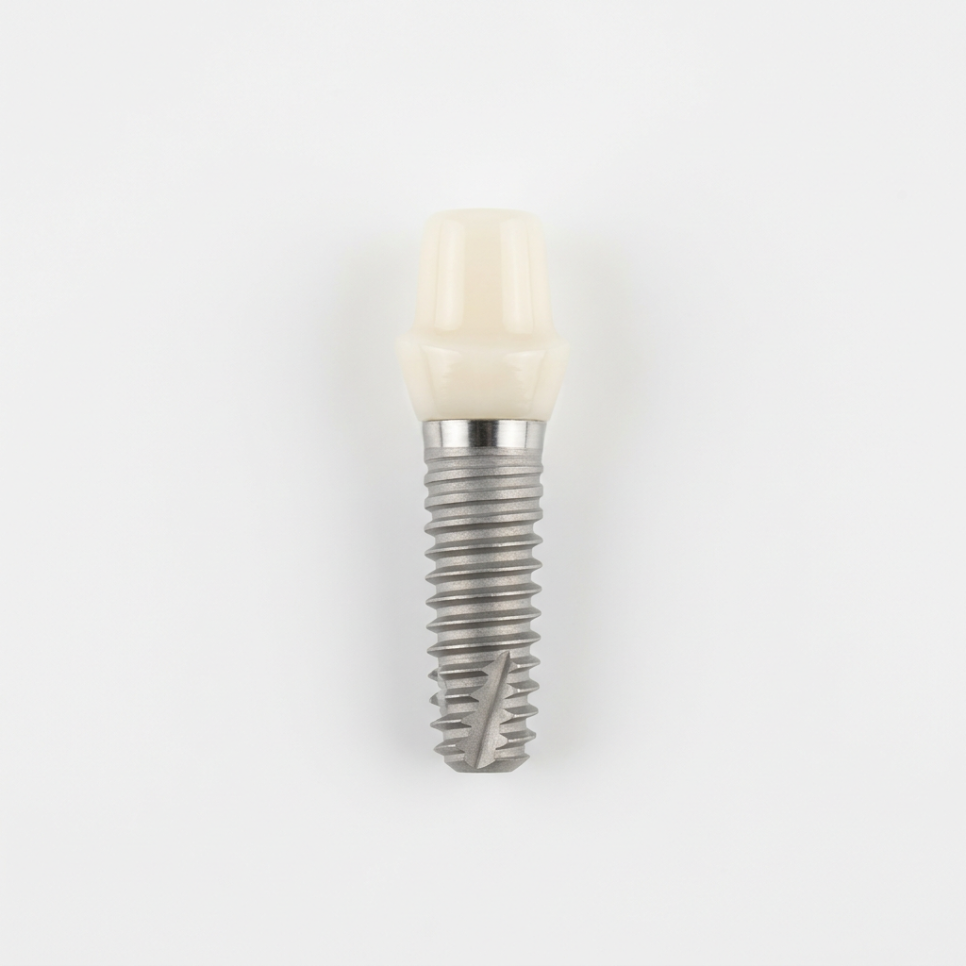
A long recovery is caused not by the implant surgery itself, but by the sutured area
This may be somewhat unexpected, but with conventional implants, the biggest factor contributing to the recovery period is not the process of placing the implant itself.
A typical implant procedure proceeds as follows: the gums are incised and opened, the bone is exposed, the implant is placed, and the gums are then covered and sutured again. You also need to return a few days later to have the stitches removed.
What makes the recovery period longer is not the implant, but the area where the gums were incised and sutured. The sutured wound needs time to heal, and during that time, swelling and discomfort may occur.
Following the logic leads to a natural conclusion:
If there is no sutured area, there is no time needed for a sutured area to heal.
In fact, clinical studies comparing a method that does not involve incising the gums (flapless) with the conventional incision method have reported lower postoperative pain with the flapless approach. Comparative studies have also reported that painkiller use was higher with the incision method.
This means that the way the body recovers after surgery may differ—not necessarily because of the difficulty of the surgery itself.
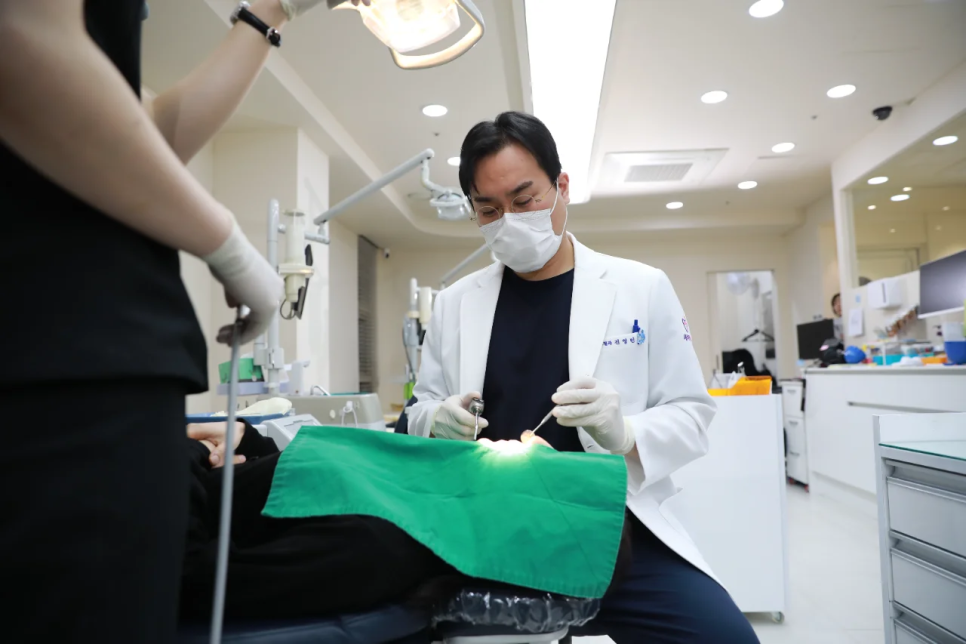
What does “no incision” mean in everyday life?
This is the part that is truly important for busy people.
“No incision” sounds like a medical expression, but in everyday terms, it means the following:
| Conventional implants | Flapless approach |
|---|
| The gums are incised and sutured | The gums are not opened and closed |
| A return visit is needed to remove the stitches | There are no sutures, so there is no stitch-removal appointment |
| Swelling and discomfort continue while the sutured area heals | Recovery may progress differently because there is no sutured wound |
| The sutured area needs to be managed while eating and brushing | The nature of the care required is different |
This may not seem like much when written down, but for someone who needs to reduce even one X on their calendar, the difference can be significant.
One fewer appointment to return for stitch removal. Less time with the treated area in your mouth feeling like a “surgical site.” A few fewer days when you may need to avoid chewing on the treatment area.
Studies tracking how the soft tissue (gums) settles have also reported a tendency for the gum condition to remain favorable after a certain period in cases performed without sutures. This suggests that the gums can settle into place without a sutured wound.
Of course, there are differences from person to person. Not everyone recovers in exactly the same way. However, this means that clinical evidence has accumulated regarding why recovery may progress differently.
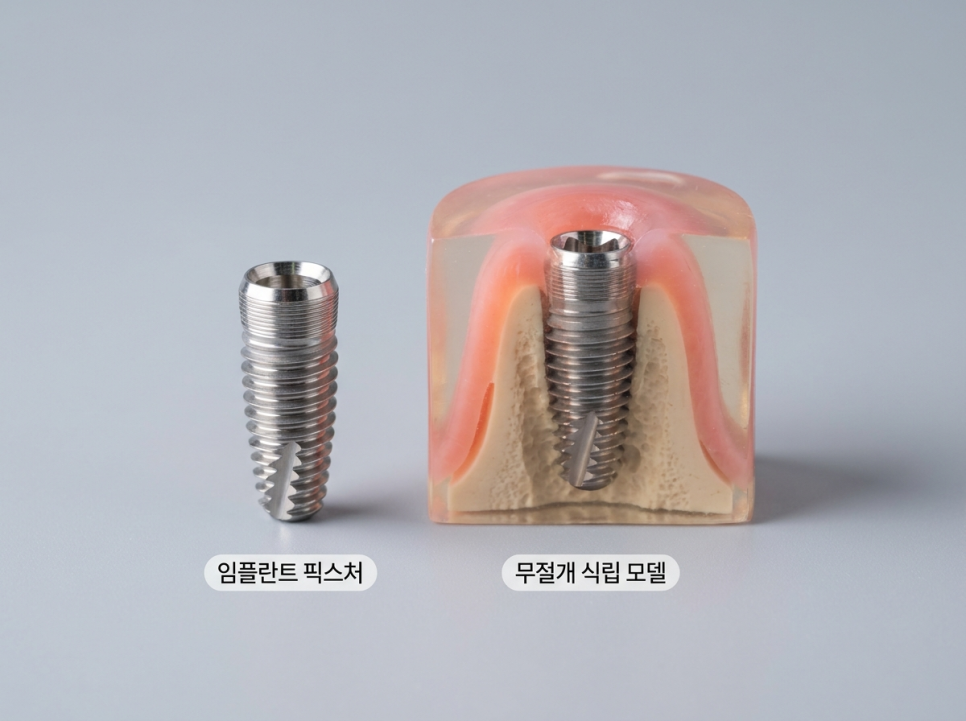
However, it is not suitable for everyone
There is an important point to address honestly here.
Flapless implants are not a method that can be applied to everyone. Rather, the necessary conditions must be checked first before determining whether the procedure is possible.
The bone beneath the gums must be sufficient to support the implant securely, the gums themselves must be in a healthy state for healing, and enough time must have passed since the extraction. The method may be considered when these conditions are met. If bone grafting is needed at the same time, or if the bone must be reduced and reshaped, it can be difficult to proceed with a flapless approach.
That is why the key to this method is not the surgery itself, but the preliminary diagnosis.
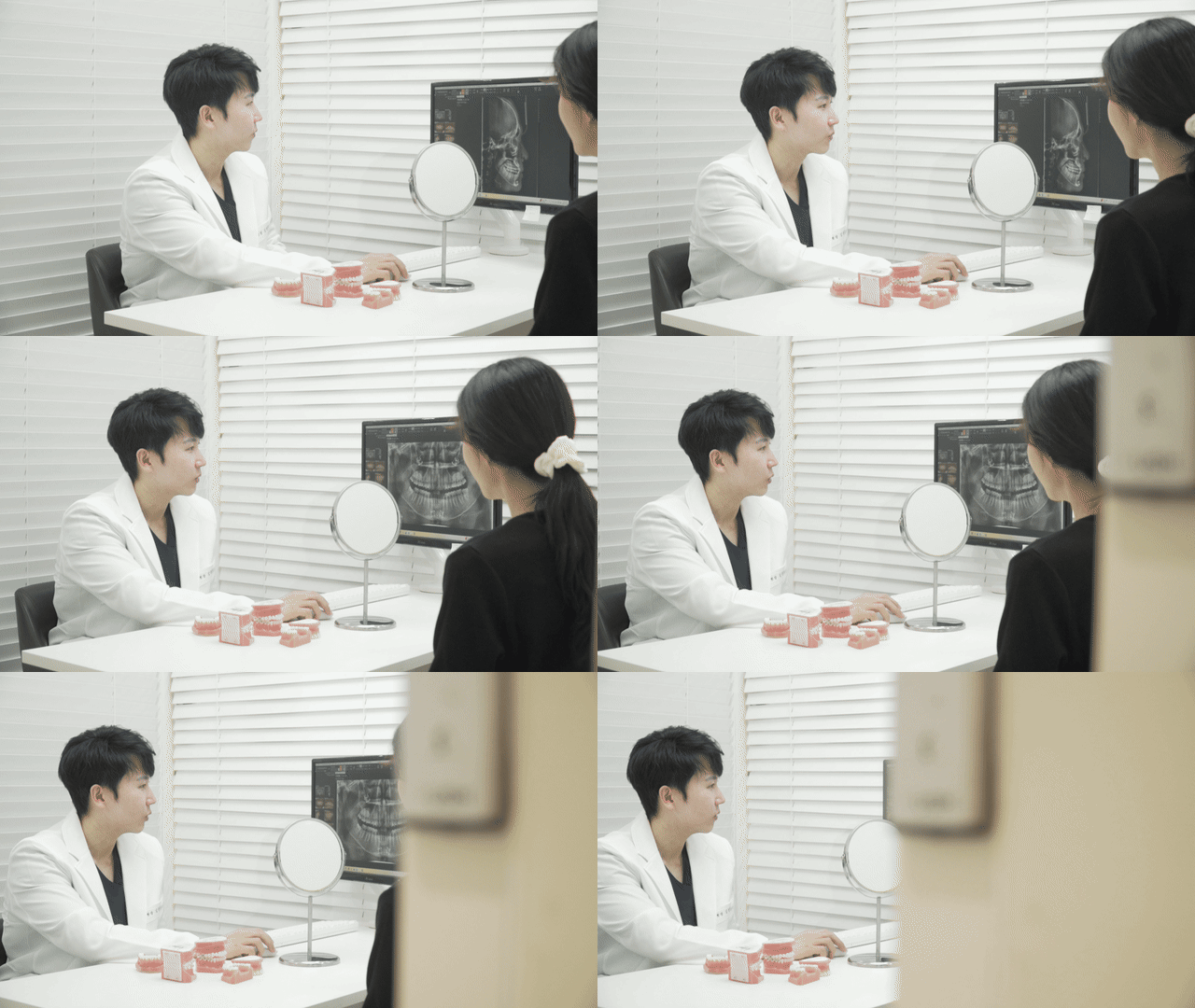
Because the bone beneath the gums is not directly exposed and viewed, the surgical path is planned in advance by using a 3D CT (CBCT) scan to check the bone width, density, and the location of nerves. Rather than proceeding by guesswork, the bone is mapped in advance, and the implant is placed along that planned path.
This also means that if the preliminary diagnosis is not thorough enough, it may be difficult even to begin.
Whether it is possible or not can only be determined after creating a map of the bone.
Therefore, a good starting point is not to estimate from internet information whether you are eligible for a flapless procedure, but to find a clinic that first evaluates the condition of your bone sufficiently with CBCT and then determines whether the procedure is possible. It may be helpful to first check whether the clinic takes enough time for detailed diagnosis.
The only thing you can do today is check
If you have read this far, I think the outline of what you need to do today may look a little different.
What you need to decide today is not “whether to get an implant.” It is not “whether to schedule the surgery for next week,” either. There is only one thing to do:
Check once whether your condition is suitable for the flapless approach.
Once this has been confirmed, you can finally plan your schedule. How many days you need to keep free, whether the procedure can be done the day before a presentation, or whether it can be scheduled just before a business trip—all of these decisions can be made afterward.
So what I would recommend is not a grand commitment. Simply have your bone and gum conditions checked to see whether they are suitable for a flapless procedure. That is enough for today.
As one final criterion for choosing a good dental clinic, it may be helpful to check whether the clinic has a collaborative diagnostic system in which several doctors participate in the evaluation. When a case is reviewed from multiple perspectives rather than being based on one person’s judgment, a more cautious conclusion may be reached even for cases near the boundary between possible and impossible.
You do not need to clear your schedule today. Simply stopping by once to get checked—that is the beginning.