The day you went in for an implant consultation and heard the term “bone grafting” for the first time.
You may have felt that something was not quite right. You may have wondered whether it was overtreatment, or thought that another dental clinic might place the implant without bone grafting. That doubt is not unusual. If it was something you heard for the first time and the explanation was brief, it is a natural thought to have.
Before deciding whether that suspicion is right or wrong, it is better to first take a look at the relevant criteria.

It is natural for doubt to come first
The word “implant” itself refers to a treatment that requires a significant decision. You probably opened the dental clinic door after preparing yourself to some extent for the cost, treatment period, and emotional commitment.
But if the sudden explanation in the consultation room was, “Bone grafting is needed first,” it means the treatment has effectively increased from one step to two, affecting both the cost and the treatment period.
The fact that doubt is the first emotion that arises in this situation is actually a fairly prudent response. “Is this really necessary, or are they recommending something that could be avoided?” Many people take that question directly to a search engine.
That is why this article does not dismiss your doubt. Instead, it will calmly explain where that doubt can begin to be resolved and what facts you should know before making your judgment again.

Bone really does shrink
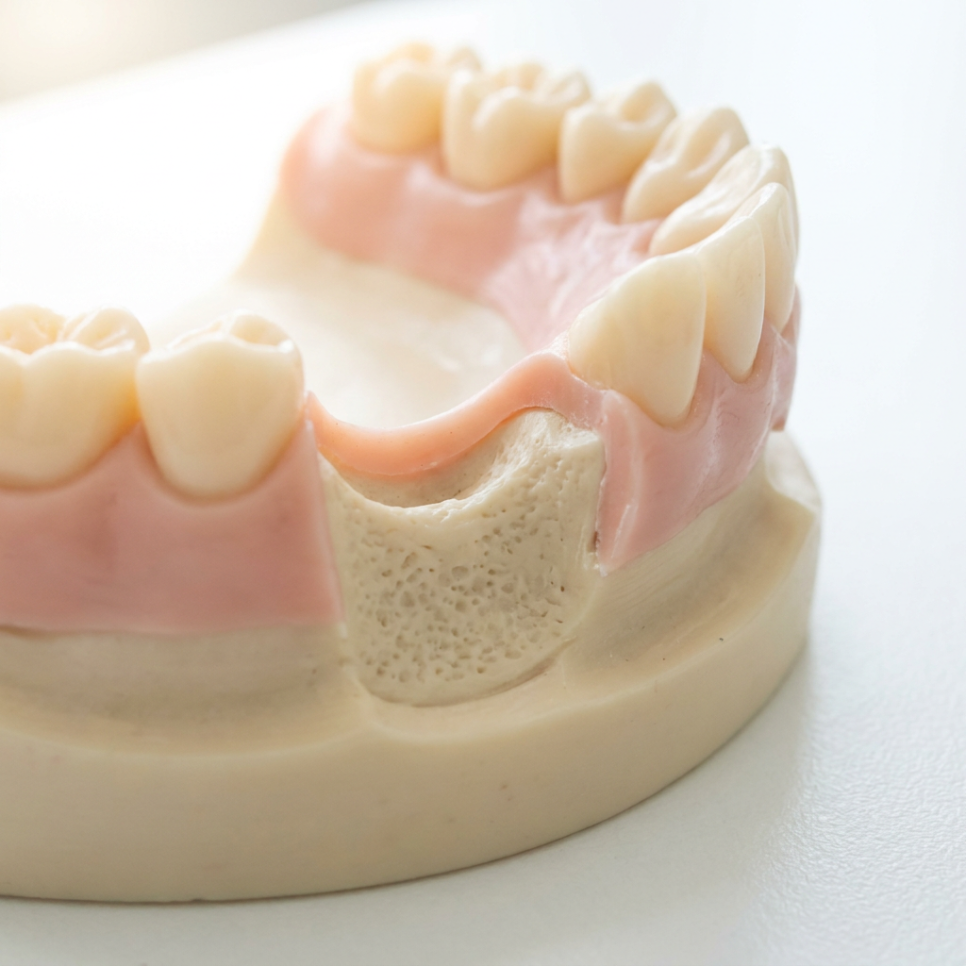
Here is the first fact you should know. After a tooth is extracted, the jawbone at that site gradually decreases over time. Although it may appear to remain unchanged, bone is tissue that needs stimulation to be maintained. When a tooth is present, chewing stimulation is transmitted to the bone; when that stimulation disappears, the bone is gradually resorbed.
This is not merely an estimate but a phenomenon that has been repeatedly observed in clinical practice. One specialist’s column explains that the height and width of the bone decrease most rapidly during the 3 to 6 months after extraction. A study published in the Journal of the Korean Academy of Periodontology summarized the extent of natural resorption during this period with specific figures.
| Category | Extent of natural resorption after extraction |
|---|
| Jawbone width | Approximately 1.25–1.86 mm |
| Jawbone height | Approximately 1.36–1.62 mm |
The unit is millimeters.
It may seem small,
but at the site where an implant will be placed,
this degree of difference is visible to the naked eye.
In other words, being told that “bone grafting is necessary” is not a diagnosis suddenly created out of nowhere. If time has passed since the extraction, if the bone has already been damaged by gum disease, or if the bone at that site was naturally thin to begin with, it means that this process may already have progressed or may still be underway.
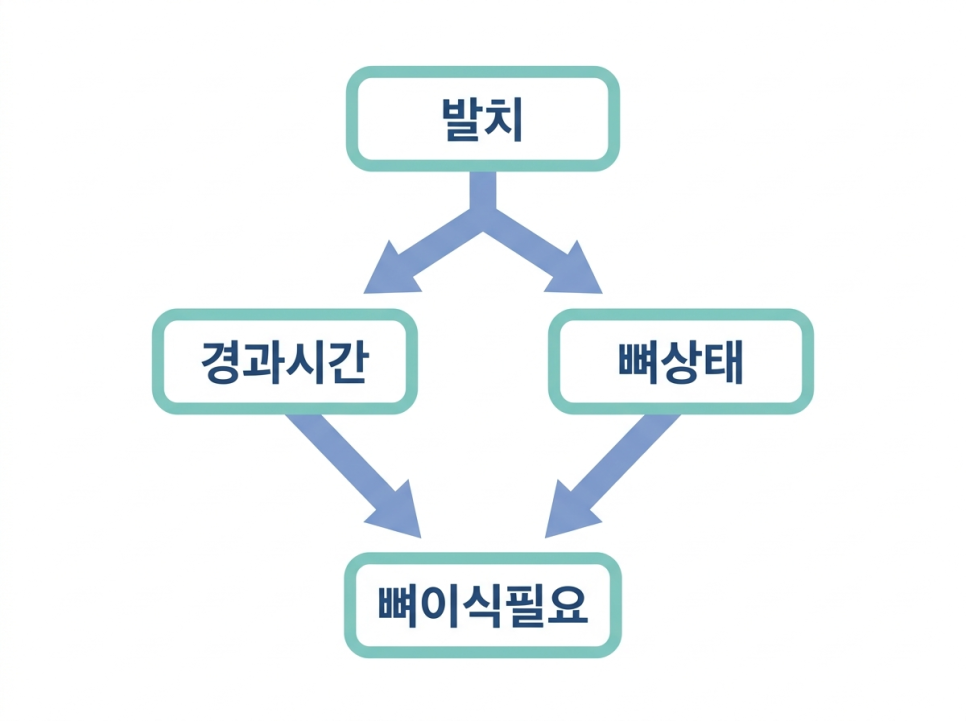
What happens if an implant is placed anyway when there is not enough bone?
Let us take this one step further. “Can’t the implant still be placed somehow? Is bone grafting really necessary?”
The answer can be explained using one medical term: osseointegration—the process in which a direct connection is formed between the implant body and the jawbone. Seoul National University Hospital’s medical information identifies osseointegration as the most essential condition for implant success.
Simply put, an implant does not function properly by merely being embedded in the gums; it needs to be firmly surrounded by bone. What happens if there is not enough bone to surround it?
-
Even when the procedure itself is possible, it is known that the risk of reduced long-term stability increases
-
The chewing forces may not be distributed sufficiently, allowing stress to accumulate in the bone around the implant
-
Over time, the implant may become loose, or a situation may arise in which additional treatment is ultimately needed
That is why bone grafting is considered not from the perspective of whether the implant can be placed immediately, but from the perspective of whether it can be made stable enough to use even 10 years later.
The reason the first dental clinic you visited recommended bone grafting was also likely based on this perspective. Although placing the implant without additional treatment may seem faster and less expensive in the short term, the judgment may have been that further treatment could be needed in the long run. This means that the recommendation you initially questioned may actually have been the more cautious one.
Once that makes sense, one question naturally follows
If you have read this far, your initial doubt may have been somewhat resolved. Bone loss is a real phenomenon, and the recommendation that bone grafting is necessary can also be based on legitimate grounds.
That naturally leads to the next question.
“So where should I get an implant that includes bone grafting?”
From the moment this question comes to mind, the nature of your search changes. It shifts from “Should I do it or not?” to “What criteria should I use to choose?” So in the next section, I will organize a few of those criteria for you.
Implants involving bone grafting require precise judgment
The key difference between an implant involving bone grafting and a straightforward implant is that there are many more variables to consider.
| Consideration | How it differs |
|---|
| Graft amount | A small amount can be performed at the same time as implant placement / A large amount requires implant placement after bone regeneration |
| Graft material | A case-specific choice among autogenous bone, allogeneic bone, xenogeneic bone, and synthetic bone |
| Healing period | Approximately 4–6 months for the upper jaw, and approximately 2–3 months for the lower jaw |
| Timing of placement | Simultaneous placement vs. staged placement — varies by case |
When only a small graft is needed, the procedures can be performed at the same time. When a large graft is needed, the established approach is to place the implant after bone regeneration has been completed. This single decision can change the overall treatment period by several months.
For such decisions to be made precisely, it can be helpful for several specialists to review the case together rather than having one doctor make the decision alone. Bone grafting cases often require a perspective that also considers the bite, prosthetic restoration, and long-term care after implant placement. Whether the collaborative care team includes clinicians who look at other areas as well, such as an orthodontic specialist, can be one criterion to check.
There is one more point—an implant is not a treatment that ends once it has been placed. Because care continues over a period of years, it is also worth considering whether the clinic thinks about the long-term relationship and care after treatment. A clinic that takes the view that “you continue seeing the same clinic even 10 years from now,” rather than “treatment ends after one visit,” tends to make its initial decisions with that longer perspective in mind.

This is not a decision, but one more check
If you have read this far, your initial doubt can now be organized in two ways.
First, the recommendation that bone grafting is necessary has a basis.
Second, the clinic that will handle that treatment should be chosen according to certain criteria.
If so, the next step does not have to be a major one. It is not the stage of deciding on surgery, but the stage of getting one more opinion on the case. Even when the diagnosis is the same, the way that diagnosis is addressed, as well as the amount and timing of grafting, may differ from case to case.
It was not wrong not to decide at the first clinic you visited. In fact, people who pause and take another look often make subsequent decisions with greater peace of mind.
Before deciding on treatment, look at the same case once more from a different perspective.
This small step may make the major decisions that follow feel a little easier. Why not visit a dental clinic today and hear an opinion from a new perspective?