Try smiling naturally in front of the mirror. You can’t see even half of your lower teeth.
I found out I had a deep bite several years ago, but there is a reason it took me this long to decide on orthodontic treatment. I didn’t want braces with wires, I wasn’t sure whether clear aligners would work, and every blog kept repeating, “It depends on the case.” That is why you are still here.
This article is an attempt to take one step beyond that inconclusive cycle.
You may have done plenty of research without finding a clear answer
If you search for “deep-bite clear aligners” on Naver, you will find plenty of articles. But by the final paragraph, the same sentence inevitably appears:
“Because every case is different, you need to receive an in-person consultation for an accurate assessment.”
It is not wrong. However, I had already heard it too many times to feel ready to walk into a consultation room based on that statement alone. So in this article, I want to first lay out the criteria hidden behind the phrase “every case is different”—from the level you can estimate in front of a mirror to the range of possibilities reported in clinical research.

One criterion you can estimate in front of a mirror
A deep bite is assessed by how much the upper teeth cover the lower teeth. In orthodontics, this is called overbite, and anyone can roughly estimate it by gently closing their mouth in front of a mirror.
| Category | Extent to which the upper teeth cover the lower teeth | Overbite |
|---|
| Normal occlusion | 30% or less of the height of the lower teeth | Approximately 2–4 mm |
| Deep bite | More than 30% of the height of the lower teeth | Over 4 mm |
| Severe deep bite | 50% or more of the height of the lower teeth | 5 mm or more |
If more than half of your lower teeth are hidden when you close your mouth naturally in front of a mirror, you may fall into the severe deep-bite category. However, a mirror can only provide a rough estimate; actual measurement in millimeters and classification take place through other diagnostic steps.
There is one more important classification to consider. Even when the condition is the same, the approach is understood to differ when the cause is different.
These two classifications are known to be the most important variables in determining whether clear aligners are appropriate. They cannot be identified from a mirror and are usually distinguished accurately through imaging diagnostics such as X-rays.

Let’s first look at cases where treatment may be possible
Even after reading several blog posts, it is difficult to find one that clearly summarizes the “cases where treatment may be possible.” So let’s start by looking at the clinical evidence.
A systematic review published in 2025 collected and analyzed 18 studies on treating deep bites with clear aligners. According to the review, the range of overbite improvement reported with clear aligners was approximately 0.4 mm to 3.8 mm.
Clinical Oral Investigations, 2025. “Effectiveness and accuracy of clear aligners in treatment of deep bite: a systematic review”
To explain what these figures mean:
-
Moderate deep bites between 4 and 7 mm, when the cause is dental → Fall within the range in which improvement has been reported with clear aligners.
-
In these cases, using auxiliary devices such as attachments—small projections bonded to the teeth—or bite ramps may help improve the outcome.
By contrast, the following cases are reported to be difficult to treat with clear aligners alone.
| Difficult case | Reason |
|---|
| Overbite greater than 8 mm | Exceeds the range of improvement reported with clear aligners |
| Cases that also require extractions | The method of creating space is different |
| Skeletal deep bite | A change to the jawbone structure itself may be necessary |
| Cases requiring orthognathic surgery | A surgical approach is also required |
So we can answer the question raised at the beginning as follows:
It is not the fact that you have a deep bite itself,
but rather
how severe the deep bite is
and what caused it
that truly determines whether clear aligners are appropriate.

Everyday life during treatment, without wires
Now that we have looked at the criteria, you may be wondering what everyday life will be like once treatment actually begins.
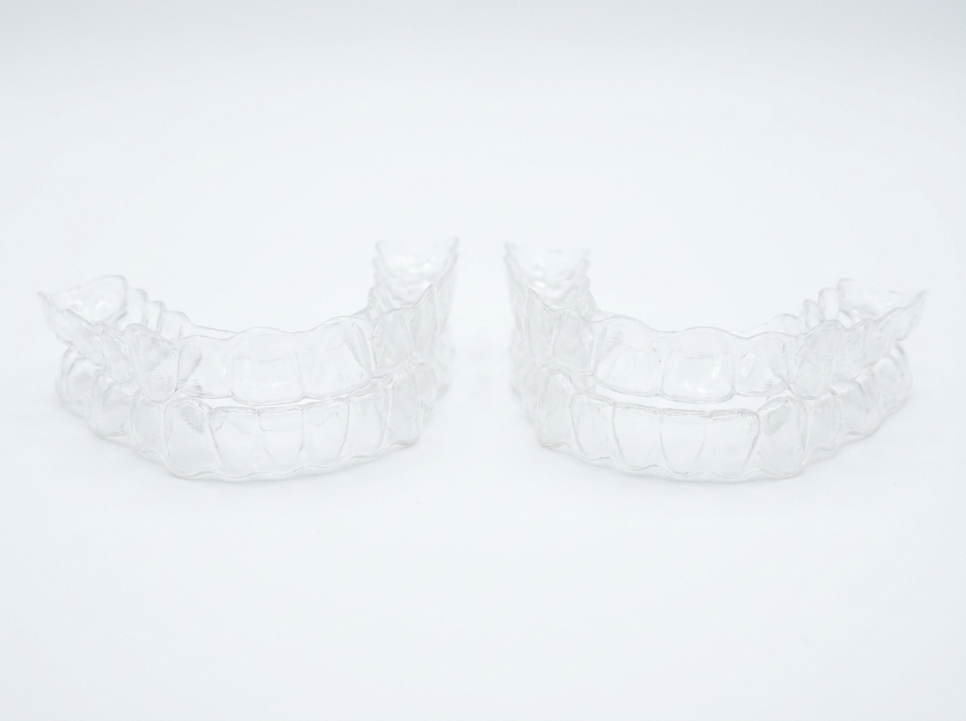
Clear aligner trays are approximately 0.5–0.75 mm thick. Because they are made of transparent plastic, they are known to be barely noticeable even when talking face-to-face. They are also reported not to create a significant burden during video calls or meetings.
Wearing them for 20–22 hours a day is recommended. You remove them only when eating and brushing your teeth. This is the most noticeable difference in everyday life.
-
Since you remove the trays when eating, you are generally advised that there are no specific food restrictions.
-
You brush your teeth as usual. You can clean the trays separately from your teeth.
-
For about 3–5 days after changing trays, discomfort related to tooth movement may occur, after which you are known to gradually adapt.
Treatment typically lasts between 6 months and 2 years, depending on the case. Cases such as deep bites, which require movement in the vertical direction, are known to tend to take longer than average.
Everyday life with clear aligners is often described as a time when only you are conscious of being “in orthodontic treatment.”
A consultation is for confirmation, not a decision
If you have read this far, there is probably one question remaining:
“So which category does my case fall into?”
This question cannot be fully answered through an article alone. A mirror can help you roughly estimate how much your upper teeth cover your lower teeth, but determining whether the cause is dental or skeletal requires imaging diagnostics. Accurate overbite measurement and decisions about using auxiliary devices such as attachments or bite ramps also require an in-person examination of your mouth.
That is why it may feel less burdensome to think of a consultation not as a place to decide whether to undergo orthodontic treatment, but as a place to confirm which category your deep bite belongs to.
Especially in cases where classification is central—such as distinguishing between dental and skeletal causes—it is appropriate to have the case evaluated directly by an orthodontic specialist in order to establish an accurate diagnosis. In addition, if the clinic uses a collaborative system in which several directors review the case together rather than having one doctor make the decision alone, this may help reduce gaps in the assessment. If the clinic also considers the aesthetic aspects of the orthodontic outcome, it may be easier to align the treatment direction with what you originally wanted.
If you have been caught in an inconclusive cycle while searching through various articles, how about finding a little courage and getting an assessment just once this time?