Although you know you should get scaling, you may keep putting it off because nothing hurts and you are busy.
Then one day, you may notice blood while brushing your teeth or become concerned about bad breath, and only then wonder, “Is it really okay to leave this untreated?”
The reason you should not ignore scaling is that these vague signals are easy to dismiss as insignificant.
Scaling Is a Dental Treatment That Is Easy to Put Off
Scaling is different from treatment for a broken tooth or severe pain that requires immediate attention.
That is why busy people often put it off, saying, “I’ll do it next time” or “I’ll get it done before the end of the year.”
However, gum problems do not always announce themselves with severe pain from the beginning.
Periodontal disease often progresses chronically, and its symptoms may not be obvious in the early stages.
In other words, it is difficult to conclude that your gums are healthy simply because they do not hurt.
“I don’t have any pain, but my gums occasionally bleed when I brush my teeth.”
Did you know that even this minor discomfort may actually be a signal from your gums?
There is no need to be afraid, but continuing to ignore recurring signals can allow the problem to worsen.
The Problem Is That It Builds Up Quietly
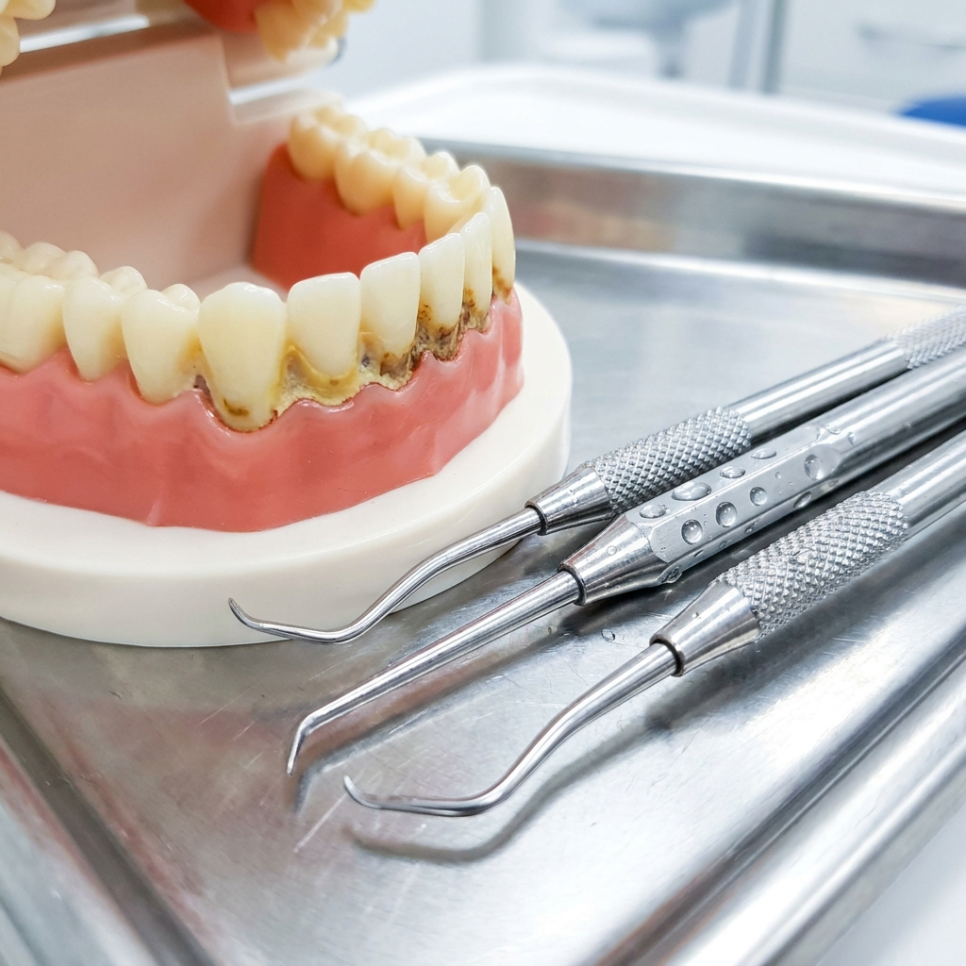
If you put off scaling for a long time, tartar may build up.
Tartar may look like nothing more than a yellowish stain attached to the teeth, but it can be connected to the condition of your gums.
Dental plaque is a film of bacteria that adheres to the surface of the teeth. If this plaque is not properly removed and time passes, it can harden into tartar. Bacteria can then attach and multiply more easily on the tartar's surface, creating a vicious cycle. Eventually, this can cause gum inflammation.
Another problem is that once tartar has hardened, it cannot be removed by brushing alone. Therefore, once it forms, it can continue to progress.
Bleeding When Brushing Is a Signal From Your Gums
One of the most common changes reported by people who have put off scaling is bleeding while brushing.
Healthy gums do not bleed simply from brushing.
Gums with a certain degree of inflammation have swollen blood vessels, much like bloodshot eyes, and can bleed easily even with minor stimulation.
Simply put,
bleeding while brushing
is caused by inflammation in the gums.
The Korea Disease Control and Prevention Agency also explains that, in the early stages of periodontal disease, bleeding caused by food or brushing, swollen gums, and bad breath may occur.
In more advanced cases, sensitivity, loose teeth, and discomfort caused by food becoming trapped may also occur.
This is not meant to make you anxious. Rather, if your gums are bleeding, you should treat it as a “signal that needs to be checked by a dentist.”
If You Have Put It Off Because You Are Afraid of Scaling
Being busy is not the only reason people postpone scaling.
It is also common to worry, “Won’t scaling wear down my teeth?” or “Won’t my teeth become more sensitive afterward?”
It is true that your teeth may temporarily feel sensitive as areas previously covered by tartar are exposed after tartar removal. However, if spaces appear between your teeth after scaling, this is not because your teeth have been worn away. It is because the tartar that had been occupying those spaces has been removed.
If You Have Put It Off for a Long Time, You Should Also Consider Future Care

The Korea Disease Control and Prevention Agency recommends regular checkups and tartar removal at least once a year because tartar is difficult to remove completely through brushing alone.
If you have been treated for periodontal disease or are at risk of recurrence, care at shorter intervals may be necessary.
Therefore, if you have put off scaling for a long time, it may be helpful to visit a dental clinic that can discuss both your future maintenance schedule and the condition of your gums.
| Criteria | Why to Consider It |
|---|
| Does it also check the condition of your gums? | Scaling can serve as the starting point for ongoing care |
| Does it explain the location of tartar and the degree of bleeding? | Helps you understand your current condition |
| Can it provide different treatment perspectives when necessary? | Gum health is important even before orthodontic or cosmetic treatment |
| Is it located somewhere convenient for regular visits? | Affects the continuity of regular care |
세라믹치과 has a collaborative treatment system involving three directors and is located one minute from Hakdong Station.
The clinic also places importance on long-term relationships with patients and aims to provide care that consistently monitors the condition of their teeth and gums.
These factors can serve as useful criteria for people who want to manage their future oral health rather than receive scaling just once and finish there.
Rather Than Assuming It Is Too Late, Start by Checking Your Current Condition
There is no need to assume that putting off scaling for a long time automatically means you have a serious problem.
Conversely, you should also be cautious about continually assuming everything is fine simply because you have no discomfort.
Health insurance subscribers or dependents aged 19 or older can receive health insurance coverage once a year when scaling is performed as the sole purpose of the visit.
If it is performed more than once a year, it is not covered by health insurance.
The reason you should not ignore scaling is not to frighten you.
When small signals recur, you need to identify where they are coming from in order to determine the right direction for future care.
Why not start taking a small step toward caring for your teeth today?