Wasn't it more frustrating that you never received a clear explanation of why this happened than hearing that your implant was loose?
If you came here searching because “it can be done again” didn't feel reassuring, then it is right to ask these questions now.
After having one unpleasant experience, anyone would naturally become cautious before making the next decision.
Today, we will carefully organize what you should check first before deciding on reimplantation.
After reading this, at the very least, you will be clear about “what you need to ask.”
The Truly Frustrating Part Is Not the “Implant,” but the “Failure Without an Explanation”
In fact, this is exactly where many people feel emotionally overwhelmed.
What is harder to endure than the implant itself developing a problem is that no one gives a clear explanation of why it happened.
You spent a considerable amount of money and quite a bit of time.
But when the answer to why this happened remains vague, it is only natural that you cannot feel at ease.
When all you hear is “it can be placed again,” thoughts like these naturally come to mind:
They said it would work that time, too,
so why did this happen?
What if the same thing happens again?
This anxiety is not caused by being overly sensitive.
It is actually a very natural response.
That is because implant failure does have identifiable patterns.
In other words, the causes are not scattered randomly; they can be organized into certain patterns.
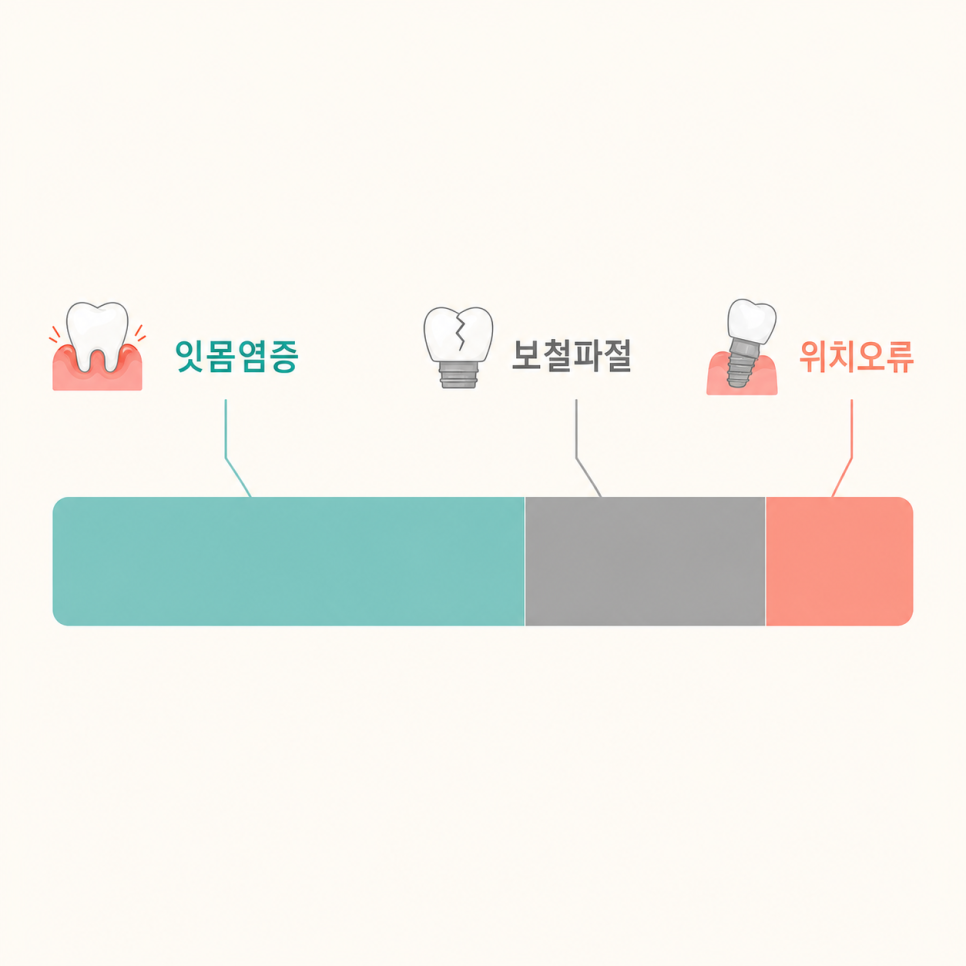
The most common cause of late failure, which appears some time after placement, is peri-implantitis. It has been reported to account for approximately 81.9% of cases.
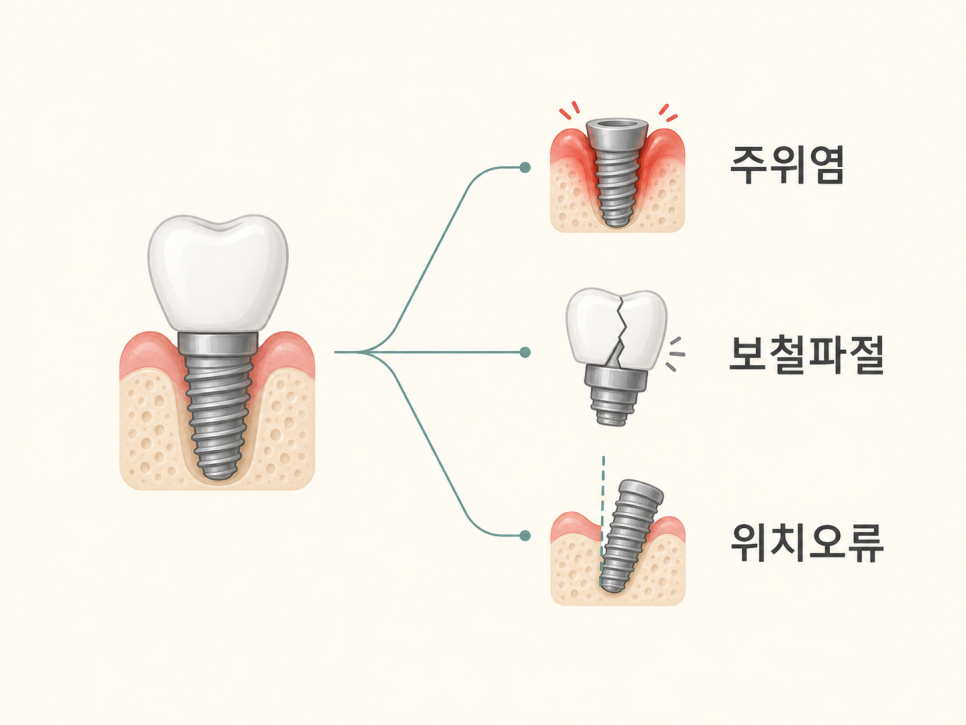
Simply put, inflammation develops in the gums and bone surrounding the implant, gradually weakening its support.
This is followed by cases in which the prosthesis or screw breaks, and cases in which the original placement position itself was unsuitable.
When the causes are divided this way, vague anxiety becomes somewhat clearer information.
Once you know what type of failure occurred, you can also see what needs to be addressed next.
Vague worry and specific information carry completely different emotional weight.
In other words, failure is generally not simply a matter of bad luck; it usually has an identifiable cause.
And the fact that there is a cause also means, when viewed from another angle, that it can be examined.
If the cause can be identified, preparations can be made.
The Success or Failure of Reimplantation Depends Not on “The Skill of Placing It Again,” but on “Identifying the Cause”
It would be helpful to clear up one misunderstanding here.
Many people think of reimplantation as a matter of having it placed again with greater technical skill this time.
Of course, procedural precision is important.
However, what should be considered first is identifying why the implant failed previously.
If it is placed again in the same location and in the same way without knowing the cause, the possibility of another failure for the same reason remains.
For example, if inflammation was the cause and the implant is placed again without managing that inflammation, you may end up walking the same path again.
Conversely, if the cause is accurately identified, a way to prevent that failure becomes visible.
Here is one fact that may be somewhat unexpected.
Even when an implant is placed again in a location where it previously failed,
reported 5-year survival rates range from 71% to 100%.
These figures are different in nature from the worry that “because it failed there before, the outcome will be worse.”
One study even reported a cumulative survival rate of 99% when reimplantation was performed in an area that had failed because of peri-implantitis, after the cause had been thoroughly addressed.
The key point is that the issue is not “where it is placed,” but “whether the cause is addressed before placing it again.”
Even in the same location, approaching the procedure after addressing the relevant conditions means starting from a different place.
That is why the question “Will it be okay to place it again?” is less helpful than “What should we prepare differently this time?”
Of course, these figures do not apply to everyone in exactly the same way.
Results may vary depending on the condition of an individual's jawbone and gums, as well as their overall health.
What is clear, however, is that “it is over because it failed there before” is not the only conclusion; after addressing the cause, it may be possible to hope for a good result again.
So the mindset needed now is not vague fear—“What if it fails again?”—but rather an attitude of control: “This time, let's identify the cause first.”
The feeling that you understand the situation and are making the decision yourself is the most realistic way to reduce anxiety.
4 Things to Check Before Having It Placed Again — Also Criteria for Choosing a Good Dental Clinic
Then what, specifically, should you consider before deciding on reimplantation?
The following four points are not merely a checklist; they can also serve as criteria for identifying a dental clinic you can trust.
It is helpful to consider whether the clinic provides sufficient explanations and does not skip steps.
| What to check | Why it matters | A good dental clinic will |
|---|
| ① Identifying the cause of failure | Without knowing the cause, the same failure may occur again in the same location | Use 3D CT to analyze the amount of jawbone, the condition of the existing implant, and the bite, then explain first whether inflammation, insufficient bone, position/angle, or the bite was the problem |
| ② Waiting for healing after removal | Placing another implant too soon can put additional stress on bone that has not fully recovered | Preserve what can be saved, and if removal is necessary, recommend reimplantation after allowing time for the jawbone to recover |
| ③ Whether bone grafting is needed | If bone loss is extensive, the process may be more complex than the initial placement | Check the bone condition in advance and explain whether bone grafting should be planned as part of the treatment |
| ④ Systemic risk factors | Factors such as smoking and diabetes have been reported to increase the risk of failure | Identify risk factors in advance and establish a management plan together |
Organizing it in a table makes it easy to see at a glance, doesn't it?
Let's discuss each point in a little more detail.
First, identifying the cause of failure.
It is difficult to fully assess the condition inside the jawbone or subtle bite problems through visual examination alone.
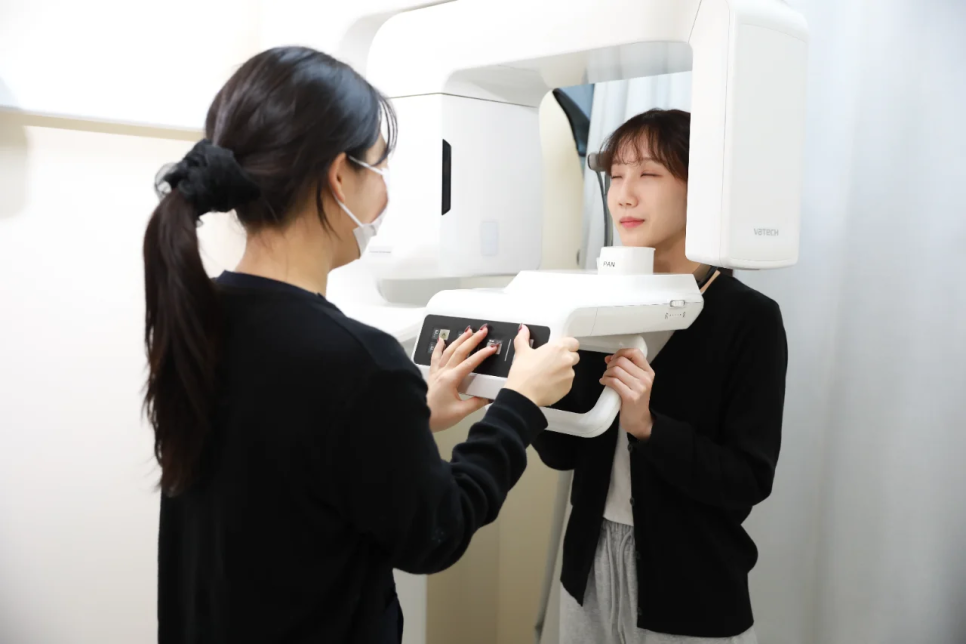
That is why the first step is to examine the inside using a detailed test such as 3D CT and identify what caused the problem.
Second, the stage of waiting for healing after removal.
Depending on the situation, the existing implant may be able to be preserved, or removal may be necessary.
If removal is necessary, it is generally considered more stable to allow time for the jawbone to recover rather than placing another implant immediately.
Third, whether bone grafting is needed.
If bone loss is extensive, the process may be more complex than when the implant was first placed, and bone grafting may also be necessary.
It is worth checking whether the clinic informs you of this possibility in advance.
To reduce the chance of later saying, “I didn't know it would be like this,” it is better to receive a sufficient explanation from the beginning.
In particular, systemic risk factors are an aspect that is surprisingly often overlooked.
According to research, the risk of implant failure in smokers has been reported to be approximately 2.4 times higher, while the risk of developing peri-implantitis has been reported to be approximately twice as high.
In people with diabetes, the risk of failure has also been reported to be approximately 1.8 times higher.
This means that not only the condition inside the mouth but also the body's overall condition can affect the outcome.
For reference, peri-implantitis is known to occur in up to 20% of patients and in approximately 30% of implants.
That means it is not as rare as you might think.
Therefore, whether the clinic identifies lifestyle habits and overall health in advance and establishes a management plan is a much more important sign than simply being “a place that places implants well.”
A clinic that explains all four of these points sufficiently is, at the very least, not one that skips steps.
Conversely, if the discussion immediately turns to the procedure without these explanations, you may want to take another moment to think it over carefully.
The Sequence Comes First — “Identify the Cause First” Rather Than “Place It Again Immediately”
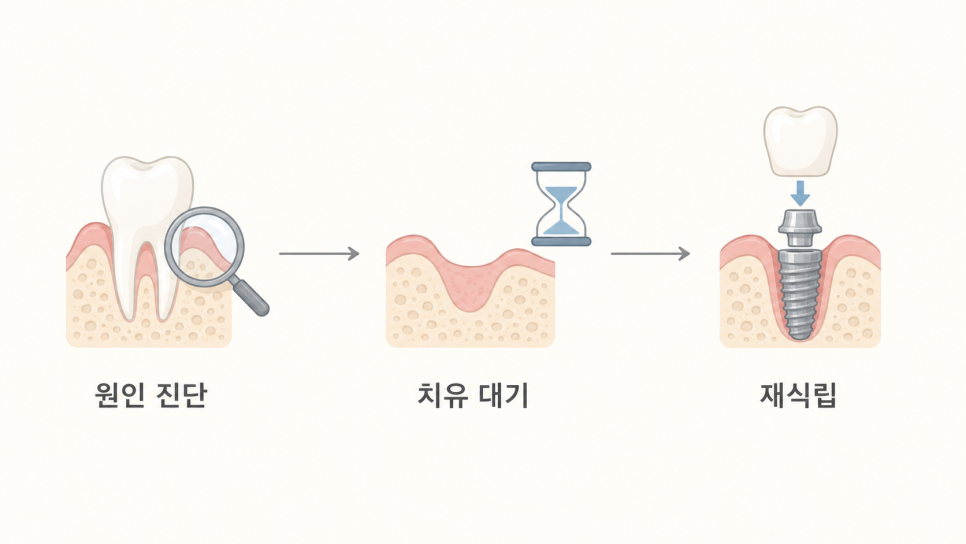
Finally, what I hope you will remember is that this ultimately comes down to the order of the steps.
If the process begins with “Let's just place it again right away” without diagnosing the cause, you are taking on the same risk again.
Although it may look fast and straightforward on the surface, internally you may end up repeating the same anxiety.
On the other hand, if the process begins with “Let's first find out why it failed,” that itself is a sign of a careful approach.
Although it may seem like taking a detour, it may actually be the fastest route.
What you need now is not to rush into deciding on surgery.
Before deciding on reimplantation, make sure the cause of failure is properly identified.
Simply going through this one step can significantly reduce the anxiety of wondering, “Could I be put through the same thing again?”
There is no need to rush the decision to place it again; you can make that decision calmly afterward.
It may be helpful to save the points summarized today and check them one by one when you receive an examination.