Hello, this is Ceramic Dental Clinic, a dental clinic in Nonhyeon.
You may have easily anticipated, from the patient’s perspective, at least hearing the words, “You need an implant.”
But as you looked into it, you may have come across something called “navigation-guided implants,” and heard that it can sometimes involve an additional cost.
Is it really necessary to pay extra for this?
How is it so different from a regular implant?
This post looks at whether navigation-guided implants are truly worth the cost and in which situations they may be meaningful.
How do conventional implants get placed in the “bone you cannot see”?
An implant is a treatment in which a post is placed inside the bone beneath the gums, rather than above the gums.
The problem is that the bone beneath the gums differs from person to person. There are significant individual differences in the height and density of the bone, as well as in how close the inferior alveolar nerve running through the lower jaw or the maxillary sinus in the upper jaw is.
However, once the procedure begins, it is not possible to see all of the bone directly with the naked eye.
Important structures that are not easily visible, such as nerves and blood vessels, may pass through the deeper areas where the drill enters. With the conventional approach, the clinician partly estimates the location of these invisible areas based on the experience and sense developed over many years.
This is not meant to frighten you. It is a method that has become established through long-term clinical experience. However, the fact that “the implant is not placed while seeing everything inside the bone” is the starting point for the navigation-guided approach discussed next.

Navigation-guided treatment allows the previously “invisible” areas to be viewed in advance
Navigation-guided implant treatment involves looking at and planning the previously invisible areas in advance.
First, a CT scan (CBCT) is used to examine the nerves and the shape of the bone in three dimensions, and the implant’s position, angle, and depth are virtually planned in advance. The procedure is then performed with assistance to place the implant in the planned position.
This difference has also been confirmed in actual research. A meta-analysis analyzing 5,673 implants reported that computer-assisted placement had greater three-dimensional accuracy relative to the planned position than placement performed by hand alone.
| Category | Conventional (freehand) approach | Navigation-guided (computer-assisted) approach |
|---|
| Examination of structures inside the bone | Difficult to view directly during the procedure | Examined and planned in advance using CT |
| Position determination | Greater reliance on the clinician’s experience and sense | Based on the planned coordinates |
| Positional accuracy (research) | Reference value | Reported as relatively higher |
Do not misunderstand this. It does not mean that “the margin of error is zero.” In the same study, the average error was approximately 1.1 mm at the entry point, approximately 1.4 mm at the endpoint, and approximately 3.5 degrees in angle. The accurate way to understand it is not as perfection, but as an approach that increases predictability.
However, it is not necessary for everyone
This is the point I want to address most honestly.
As the figures above show, navigation-guided treatment does not have zero error, nor is it essential for every implant. If there is sufficient bone and the nerve is a safe distance away in a simple case involving a single implant, the conventional approach is often sufficient.
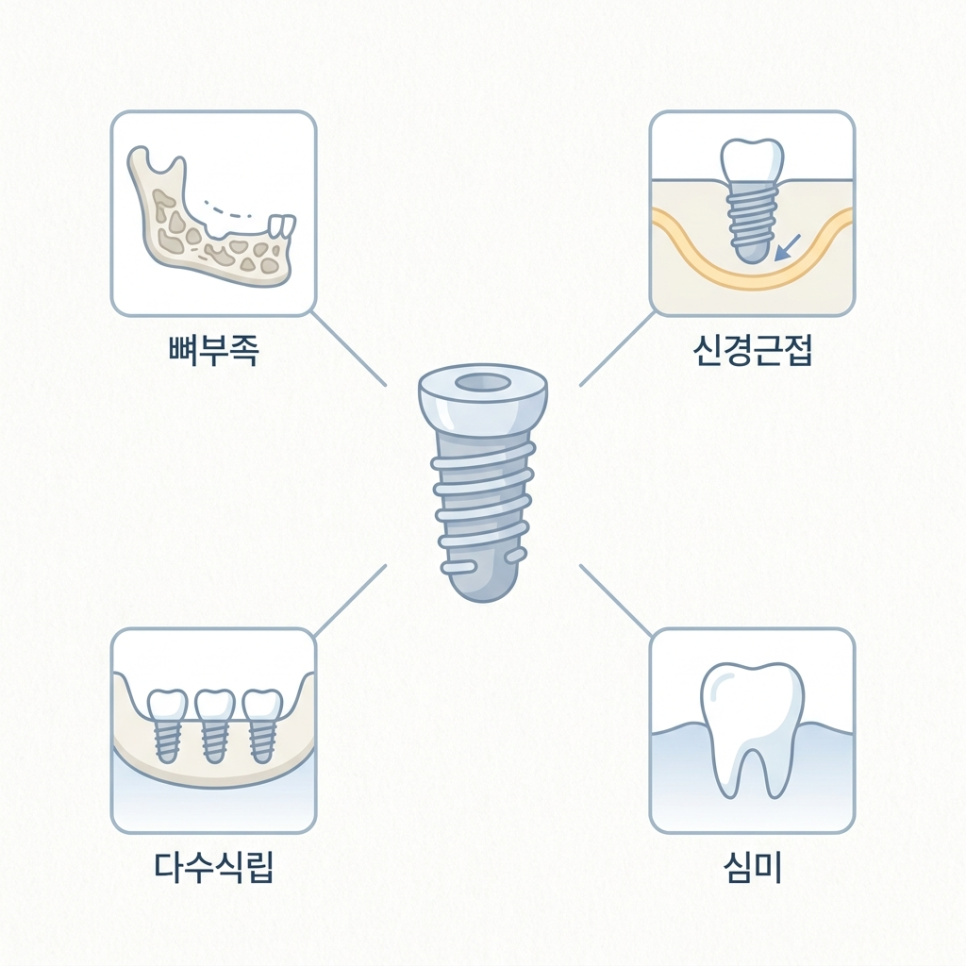
Then, in what situations may this approach be worth the additional cost? In general, these are the kinds of conditions:
-
When there is insufficient bone or bone grafting is also required
-
When the nerve or maxillary sinus is close and the position must be determined precisely
-
When several implants must be placed at once and their overall alignment needs to be coordinated
-
When esthetics are important, such as with front teeth, and the angle and position can greatly affect the result
The more complicated the conditions, the more reassuring it can be to receive a diagnosis at a clinic where multiple dentists review the images and examine the treatment plan together rather than relying on one person’s judgment. Even when looking at the same CT scan, this adds multiple perspectives to the interpretation.

Ultimately, the key question is: “Which situation does my mouth fall into?”
The advantages of navigation-guided treatment are fairly clear, but whether it is absolutely necessary is somewhat difficult to answer in general terms. The answer depends on how much bone remains and how close the nerve is, and this cannot be determined from outside the mouth.
The starting point for checking this is X-rays and CBCT imaging. Bone quality and quantity, as well as the distance from the nerve and maxillary sinus, can be assessed three-dimensionally. In particular, a virtual implant-placement image can be used to discuss in advance which approach is appropriate in your case. The radiation dose from CBCT is known to be lower than that of conventional medical CT, so a single scan for diagnostic purposes is generally not considered a significant burden.
Therefore, rather than deciding on your own whether you “should or should not have navigation-guided treatment,” the proper order is to first determine which of the two situations your oral condition falls into. Even if the result shows that the conventional approach is sufficient, that is still accurate information that can help you avoid unnecessary costs.
If you have been postponing implant treatment because you feel overwhelmed and tired from all the information you have encountered, why not visit a dental clinic in Nonhyeon this time with an open mind and start by hearing a simple explanation?