You may have typed “Are laminates possible in your 40s?” into the search bar, then paused for a moment at the question mark.
You clearly want to do it, but perhaps you also wondered, “Is it a little excessive to be looking into something like this at my age?”
However, more people in their 40s come to the clinic with the same concerns than you might expect. Discoloration of the front teeth, slightly visible gaps, or the shape of their teeth that has bothered them for years—these are common concerns.
Laminates are used for a wide range of situations, including discoloration, gaps between teeth, irregular tooth shape, and minor fractures. They are not limited to a particular age group; they are selected based on the condition of the teeth. Before you set the idea aside because you think it is too late, there is one thing worth considering.
Where does the feeling that “it probably won’t be possible at my age” come from?
Many people feel that “it won’t be possible because I’m in my 40s,” but when you look beneath that feeling, age itself is not actually the basis for it.
The real source is often vague speculation such as, “My gums probably aren’t what they used to be,” or “My teeth have aged too, so they must have become weaker.”
But these assumptions are closer to conclusions formed in advance than facts that have been directly confirmed. Without ever looking inside your mouth, you close the door first with the words, “It won’t work at my age.”
“What's the point? They’ll just tell me it’s not possible anyway.”
This thought makes you hesitate to search and even causes you to postpone a consultation. Yet the criteria that actually determine whether laminates are suitable are found somewhere slightly different from where you might expect.

What determines suitability is not your birth year, but the conditions inside your mouth
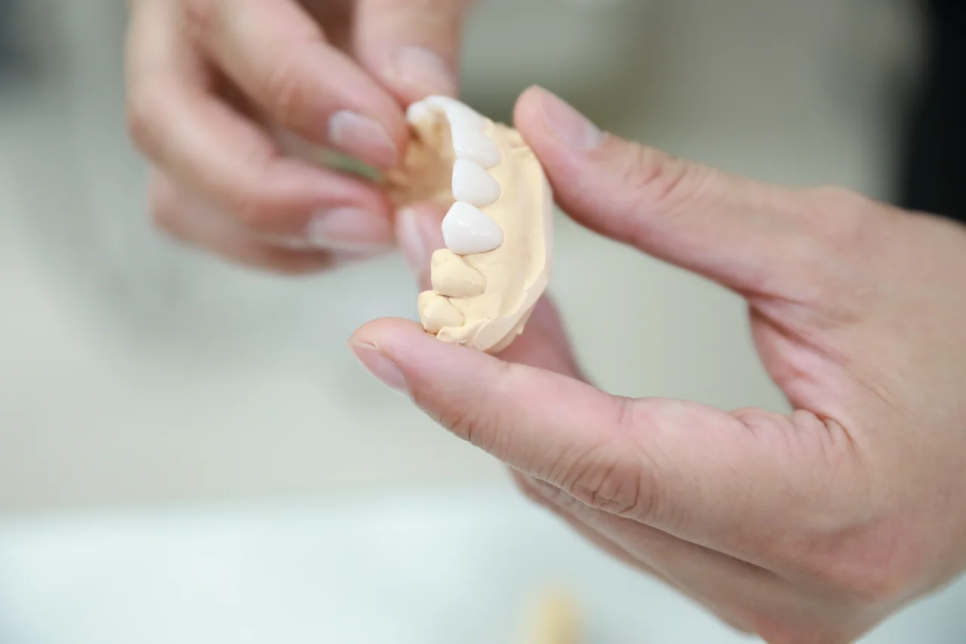
Laminates involve slightly reshaping the teeth—typically by about 0.5–1.0 mm—and bonding thin ceramic shells to them. These days, even less preparation may be performed, or no-preparation laminates may be used. Because the ceramic is bonded to the enamel—the hard outer layer of the tooth—the bond is more stable when sufficient healthy enamel remains.
So what is actually examined is not the year you were born, but the current condition of your mouth. There are three key factors.
| What is examined | Why it matters |
|---|
| Gum (periodontal) health | Healthy gums contribute to stable bonding and a stable course afterward |
| Amount of remaining enamel | Since this is the surface to which the ceramic is bonded, healthy enamel needs to remain |
| Occlusion (how the teeth meet) | The force created when the upper and lower teeth meet is assessed, and occlusal adjustment may be included in the procedure |
These three factors vary from person to person and from tooth to tooth, not according to age. Even in your 40s, laminates may be considered if your gums, enamel, and bite are in good condition. Conversely, even younger people may be advised to choose another method if their conditions are not suitable.
In other words, “It is not your age that is examined, but these factors.” And because these are things that must literally be examined directly, no one can tell you “you can” or “you cannot” based on a search alone.

However, there are some things that should be examined more carefully in your 40s
If you have read this far and felt relieved, thinking, “Then I may be able to do it too,” I should also share the honest part of the story.
It is true that people in their 40s start from a slightly different place than people in their 20s. But that does not mean “it is not possible.” It is more accurate to say that a preliminary check can make the process safer.
-
If you have periodontal disease or severe teeth-grinding or clenching habits, laminates may not be suitable. This does not mean simply ruling them out; it means checking your condition first and addressing gum care if necessary.
-
Reshaping the teeth is irreversible. Therefore, it is important to consider the decision carefully at the outset, or to choose a no-preparation approach where appropriate.
-
Complications may include ceramic fracture or debonding, discoloration along the margins, and tooth sensitivity.
-
If the teeth are excessively misaligned, orthodontic treatment or crowns may be a more appropriate choice than laminates.
The reason for addressing these points openly in advance is that you ultimately need to understand where your own case falls before you can make a comfortable decision. In most cases, these are manageable issues if the condition is checked in advance and any necessary care is provided. If you have previously received resin or crown treatment, that history should also be taken into account.

To know whether laminates are suitable, your own teeth need to be examined
To summarize, being in your 40s is not a factor that determines whether laminates are possible or impossible. What is actually examined is your gums, enamel, and bite, and the answer can only be determined through a direct examination.
When proper care is provided, the outcome is generally considered relatively stable. Some sources report that porcelain (ceramic) laminates last an average of 5–10 years when properly maintained, with a cumulative 10-year survival rate of approximately 95.5%.
However, because fractures or debonding can occur within the first few years after bonding, regular care afterward may be even more important than the procedure itself.
Because of these characteristics, there is one thing worth keeping in mind when choosing where to receive a consultation. Laminates require an overall assessment of the gums, enamel, and bite, and in some cases orthodontic or gum treatment may also be necessary.
That is why it may feel more reassuring to consult a clinic where doctors from several areas of dentistry work together,
and where your condition continues to be monitored over the long term even after the procedure is complete.
After all, this is not a treatment that ends once the laminates are bonded; it is something you will use and care for together over several years.
Instead of deciding on your own that laminates are or are not possible, consider simply taking a look at the current condition of your gums and teeth. That is something you can do even before making a decision. At least, being in your 40s is not by itself a reason to put it off.
If you have only been postponing it for reasons that do not really apply, how about considering a small gift for yourself this time—after spending all these years focused on moving forward?