Hello, this is Hakdong Station Ceramic Dental Clinic. Today, we would like to provide an overview of open bites. Since we are covering the topic broadly, we cannot go into every detail, but we hope this can serve as a starting point for finding more detailed information.
First, even when the condition is the same open bite, there is not just one orthodontic approach. Depending on how much of the front teeth is visible when smiling and on the position of the molars, the approach may differ: should the front teeth be moved downward so that they make contact, or should the molars be moved upward so that the front teeth meet instead?
We will go through this step by step for those who have felt discomfort because their front teeth do not come together, or who have been diagnosed with an open bite and are wondering what type of orthodontic treatment they may undergo.
What Is an Open Bite?
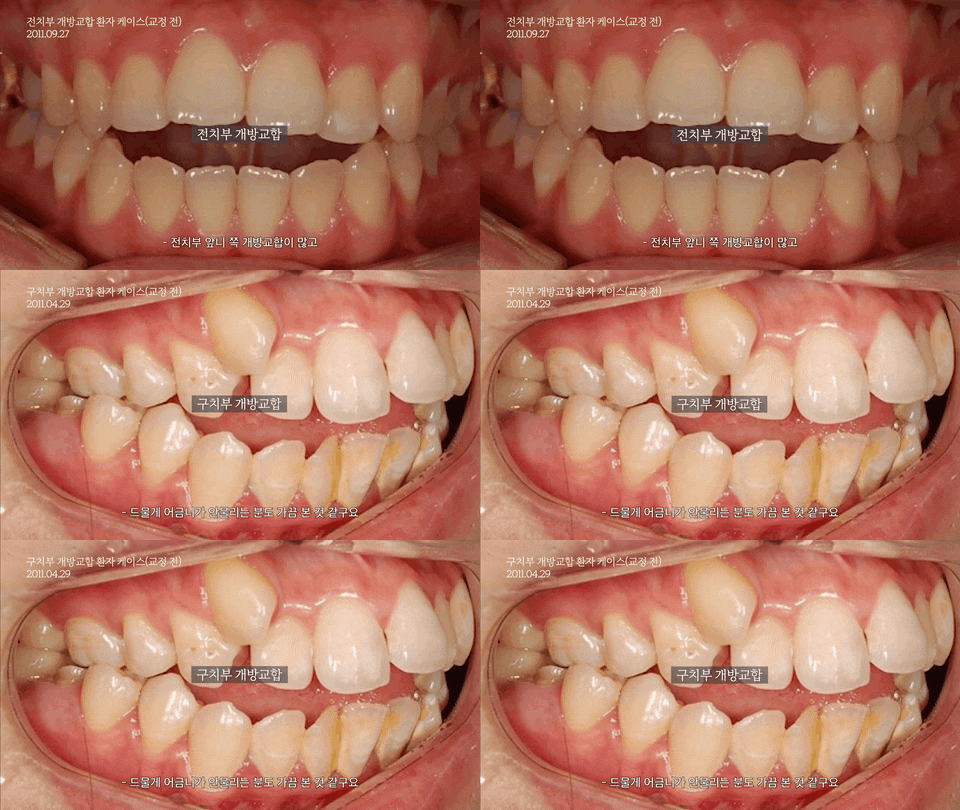
An open bite refers to a condition in which the upper and lower teeth remain open without touching in a particular area.
The most common form is an anterior open bite, in which the front teeth do not make contact. More rarely, there is also a posterior open bite, in which the molars do not come together.
An open bite may also be observed together with protruding teeth or a receding lower jaw, and sometimes with a protruding lower jaw. Since the treatment plan can differ depending on whether the problem is limited to the teeth or also involves skeletal factors such as the proportions of the facial bones, identifying the type of open bite is the starting point.
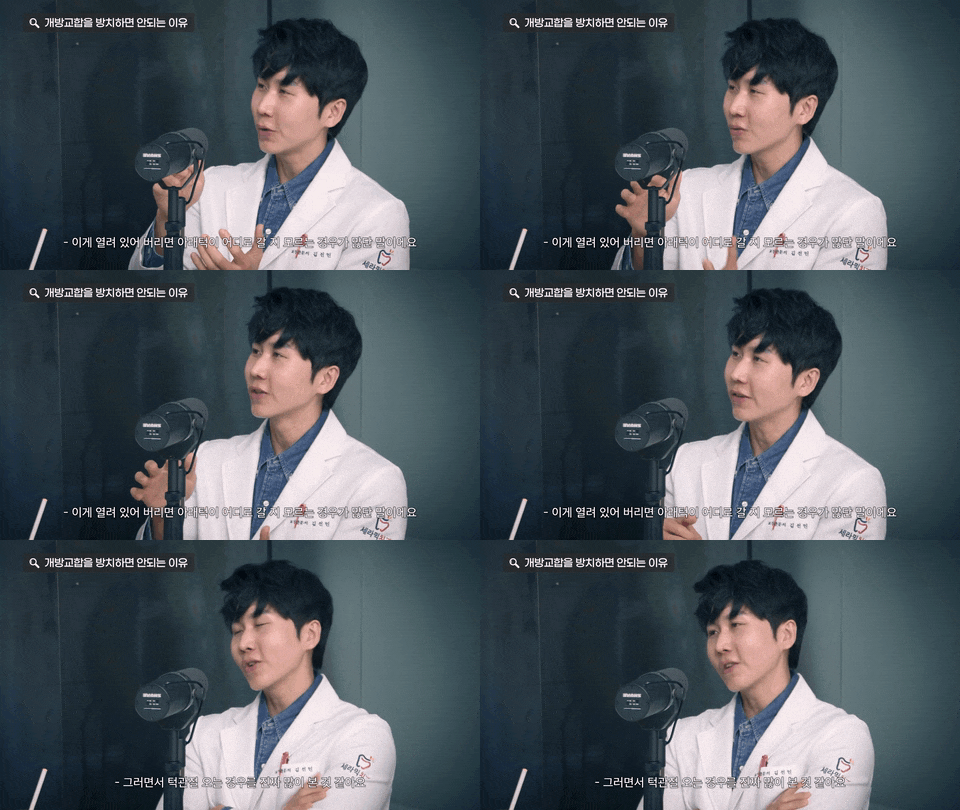
Then, if the teeth remain unable to make contact, what kind of strain can develop in the remaining teeth and jaw?
Problems That May Occur When Force Is Concentrated on the Molars
For the bite to be stable, the molars and front teeth need to come together properly at the same time.
When the front teeth remain open, there is no reference point for positioning the lower jaw, which can make the jaw position unstable. In this process, discomfort in the jaw joint is also relatively common.
What happens when only the molars continue to make contact? As chewing force becomes concentrated in that area, the following issues should also be considered.
-
Severe wear of the teeth in that area
-
Periodontal problems, such as deterioration of the gums
-
A jaw joint that may become sensitive
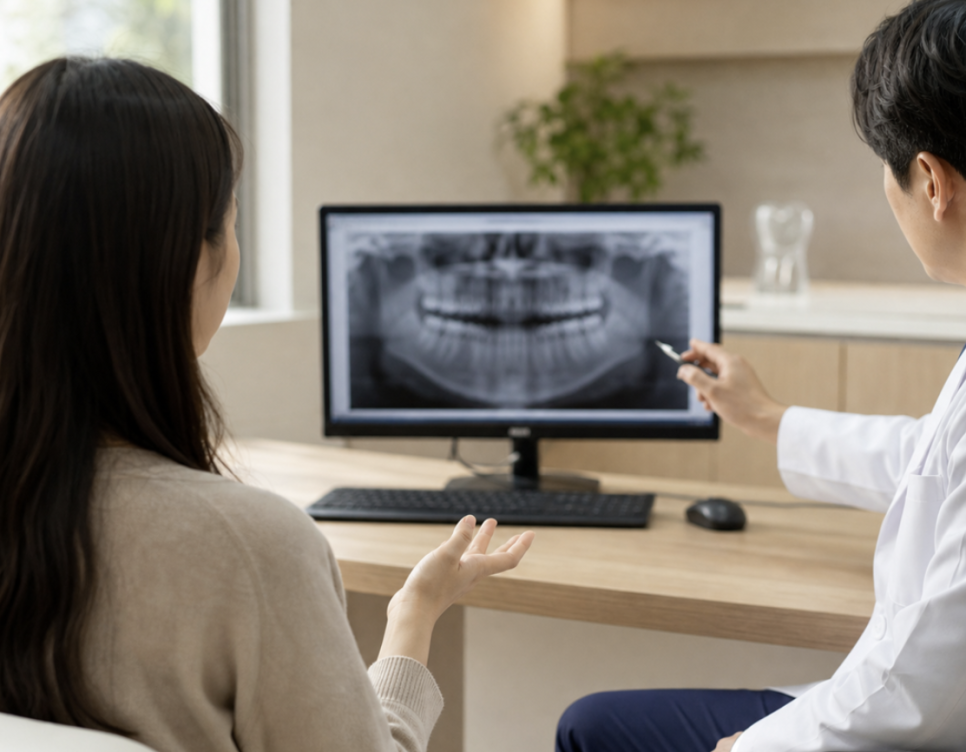
“I'm not in pain right now. Do I really need to have it checked?”
Even without pain, it is a good idea to have the condition examined in advance if the structure places excessive strain on particular teeth. An open bite is known to tend to progress over time, so if it is discovered at a young age, an early evaluation may be helpful from the perspectives of dental health and the jaw joint.
However, treatment does not simply involve closing the open area indiscriminately. The first step is to determine whether the cause lies in the teeth or in the skeletal structure. People who have previously experienced jaw joint problems may be sensitive even to minor stimulation, so the treatment plan is established after evaluating this aspect as well and identifying ways to break the chain of factors that could lead to worsening symptoms.
Should the Front Teeth Be Lowered, or Should the Molars Be Raised?
One important factor in determining the direction of open-bite orthodontic treatment is how much of the front teeth is visible when smiling.
| Category | Moving the front teeth downward | Moving the molars upward |
|---|
| Conditions considered | Cases in which little of the front teeth is visible when smiling | Cases in which the front teeth are already highly visible and the molars have descended |
| Nature of movement | Movement that brings the teeth out of the gums | Movement that pushes the teeth toward the gums |
| Difficulty | Relatively easier | Relatively more difficult and may take longer |
| Additional appliances | — | Additional appliances such as miniscrews may be needed |
If little of the front teeth is visible, moving the front teeth downward so that they make contact may be considered. If the front teeth are already sufficiently visible but the molars have descended, the approach may be to raise the molars so that the front teeth meet.
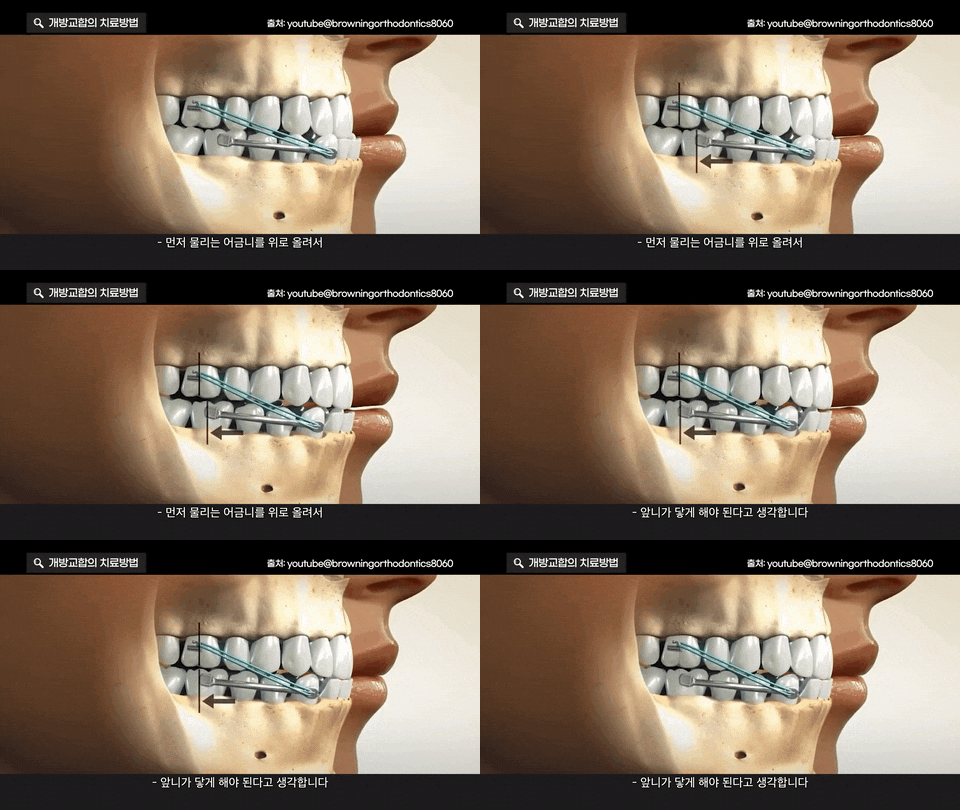
However, moving teeth into the gums is more difficult than moving them outward. For this reason, orthodontic treatment to raise the molars may take longer, and the molars may require the assistance of an appliance such as a miniscrew rather than moving upward simply by applying force to the teeth.
If the degree of front-tooth exposure is within the normal range, raising the molars may also be considered in light of a long facial profile. Ultimately, this means that even with the same open bite, the treatment plan can differ from person to person.
Tongue-Thrusting Habits and Each Patient’s Bite Must Also Be Evaluated
There are times when looking only at the teeth and skeletal structure is not enough. Daily habits that continue to affect the teeth during treatment are especially important, with tongue thrusting being a representative example.
When the teeth and tongue compete for force, the tongue wins. If the tongue continuously pushes the teeth outward, spaces may develop between the teeth and this can affect the open bite. Therefore, it is important to assess and control this habit as part of treatment.
In such cases, a tongue-thrust prevention appliance, also known as a tongue spur, may be used. Some appliances are fixed to the teeth, while others can be inserted and removed. In either case, consistently wearing or using the appliance for a certain period is important.
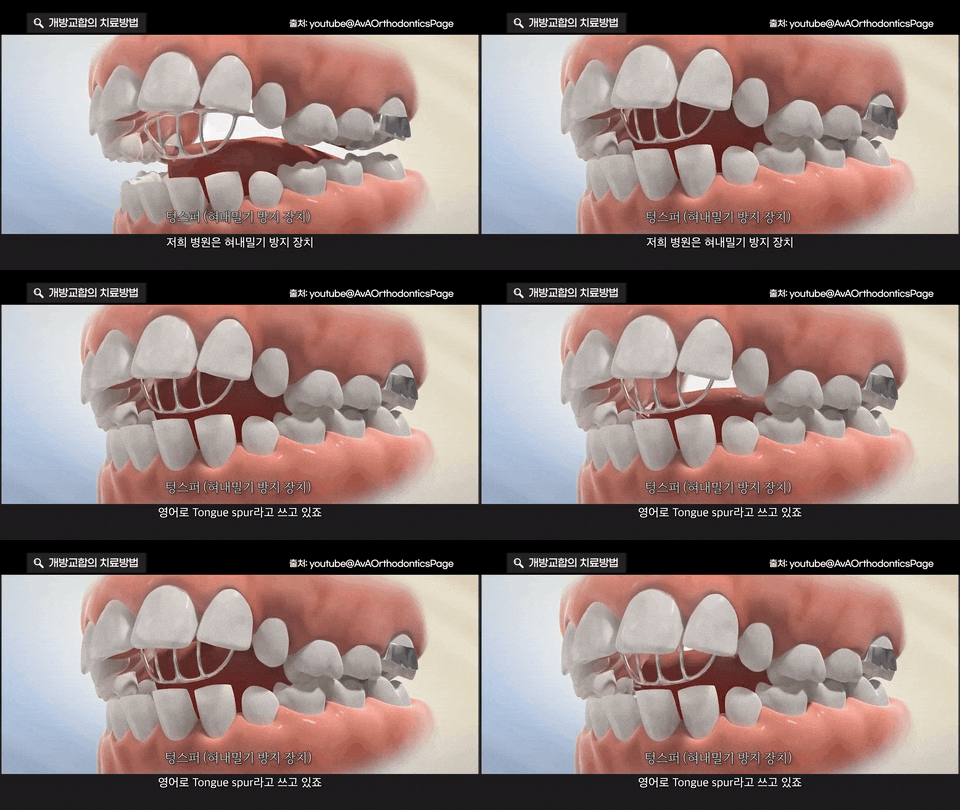
Actual treatment plans differ from patient to patient.
-
Cases in which a prevention appliance was used because the tongue-thrusting habit was severe
-
Cases treated together with extraction orthodontics because protruding teeth were also present
-
Cases in which the lower jaw was positioned too far back and the molars were severely worn, requiring treatment to restore the height of the damaged teeth alongside orthodontic treatment
-
Cases of a posterior open bite in which only the front teeth make contact and the molars remain open
A posterior open bite tends to occur when there is a severe upper–lower jaw malocclusion or a narrow skeletal structure, so the skeletal condition is also evaluated in these cases.
As shown above, the choice of appliances, whether extractions are needed, and whether dental restorations should be performed at the same time all depend on the individual condition. Please also keep in mind that the rate of change or the length of appliance use in a particular case does not apply equally to everyone.
People whose jaw joints have been sensitive in the past may also be more sensitive to stimulation during orthodontic treatment, so moving the teeth at a pace that does not place excessive strain on the jaw is another important consideration.
Why an Individual Diagnosis Is Necessary
In summary, there is no single formula for determining the direction of open-bite orthodontic treatment.
-
Whether the open area is in the front teeth or the molars
-
Whether the cause lies in the teeth or the skeletal structure
-
How much of the front teeth is visible when smiling
-
Whether habits such as tongue thrusting are present
-
What condition the jaw joints are in
Only after evaluating all of these factors together can it be determined whether to move the front teeth downward, raise the molars, or use appliances or extractions.
People with an open bite may experience everyday inconveniences, such as difficulty biting through noodles like ramen or cold noodles with their front teeth. The process of creating a bite in which the front teeth come together properly is also connected to these functional aspects.
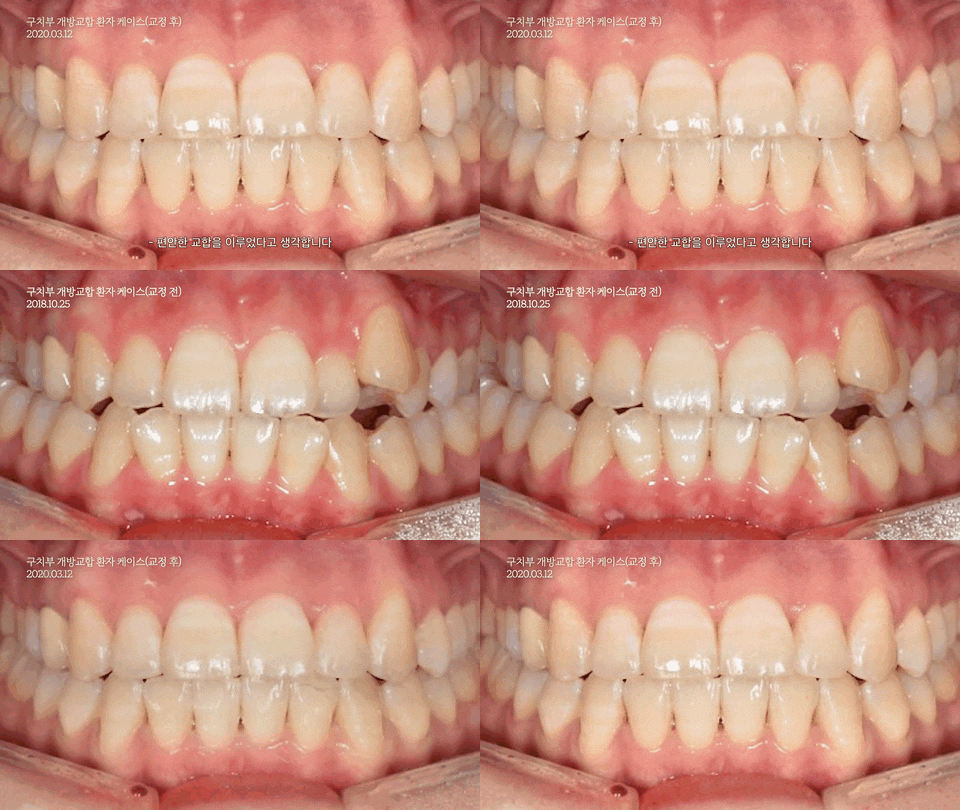
If you are concerned that your front teeth do not make contact, it may be a good idea to visit a dental clinic that can identify the approach suited to you through an individual diagnosis evaluating all five factors above—teeth, skeletal structure, front-tooth exposure, habits, and the jaw joints.
If your open bite has been causing you significant concern, why not visit a dental clinic this time and hear the opinion of a dental specialist?