Hello, I am Dr. Sun-min Kim, the director of a ceramic dental clinic near Hakdong Station. Today, I would like to introduce a case involving the correction of prominent upper front teeth in a male patient in his early 20s.
The patient felt self-conscious because his upper teeth appeared to protrude when he smiled, so he was unable to laugh openly in front of others. He visited us with the earnest wish to “gain confidence through orthodontic treatment,” and the changes before and after treatment were truly dramatic. I will explain the process in detail below.
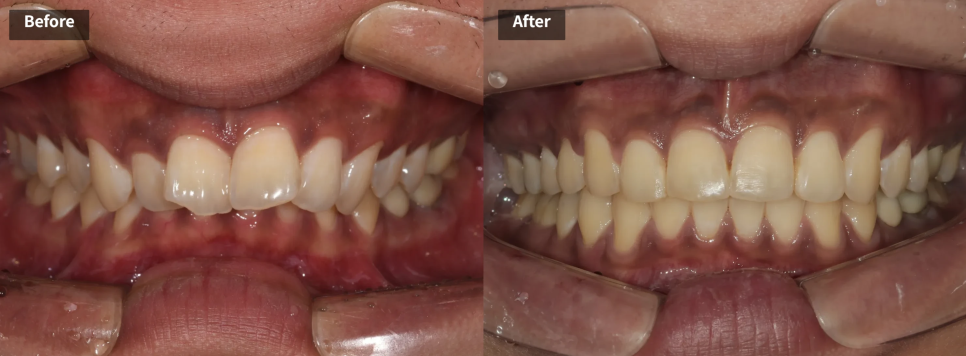
Introduction: A Man in His 20s Concerned About Prominent Front Teeth and Confidence
As mentioned, this patient visited us because of protruding upper front teeth. He said that he had avoided laughing openly for a long time because he was uncomfortable with his front teeth being excessively visible when he smiled.
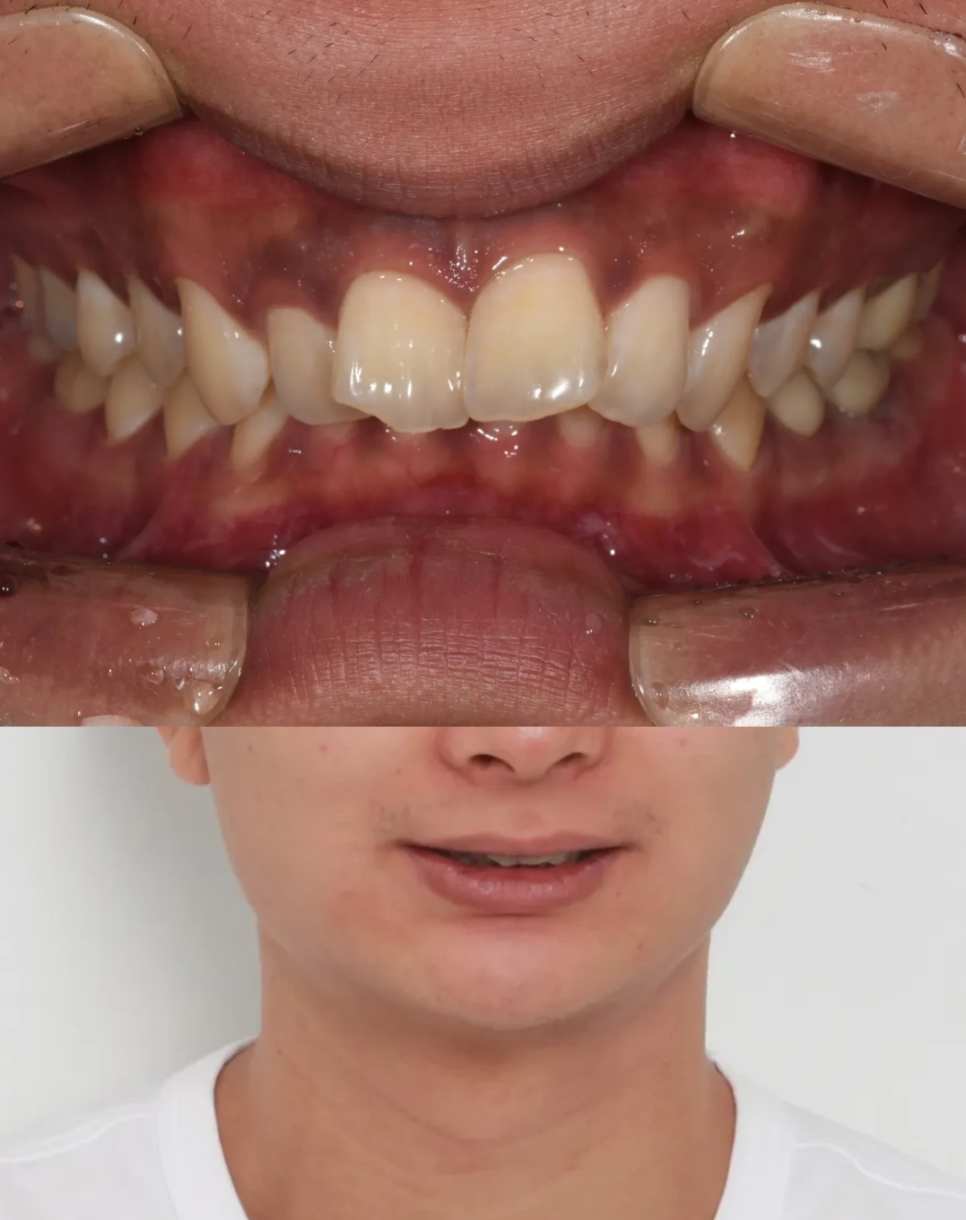
In fact, the pre-treatment facial photographs show that almost none of his teeth were visible even though he was smiling. This shows how deeply ingrained the habit of consciously keeping his mouth closed while smiling had become. The primary goals of this treatment were to improve his smile through orthodontic treatment and restore his self-esteem.
Diagnosis: What Problems Were Present?
A detailed examination showed that several issues were present in the patient’s dentition. It was important not simply to conclude that “the front teeth protrude,” but also to identify the underlying causes.
| Problem | Description |
|---|
| Labial inclination of the upper front teeth (prominent front teeth) | The upper front teeth were tilted forward, toward the lips, making them appear protruded |
| Mandibular retrusion (small lower jaw) | Because the lower jaw itself was small, the upper teeth appeared relatively protruded; this was a skeletal factor |
| Deep bite | The upper front teeth excessively covered the lower front teeth |
| Lack of contact between the front teeth | The upper and lower front teeth did not normally touch, causing the teeth to erupt upward (extrusion) |
| Impacted wisdom teeth | Wisdom teeth were present but hidden beneath the gums |
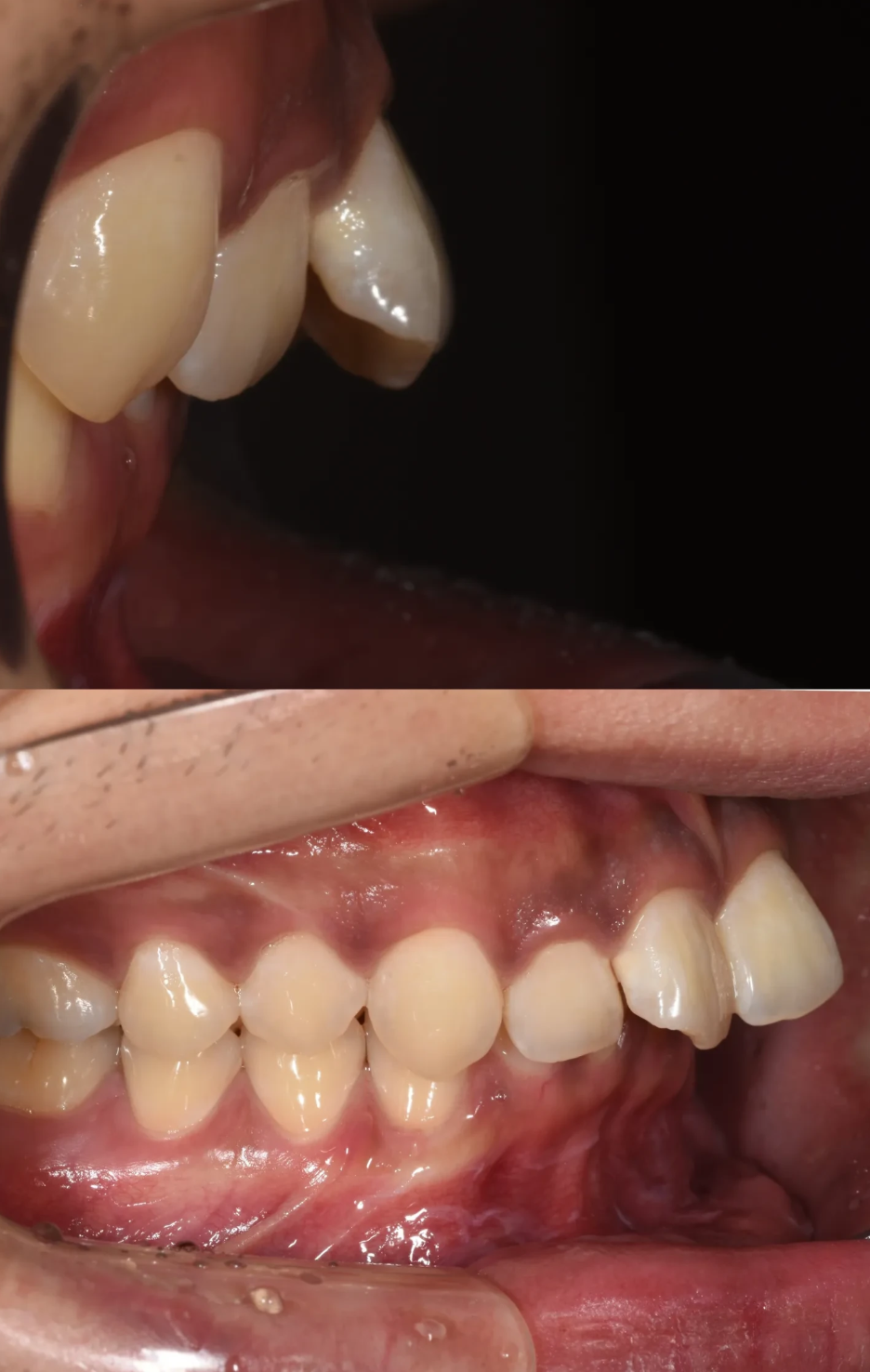
The key cause was the small lower jaw. Because the lower jaw was positioned farther back, the upper and lower front teeth did not touch. As the teeth rose compensatorily in an attempt to make contact, the deep bite and protrusion of the front teeth became more pronounced. In addition, the front teeth had become irregularly arranged because there was no balancing outward pressure from the tongue, while inward pressure from the lips remained.
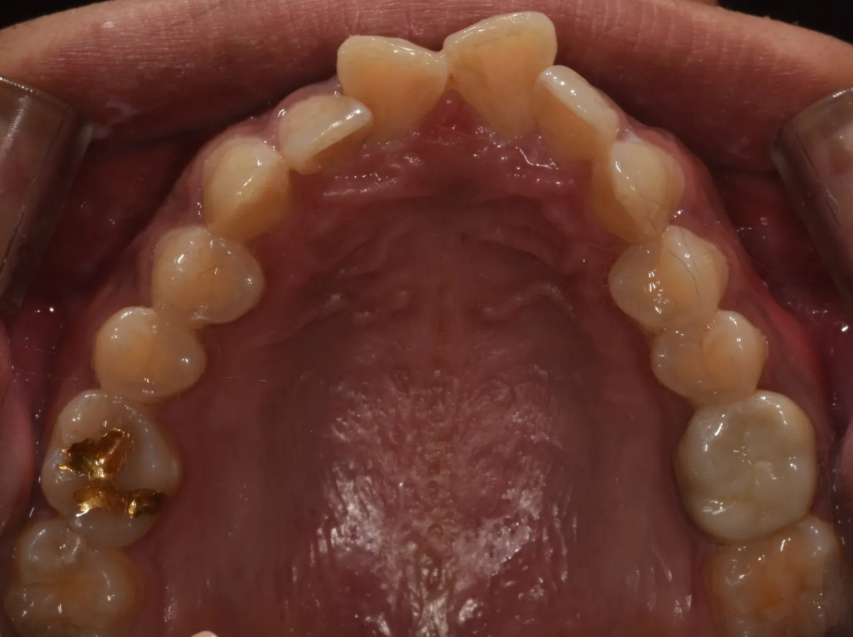
Upper dental arch – a narrow arch with the typical prominent-front-teeth arrangement in the anterior region
Treatment Plan: Wisdom Tooth Extraction Instead of Premolar Extraction
One of the most important decisions in orthodontic treatment is whether to extract teeth and, if so, which teeth to remove. In this patient’s case, we initially considered two options: premolar extraction and wisdom tooth extraction.
Final Decision: Extraction of Only the Upper Wisdom Teeth (Effectively Non-Extraction Treatment)
I will explain why the premolars were not extracted. In patients like this one with a small lower jaw, moving the upper teeth too far backward can actually create additional problems.
| Risks of Premolar Extraction | Advantages of Wisdom Tooth Extraction |
|---|
| Excessive backward movement of the upper teeth → risk of a flattened facial profile | Controlled backward movement → preservation of natural lip volume |
| The front teeth may tilt too far inward | The front teeth can maintain a natural inclination |
| Reduced lip volume can cause the lips to fold inward | Preservation of midface volume helps maintain a youthful appearance |
| This amounts to adapting the teeth excessively to an abnormal feature (the small lower jaw) | A plan that considers the harmony of the entire face |
Simply put, pushing the upper teeth too far backward to match a small lower jaw can cause the lips to look sunken and may make the face appear older or overly flat. Therefore, we planned to extract only the upper wisdom teeth and bring the lower teeth slightly forward to achieve a harmonious bite.
Additional planned procedures were as follows:
-
Use of mini-screws (TADs): Move the upper teeth backward by only the controlled amount needed
-
Anterior bite plate (ABP): Rapidly resolve the deep bite at the beginning of treatment
-
Interproximal reduction (IPR): Manage spaces between the teeth (black triangles) that may occur after alignment
-
Estimated treatment duration: Approximately 24–30 months
Treatment Process, Stage 1: Bracket Placement and Deep Bite Correction
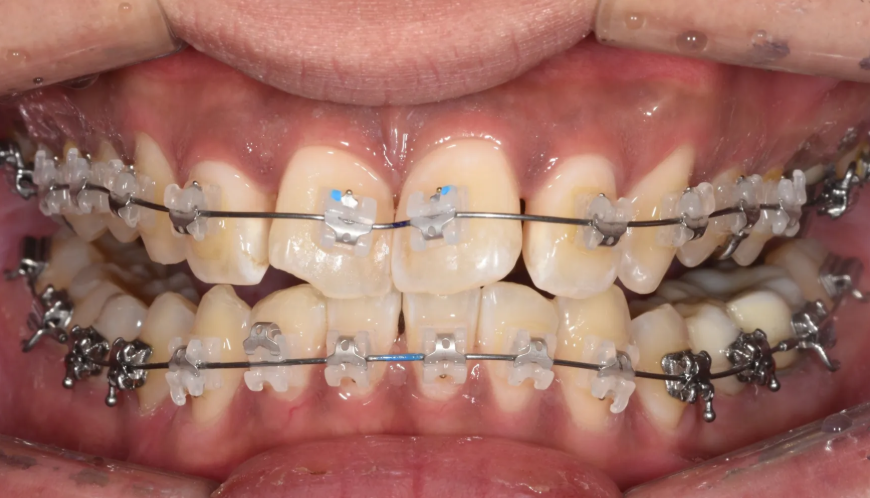
The first stage of treatment involved placing the appliances and correcting the deep bite. Ceramic brackets were placed on both the upper and lower teeth, and initial alignment was begun with light nickel-titanium (NiTi) wires.
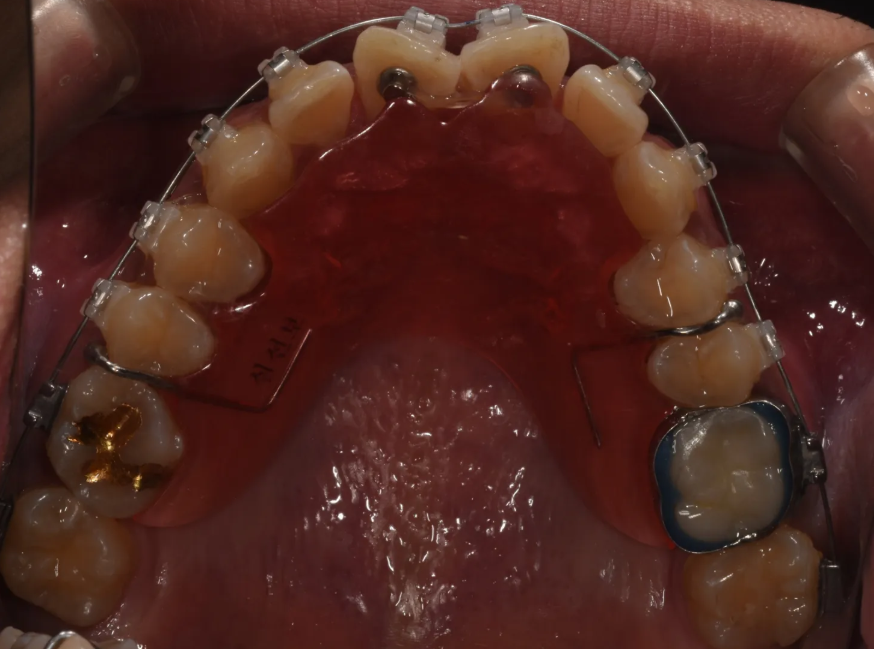
The key appliance used here was the anterior bite plate (ABP). This is a thin plastic plate attached to the palate. When the lower front teeth contact the plate, the molar area is lifted slightly and separated.
Role of the ABP
-
Immediately prevent contact between the upper and lower molars
-
Guide the lower front teeth downward (intrusion)
-
Gradually correct the overall deep bite
The deep bite must be opened first to make subsequent placement and alignment of the lower appliances much easier. The patient initially experienced slight difficulty with pronunciation, but adapted within one to two weeks.
Treatment Process, Stage 2: Backward Movement of the Upper Front Teeth Using TADs
Once initial alignment and deep bite correction had progressed to a certain extent, we began the stage of actively moving the upper front teeth backward. The key tool used at this stage was the mini-screw (TAD, Temporary Anchorage Device).
A mini-screw is a small screw placed in the alveolar bone and used as an absolute anchorage point. Normally, when teeth are pushed backward, a reaction force is generated that tends to move the molars forward. However, by using a mini-screw as the fixed point, the molars do not move at all, allowing only the desired teeth to be moved accurately in the desired direction.
-
Placement of mini-screws in the gum bone on both cheek-side areas
-
Replacement with rectangular stainless-steel wires to control the angle (torque) of the front teeth
-
En-masse retraction of all the upper front teeth using closed-coil springs
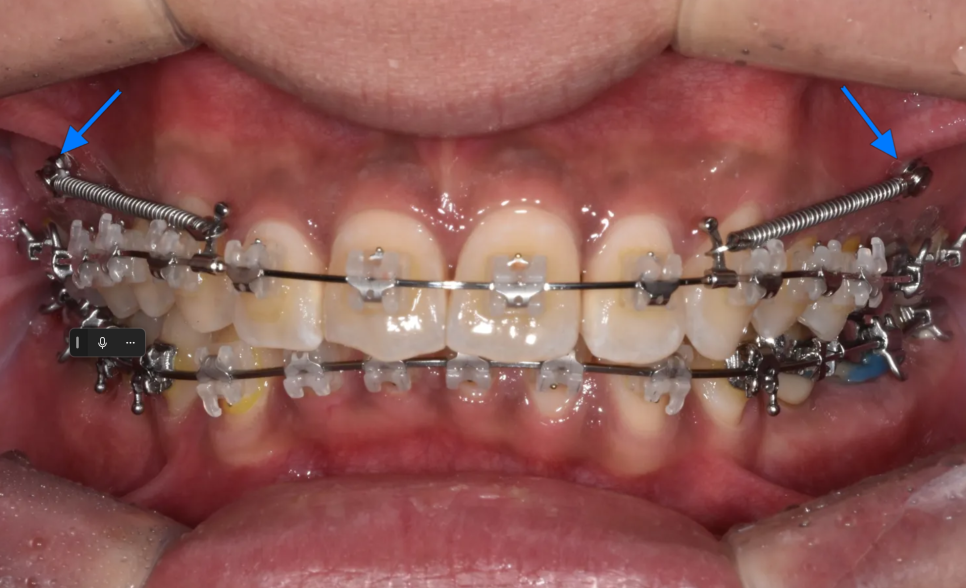
The upper front teeth being moved backward using mini-screws (arrows) as anchorage points
After several months of backward movement, the upper front teeth had nearly reached their target position. Both the horizontal distance between the upper and lower front teeth (overjet) and the vertical depth (overbite) had approached the normal range.
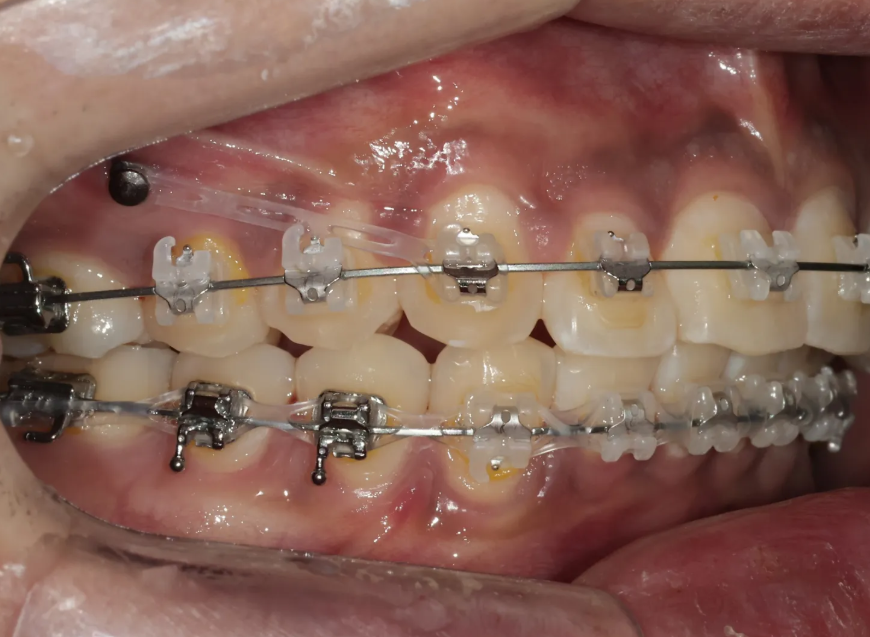
The upper front teeth have almost reached their normal position
Treatment Results: Before & After
After approximately two years of treatment, the appliances were finally removed and the final results could be assessed. The results can be summarized numerically as follows.
| Item | Before Treatment | After Treatment |
|---|
| Protrusion of the upper front teeth | Severe labial inclination (prominent front teeth) | Aligned at a normal angle |
| Horizontal distance (overjet) | Excessively increased | 2–3 mm (normal) |
| Vertical depth (overbite) | Excessive overbite (deep bite) | 20–30% (normal) |
| Molar relationship | Class II (lower teeth positioned backward) | Close to Class I (normal) |
| Midline | Misaligned | Well aligned |
| Remaining spaces | – | Completely closed |
After treatment was completed, a fixed retainer (3-3 retainer) was attached to the back surfaces of the upper front teeth to stabilize the aligned teeth and prevent them from shifting again.
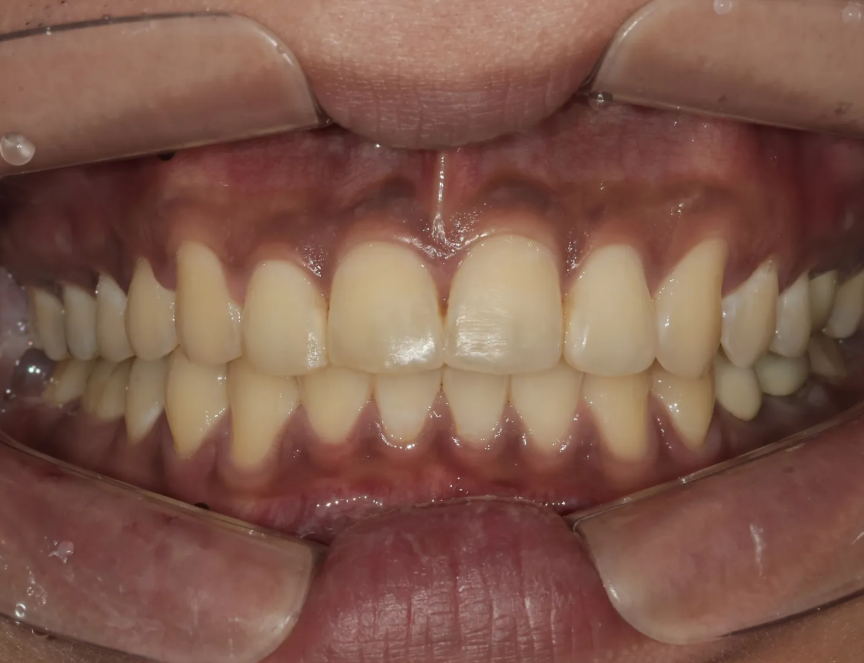
The dentition viewed from the front. The teeth are evenly aligned, and the bite is stable.
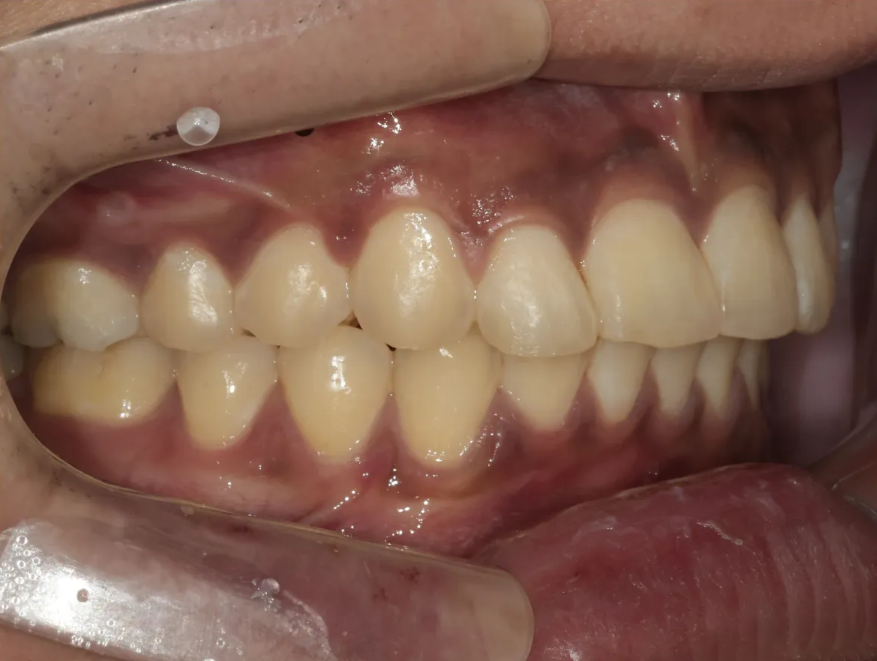
The molar relationship viewed from the side. A normal bite relationship can be observed.
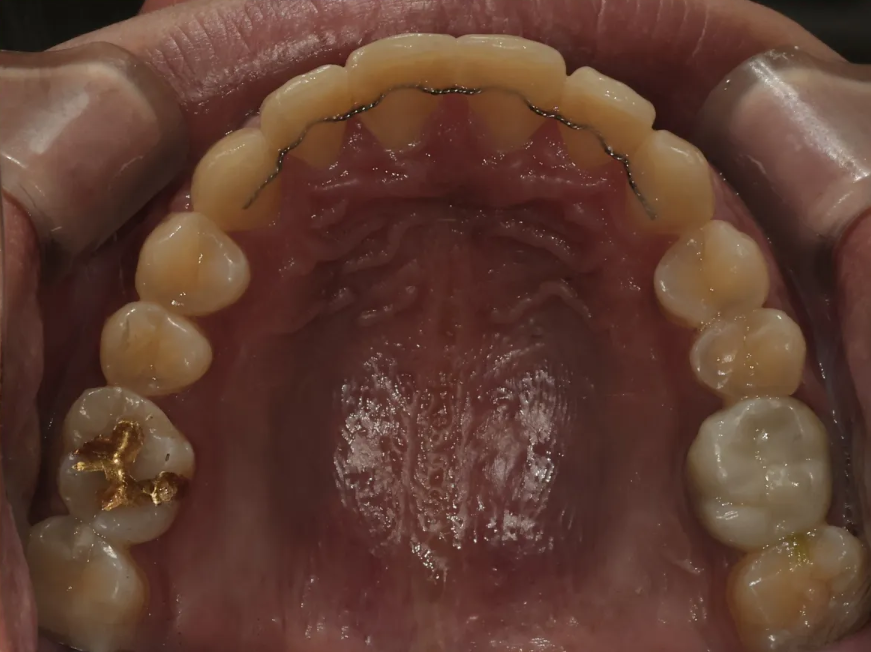
A uniform arch shape and the fixed retainer can be seen.
Most moving of all was the change in the patient’s facial appearance. He showed his teeth and smiled broadly with confidence—something he had never done before treatment.
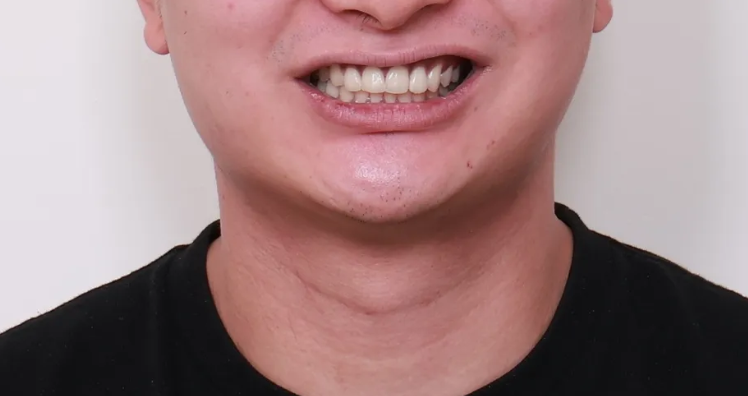
Smiling broadly and showing his teeth naturally. This change is truly meaningful.
Key Points of This Case
Here are the points I would especially like to emphasize from this case.
1. Extraction Is Not Always the Answer for a Small Lower Jaw
Patients with a small lower jaw (skeletal Class II) may seem likely to benefit from moving the upper teeth far backward, but in reality, beyond a certain point, this can make the face look overly flat or cause the lips to appear sunken. Excessively changing a normal feature (the upper teeth) to match an abnormal feature (the small lower jaw) is not desirable.
2. Preserving Soft-Tissue Volume in the Lips and Cheeks Is Important
The goal of orthodontic treatment is not simply to straighten the teeth, but to create harmony with the entire face. If the natural volume of the lips and fullness of the cheeks are not considered, the teeth may look attractive while the overall facial appearance becomes awkward.
3. TADs Can Enable Effective Backward Movement Without Extraction
Thanks to tools such as mini-screws, cases that once required premolar extraction can now be treated with non-extraction or minimal-extraction approaches.
4. Early Deep Bite Correction with an ABP Makes Treatment Easier
If lower appliances are placed while a deep bite remains, the upper teeth may bite into the lower brackets. Blocking this at an early stage with an ABP allows the entire treatment process to proceed much more smoothly.
Conclusion: For Those Considering Orthodontic Treatment
For those concerned about prominent front teeth or a protruding mouth, I would like to say that significant improvement is possible with orthodontic treatment. However, the most important part of the process is an accurate diagnosis.
Even when the concern is the same—“protruding front teeth”—the treatment approach can differ completely depending on whether the cause is skeletal or related to the teeth themselves. The decision about extraction should also be made carefully based on the desired final facial outcome, rather than extracting teeth automatically simply because there is insufficient space.