You may have been looking into veneers because you wanted to improve just your front teeth, only to close the search window when you read that "the teeth need to be filed down."
Then, a few days later, you found yourself searching for “partial orthodontic treatment.” You thought that if the issue could be resolved without filing down your teeth, that might be the better option.
There is just one thing left to check.
Is my case one in which partial orthodontic treatment is actually possible?
Today, I’ll organize the criteria that can help you get an initial sense of where you stand.

The Real Advantages of Partial Orthodontic Treatment
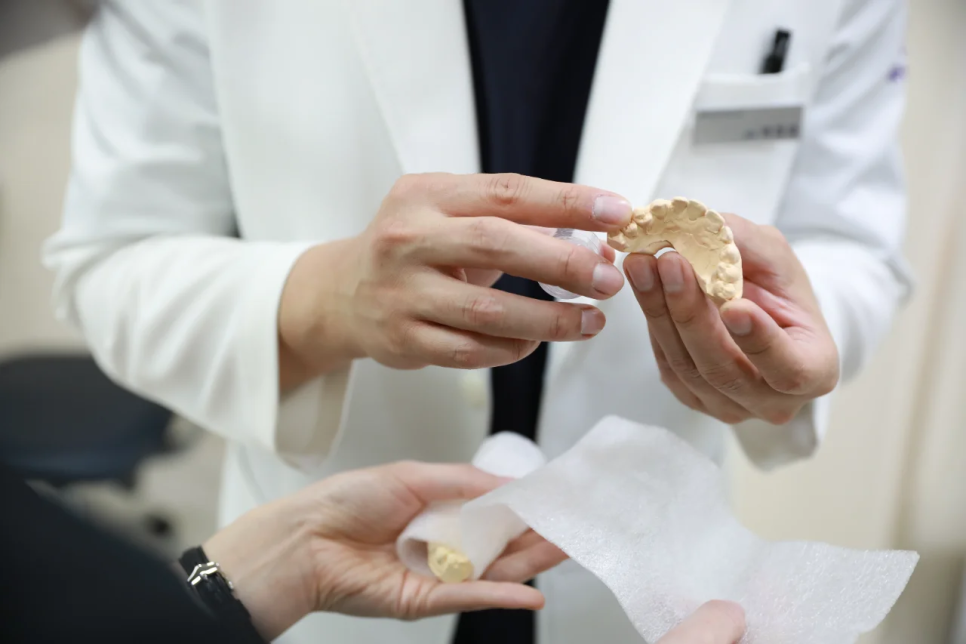
As the name suggests, partial orthodontic treatment moves only a limited section of the teeth rather than the entire dentition.
It may be considered when the problem is confined to a limited area, such as a gap between the front teeth or mild overlapping or rotation involving one or two teeth.
The greatest significance of this approach is that it preserves the natural teeth without filing them down. If you hesitated when considering veneers, this is probably the point that mattered most to you.
Because the range of movement is limited, partial orthodontic treatment generally takes less time than comprehensive orthodontic treatment. You may also have the option of choosing an appliance that is less noticeable.
So, if it is suitable for your case, it can be a reasonable option to consider.
The issue is the condition “if it is suitable.” Whether it can be used depends on the alignment of the teeth and the way the molars fit together, so this is where the main discussion begins.
Cases Where Partial Orthodontic Treatment May Be Possible — Compare Your Situation in the Mirror

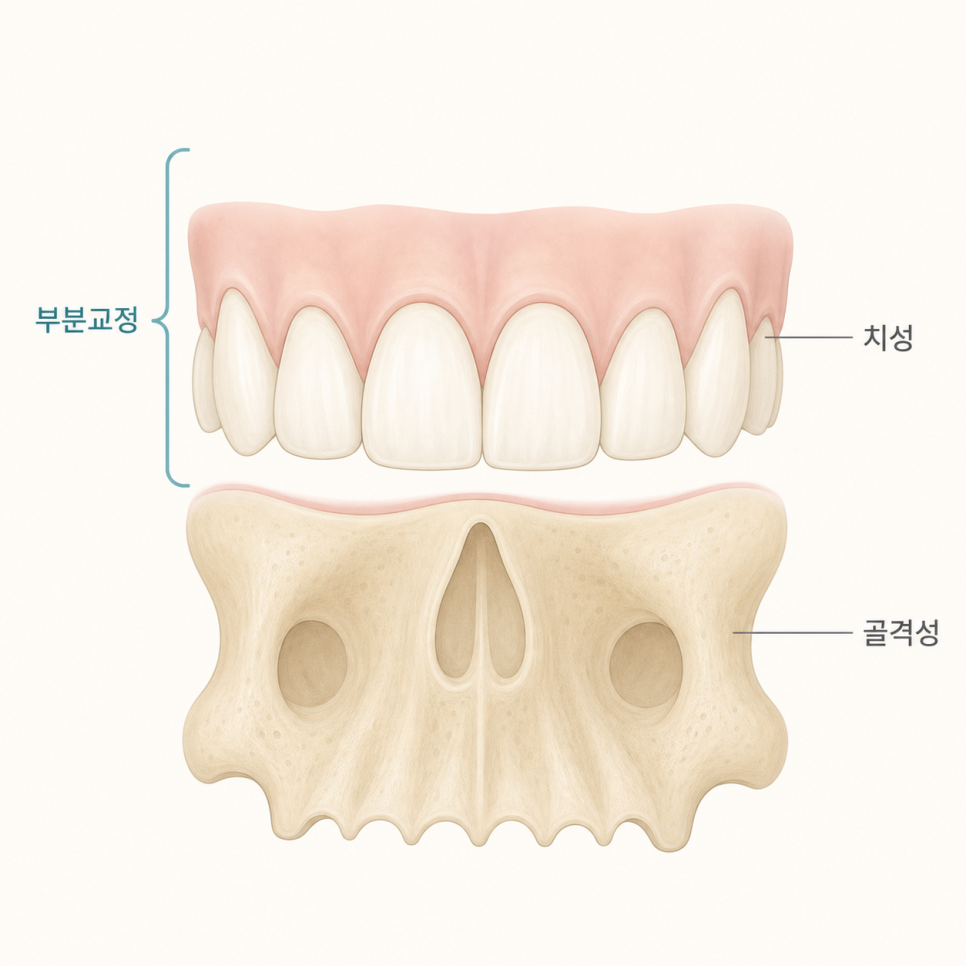
Malocclusion can broadly be divided into two levels. Dental malocclusion is a problem with the alignment of the teeth themselves, while skeletal malocclusion is a problem involving the jawbones.
Partial orthodontic treatment is considered when the problem is limited to the level of tooth alignment. Compare your situation with the following examples in the mirror.
-
One or two front teeth are slightly rotated or crooked
-
There is a slight gap between the front teeth
-
You had orthodontic treatment in the past, but only the front teeth have become crooked again
There is one common prerequisite in all three cases: the molars must fit together properly—in other words, the bite relationship must be stable.
The front teeth are the actors on the stage, while the molars are the stage itself. The idea is that a few actors can change positions only if the stage is in good condition.
If you have read this far and thought, “Oh, this might work for me,” be sure to read the next section as well.
However, If This Applies to You, the Situation Is Different
There are cases in which partial orthodontic treatment is difficult or may not produce the result you expect even if it is technically possible.
| Category | Situation | Why partial treatment may not be enough |
|---|
| Bite problem | The molars themselves do not fit together properly | Moving only the front teeth does not resolve the functional problem with the bite |
| Insufficient space | The teeth overlap severely, leaving no room for them to fit into | Adjusting the entire dental arch may be necessary to create space |
| Skeletal problem | The size or position of the jawbones is misaligned | This is a problem at a level that cannot be resolved by moving the teeth alone |
| Shape or color problem | The alignment is acceptable, but the cause is the shape, size, or discoloration of the teeth | Moving the teeth does not change their shape |
According to the Korean Association of Orthodontists, skeletal malocclusion refers to a condition in which the upper and lower teeth do not fit together properly even when the tooth alignment is good. When the skeletal discrepancy is significant, surgery may also be performed. This is especially true for adults who have finished growing. Problems at this level are outside the scope of partial orthodontic treatment from the outset.
And the fourth row of the table is the point people most easily overlook.
Having straight teeth and
looking attractive
are not necessarily the same thing.
If the reason you dislike your front teeth is not their “position” but their “shape, size, or color,” even perfectly aligning them through orthodontic treatment may not significantly change the impression you see in the mirror.
Problems involving excessive misalignment are generally within the scope of orthodontic treatment, while discoloration, congenital abnormalities in shape, and fractures are generally addressed through prosthetic or cosmetic dental treatment.
At this point, you may be thinking, “My teeth have some shape issues too—does that mean they have to be filed down after all?” Not necessarily. Even in such cases, a diagnosis may reveal options that can be coordinated together. That is what I’ll discuss next.
Even If the Diagnosis Is “Not Possible,” You Are Not at a Dead End
Even if you are told that partial orthodontic treatment would be difficult, your remaining option is not limited to veneers.
There are several alternatives: comprehensive orthodontic treatment to address the bite as well, partial orthodontic treatment to correct the position first followed by minimal prosthetic treatment, or cosmetic treatment including veneers. The patient decides which option to choose based on the diagnostic results.
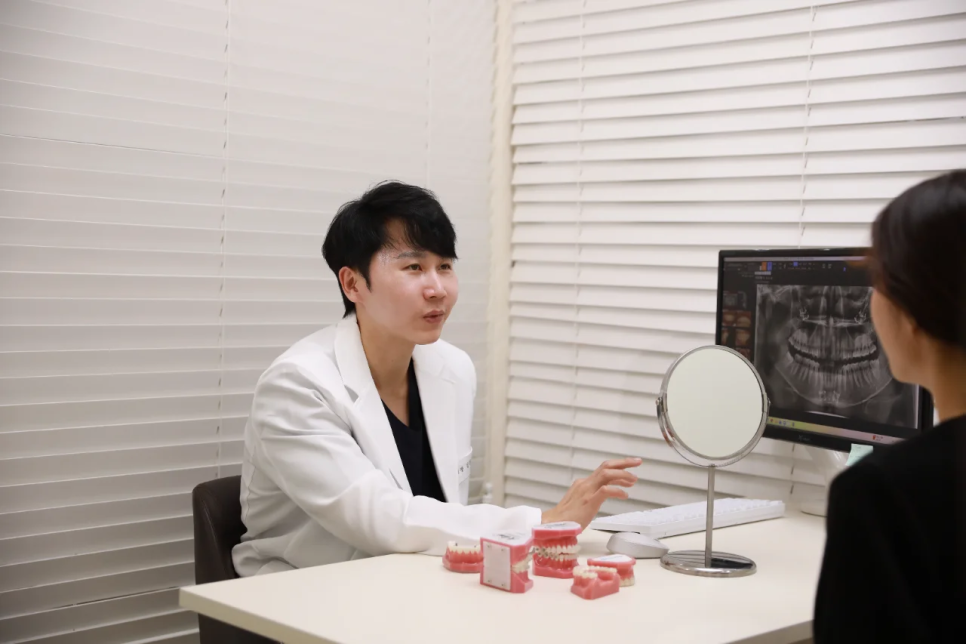
However, the information needed to make that decision cannot be obtained from a mirror. The diagnostic factors identified by the Korean Association of Orthodontists include the bite, root condition, skeletal structure, the feasibility of tooth movement, and individual patient differences—all of which are not visible from the outside. This is why the association also explains that a professional diagnosis is essential for effective orthodontic treatment.
One point worth considering is that the type of treatment needed depends on whether the issue is with the “position,” the “shape,” or both. For this reason, it may be helpful to check whether the diagnosis is performed by a doctor with specialized orthodontic training and whether the clinic has a structure that allows orthodontic and cosmetic prosthetic treatment to be discussed together. Both position and shape need to be examined to discuss the full range of options.
This Is as Far as This Article Can Take You — The Rest Has to Come from Your Teeth
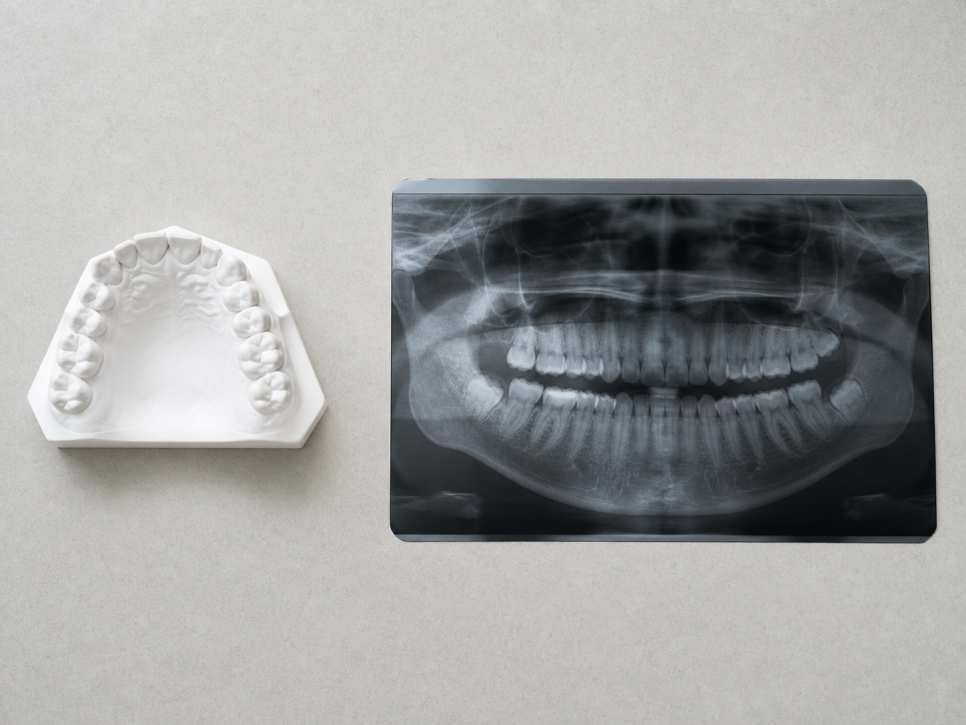
To summarize honestly, the criteria described above are only general tendencies.
The actual boundary between what is and is not possible depends on invisible factors such as the direction of the roots, the condition of the gums and supporting bone, and the details of the bite. X-rays or dental CT scans are therefore needed to check the hidden condition of the teeth and improve the predictability of tooth movement.
The Korean Association of Orthodontists also consistently explains that the outcome of the same treatment may vary depending on each patient’s individual conditions. For that reason, it is difficult for this article to make definitive statements such as “it will be finished in a few months.”
Go through the criteria discussed today one by one in front of a mirror. How many front teeth are involved? Is the molar bite acceptable? And is the issue their position or their appearance? If there is a point where your judgment remains uncertain, take that question as it is and ask about it at a nearby dental clinic.