"What age is best for my child to start orthodontic treatment?"
This is a question parents ask very often in the treatment rooms of dentists around Hakdong Station. But to give you the conclusion first, there is no fixed answer to this question.
That is because some children need to start right around age seven, while for others, starting in middle school is not too late. This is also why searches online show such different recommended ages, including six, nine, and adolescence.
It is natural for parents to feel anxious that their child might struggle if treatment is started too late, while also worrying that putting braces on too early could make a young child go through the experience twice.
So what exactly causes these differences in timing?
Why recommendations differ—“Tooth problems” and “jaw problems” require different timing

Orthodontic treatment may look essentially the same from the outside, but when we look more closely, it can be broadly divided into two types depending on its goal.
The first is a problem with tooth alignment, such as crooked teeth or crowding.
The second is a problem with the jaw, or more precisely, the underlying skeletal structure. This refers to cases in which the direction of jawbone growth itself is abnormal, such as an underbite, in which the lower jaw comes forward.
The ideal timing for orthodontic treatment is completely different for these two types of problems.
| Category | Nature of the problem | Timing of intervention |
|---|
| Tooth alignment problem | Crooked teeth or crowding | In many cases, it is sufficient to begin after all the permanent teeth have erupted |
| Skeletal (jaw) problem | A problem with the direction of jaw growth, such as an underbite | As a rule, intervention should begin as soon as it is detected during growth |
The Korean Association of Orthodontists also explains that for a simple tooth-alignment problem, it is not too late to begin orthodontic treatment after all the permanent teeth have grown in.
Skeletal problems, however, are a different matter. Because the direction of jaw growth can be guided only while a child is actively growing, the general principle is to intervene as soon as the problem is detected. Of course, each child’s growth rate and pattern of jawbone development differ, so the final decision should be made after a dental examination.
In the end, both “orthodontic treatment should begin as soon as possible” and “it is fine to wait until all the permanent teeth have erupted” can be correct advice. They were simply referring to children with different oral conditions.
Children who should be checked early and children who can wait
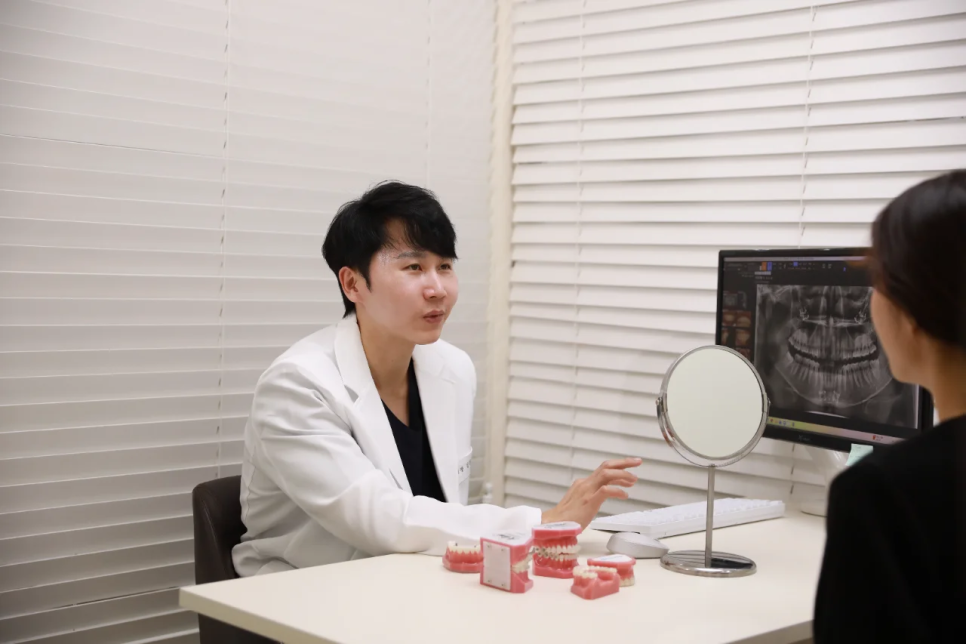
So which category does your child fall into? Signs that indicate your child should have an early dental consultation may be hidden in everyday behaviors that parents casually observe at home.
The first is when the lower teeth cover the upper teeth in the opposite direction when the child bites down. This is the most typical feature of the underbite mentioned earlier.
You should also pay close attention if your child consistently sleeps with their mouth open when sleeping soundly, or if they still suck their fingers after entering elementary school. Orthodontic specialists consider even these seemingly minor everyday habits to have a potentially harmful effect on jawbone or dental-arch development, so they are important things to monitor.
An open bite, in which the upper and lower front teeth do not touch and remain separated, or particularly severe crowding, also requires an early evaluation.
An underbite in particular can seriously interfere with the normal growth of the upper jaw if it is left untreated at the appropriate time. Many clinics caution that treatment options may become significantly more limited later in adulthood.
Conversely, there are also situations in which parents can feel more at ease.
"The teeth are a little crooked,
but the jaw shape and proportions look fine…"
If this describes your child’s condition, there is no need to become anxious right away.
If the problem is simply crooked tooth alignment, it is usually sufficient to begin orthodontic treatment after all the permanent teeth have erupted. Even if treatment begins in adulthood, good results can still be achieved.
In other words, just because a seven-year-old’s teeth are slightly crooked does not mean you need to rush to put on an orthodontic appliance.
It may not be possible to tell from appearances alone
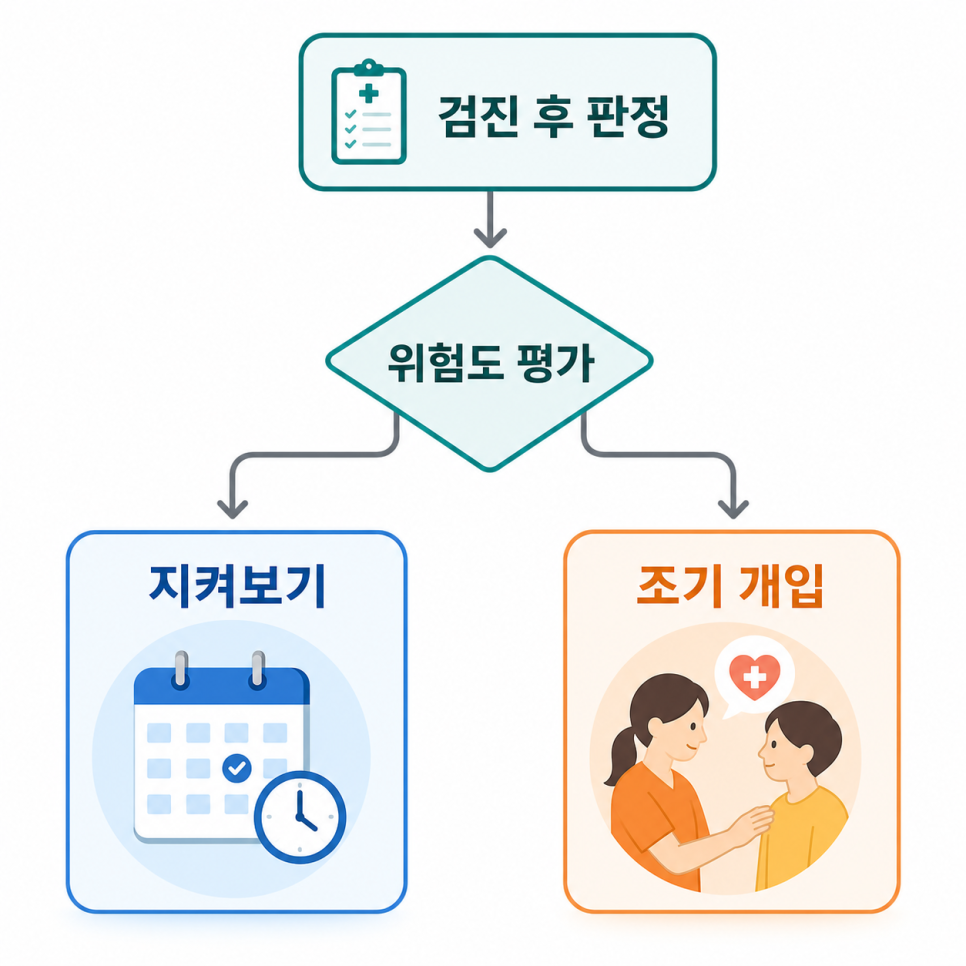
If you have read this far, one important question is probably still on your mind:
"So does my child have a jaw problem,
or is it simply a tooth problem?"
Unfortunately, it is by no means easy to distinguish these two conditions clearly based solely on a parent’s observations.
Some symptoms, such as an underbite, are clearly visible from the outside. However, there is no way to determine from appearance alone which direction the jawbones will grow in the future or at what angle the permanent teeth developing inside the gums are preparing to emerge.
For this reason, orthodontic specialists, including those in the Korean Association of Orthodontists, generally strongly recommend an initial orthodontic examination around age six to seven, when the baby front teeth begin to loosen and the permanent teeth start to erupt. This is, of course, only a general reference point, and the appropriate age for a child’s first dental visit may vary depending on how quickly the baby teeth are lost.
Ages six to seven correspond to the so-called mixed dentition period, when both baby teeth and permanent teeth are present in the mouth. A dental examination at this time can identify not only skeletal problems but also hidden issues such as a supernumerary tooth, in which there is one more tooth than usual; congenital absence of a permanent tooth, in which the permanent tooth bud is missing entirely; and an eruption disorder, in which a tooth becomes trapped in the bone and cannot emerge into its proper position.
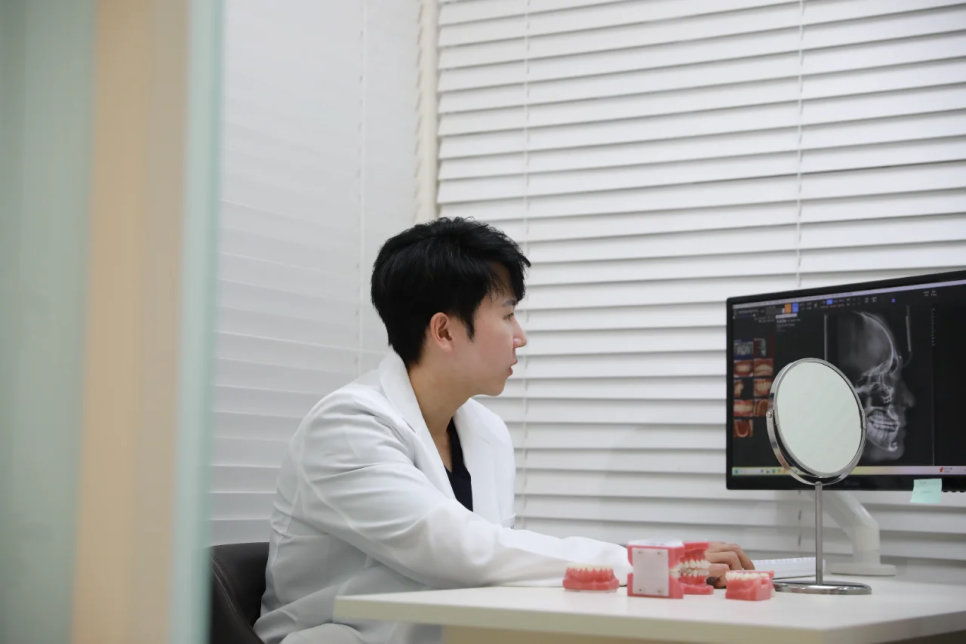
The most important point here is that a dental visit at this stage is simply a process of “checking” whether there is a problem. Jaw-skeletal treatment during growth can be extremely difficult to reverse once the optimal treatment window has passed. However, a brief examination can clearly determine whether treatment needs to begin right away or whether it is safe to wait.
What is needed now is not to “start orthodontic treatment,” but to “determine the timing”
Even so, many parents hesitate to take a child to the dentist when the child is not experiencing any pain. They worry that they may be pressured into undergoing extensive treatment.
"We are worried that after going in for an examination,
they will pressure us to start orthodontic treatment immediately."
However, an initial orthodontic evaluation during the mixed dentition period is by no means an occasion to pressure you by saying, “Let’s put on an appliance right away.” It is much closer to an opportunity to “determine” the most appropriate treatment timing for your child.
After the examination, if you can feel reassured by hearing, “This is simply an alignment issue, so you can comfortably watch and wait until all the permanent teeth have erupted,” that alone can greatly ease a parent’s burden. Putting off treatment day after day while carrying vague anxiety is entirely different from waiting calmly under the guidance of a professional diagnosis.
Conversely, even if the examination reveals a skeletal problem requiring immediate jaw treatment, there is no need to panic or regret not acting sooner. Since you can respond while your child’s jaw is growing most actively—“now”—you will have much more favorable conditions for successful orthodontic treatment.
The key to determining the timing is accurately measuring and evaluating the growth potential of the child’s jawbones. Therefore, we recommend having the initial examination, whenever possible, with an orthodontic specialist. There is no need to travel all the way to a university hospital; it is sufficient to find a local dental clinic near your home or workplace, such as a dentist near Hakdong Station, where an orthodontic specialist is consistently available.
There is one more point worth checking. Orthodontic treatment for growing children is not a short-term treatment that ends after taking a single X-ray. It is a long-term process that requires continuously monitoring how the child grows over several years and determining the next step. Therefore, be sure to check whether the clinic can responsibly monitor your child’s growth through to the end without frequently changing the treating doctor during the process.
The best age to begin orthodontic treatment in earnest differs from child to child. But there is clearly an age that is most appropriate for “checking” the right timing for your child: around age six to seven, when the front teeth begin to be replaced by permanent teeth.
This evening, when your child is eating, smiling brightly, or sleeping soundly, take a moment to look closely at their face. If you notice the lower teeth covering the upper teeth in the opposite direction, or your child sleeping with their mouth partly open and breathing through their mouth, do not delay. Visit a dentist near Hakdong Station or an orthodontic dental clinic near your home, and make sure to have an examination to determine the appropriate timing first.