Have you ever looked in the mirror, said “Eee,” and closed your teeth, only to feel surprised because you could barely see your lower teeth?
You may have wondered whether the “deep bite” often mentioned online applies to you, but hesitated because you were not in enough pain or discomfort to rush to the dentist.
If you have opened a search engine wondering whether it is okay to leave it alone or whether it could cause serious problems later, please read this article to the end. I will address your questions one by one.
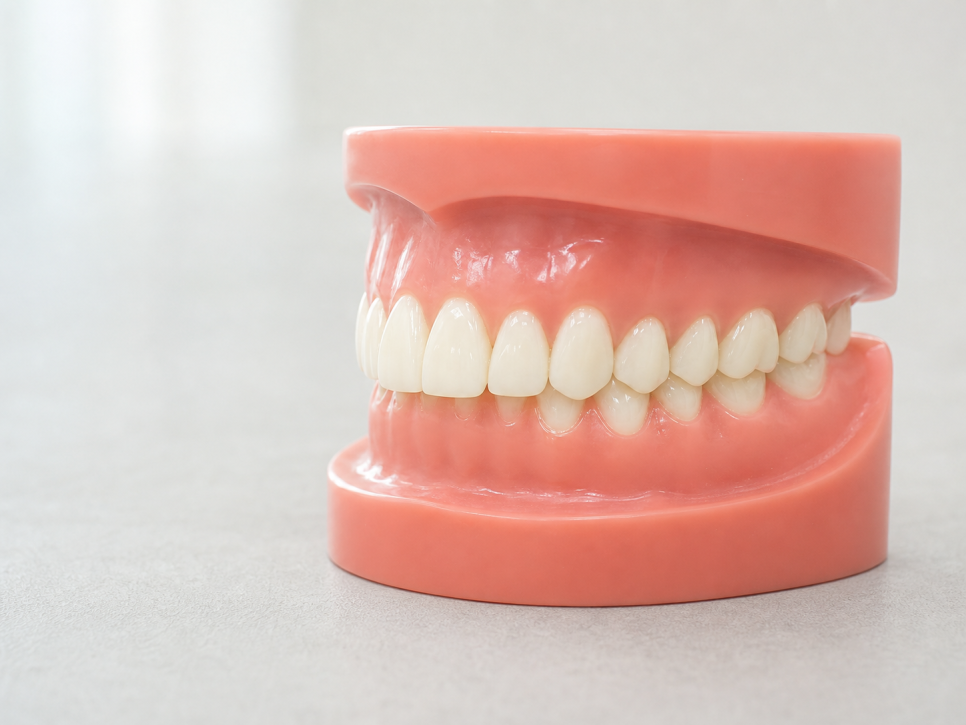
How much coverage of the lower teeth indicates a deep bite?
First, I would like to reassure you.
Not every case in which the teeth appear slightly overlapped requires treatment.
Even in a normal bite, it is natural for the upper teeth to cover the lower teeth by about 2–3 mm, or roughly one-third of the tooth length. In orthodontic evaluations, this range is considered normal vertical overlap.
The problem occurs when the overlap significantly exceeds this range, so that more than half of the lower teeth are covered or they cannot be seen at all. This condition is called an overbite, or deep bite.
In other words, if your lower teeth are only slightly covered when you look in the mirror, that alone does not mean you need to start considering orthodontic treatment right away.
“Then if the overlap is significant, does that always mean orthodontic treatment is necessary?”
The answer to this question, which many people ask, is the key point of today’s article.
The need for treatment in a deep bite is determined not by its ‘severity,’ but by its ‘consequences’

Teeth that overlap deeply are simply a sign that a thorough examination is needed. The actual basis for deciding whether orthodontic treatment is necessary is what effect the current bite is having inside your mouth.
When the teeth come together deeply, the upper and lower front teeth inevitably collide with much more force than is normal. If this abnormal force is concentrated in one area over a long period, the following changes may occur.
| Possible change | What it involves |
|---|
| Wear at the ends of the front teeth | The cutting edges gradually wear down and become shorter, which may lead to sensitivity |
| Injury to the palate | The lower front teeth bite into the gum tissue on the palate, causing repeated irritation |
| Gum recession | The upper teeth press against the gums around the lower front teeth, causing the gums to recede over time |
| Strain on the jaw joint | The jaw closes excessively because of the deep bite, placing stress on the joint |
The key word to keep in mind here is ‘progressive.’
Wear of the front teeth and gum recession do not develop overnight. They are changes caused by the gradual accumulation of force applied each day when you chew food and close your teeth.
Therefore, the absence of noticeable symptoms right now does not necessarily mean that there is no problem. It may simply mean that damage is still accumulating.
Of course, even when the teeth come together deeply, the chewing forces may be distributed evenly enough that these side effects do not occur. If that is the case, there is no need to rush into orthodontic treatment.
Why is it beneficial to have it checked now?

You may be thinking, “Can’t I just visit the dentist if symptoms develop later?”
That is a reasonable question, but there is one serious problem.
Once wear of the front teeth and gum recession progress, they are irreversible forms of damage that do not heal on their own.
If you begin orthodontic treatment only after the tooth wear has become severe, you may need additional treatment to restore the teeth that have already worn down, rather than simply correcting the bite.
In other words, the earlier you understand the condition of your teeth, the more treatment options you will have, and the process you need to undergo will be much simpler.
Many people also worry, “Am I already too old to have orthodontic treatment because I am an adult?” However, successful clinical outcomes for deep-bite correction continue to be reported in both adults and adolescents. There is no reason to delay or give up on an examination simply because of your age.
To emphasize once again, the decision you need to make at this stage is not “I will start orthodontic treatment immediately.”
It is to clearly determine whether your overbite is causing harmful consequences for your teeth.
That alone is more than enough reason to visit a dentist.
However, some things cannot be determined by looking in the mirror

At this point, I should be honest about the limitations of self-diagnosis.
Even if you understand the criteria explained so far, the only thing you can check at home with a mirror is the degree to which the teeth overlap.
The key information needed to determine whether treatment is necessary cannot be seen with the naked eye.
-
Whether wear of the front teeth has already begun and how far it has progressed
-
The direction in which chewing forces are being applied and where they are concentrated
-
Whether the deep bite is dental in origin—such as excessive downward growth of the upper teeth or insufficient eruption of the lower teeth—or skeletal in origin, resulting from the jaw’s growth pattern
The third point in particular is extremely important.
During an orthodontic evaluation, the cause of the deep bite must be accurately distinguished as dental or skeletal. For this purpose, professional examinations such as a lateral cephalometric radiograph and bite analysis are essential.
The approach to deep-bite correction varies completely depending on the underlying cause. This also has a significant effect on the stability of the result and on preventing the bite from becoming deep again after treatment.
Because the overall treatment plan changes starting with the analysis of the cause, it is advisable to have your condition accurately diagnosed by a clinician with extensive clinical experience.
First, distinguish between cases that require treatment and cases that can be monitored
Please refer to the table below for an easy comparison of the two situations.
| Category | Condition |
|---|
| Often suitable for monitoring | The overlap is close to the normal range, with no particular findings involving tooth wear, the gums, or the jaw joint |
| Requires a detailed examination | More than half of the lower teeth are covered, or the front teeth feel sensitive and shorter, or the palate is being bitten |
The primary purpose of a dental examination is to accurately determine which of these situations applies to you. It is not to recommend orthodontic treatment unconditionally.
If your examination shows that it is appropriate to monitor the condition, that alone will be a valuable result that can ease your worries.
Deep overlap is a ‘sign’ of the bite, while changes in the teeth and jaw joint are the ‘consequences.’ Keeping these two points in mind can make your concerns in front of the mirror feel much less burdensome.
If more than half of your lower teeth are covered when you look in the mirror, or if your front teeth feel unusually sensitive and seem to be gradually becoming shorter, visit a nearby dentist first. Begin by checking the cause of your bite and its current progression through a detailed examination. The results will finally clarify whether deep-bite correction is truly necessary or whether you can simply monitor the condition with peace of mind.