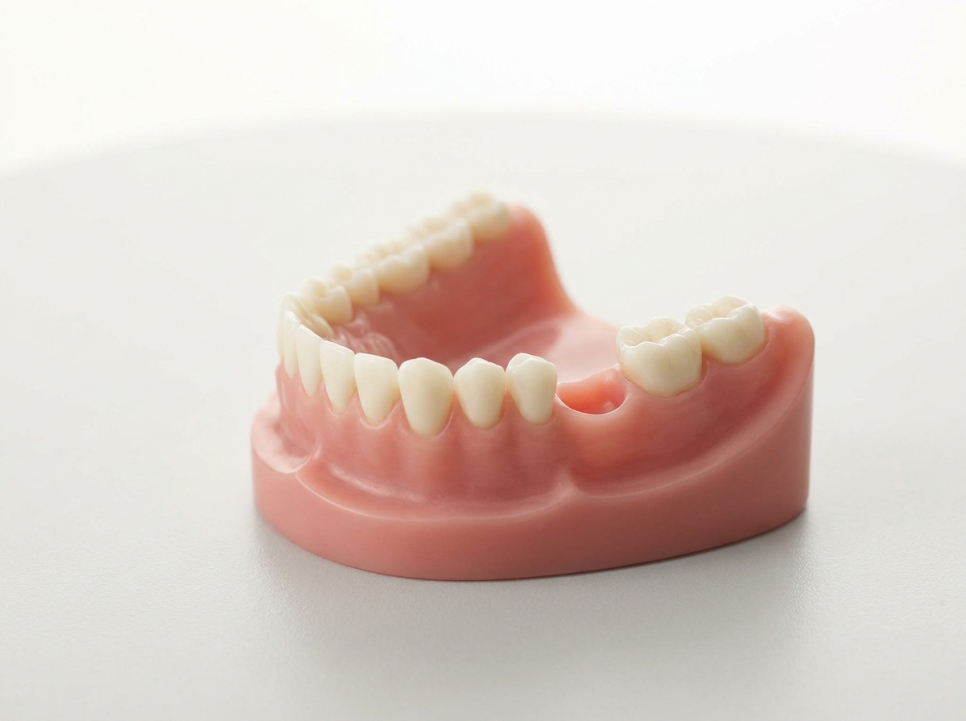
You may have had a molar extracted and kept putting it off, saying, “I’ll deal with it later”—until several months, or even a few years, have passed.
If you leave the empty space where a tooth was for too long, the adjacent teeth may tilt and the opposing tooth may move downward, even if there is no immediate pain. By the time you finally seek treatment, the space may have narrowed, making treatment more difficult.
Even when you understand this, it can still be hard to take the first step and visit the dentist. You may not have much trouble chewing right now, and you may have opened a search engine first because you were worried that the dentist would scold you for “waiting this long.” These concerns are common among people who have lost a tooth and delayed treatment.
Putting it off is not unusual
Right after an extraction, most people resolve to “replace the tooth as soon as possible.”
But after a few days, once you get used to chewing on the other side and the pain subsides, it may no longer seem urgent. When concerns about the considerable cost are added, visiting the dentist naturally falls down the list of priorities.
“Chewing is manageable like this. Can’t I just leave it alone?”
This is the thought most commonly shared by people who have lost a tooth.
However, the area that needs attention is not the empty space itself but the surrounding teeth. When one tooth is lost, the teeth on either side gradually tip toward the open space.
You may not notice because there is no immediate pain, but structural changes are quietly taking place in your mouth.
What happens in the empty space — tooth movement and changes in the jawbone

Teeth support one another side by side and maintain their positions. It is similar to what happens when you pull one book from a tightly packed bookshelf and the books on either side gradually lean into the gap.
When one space becomes empty and this balance is disrupted, three major changes can occur in sequence.
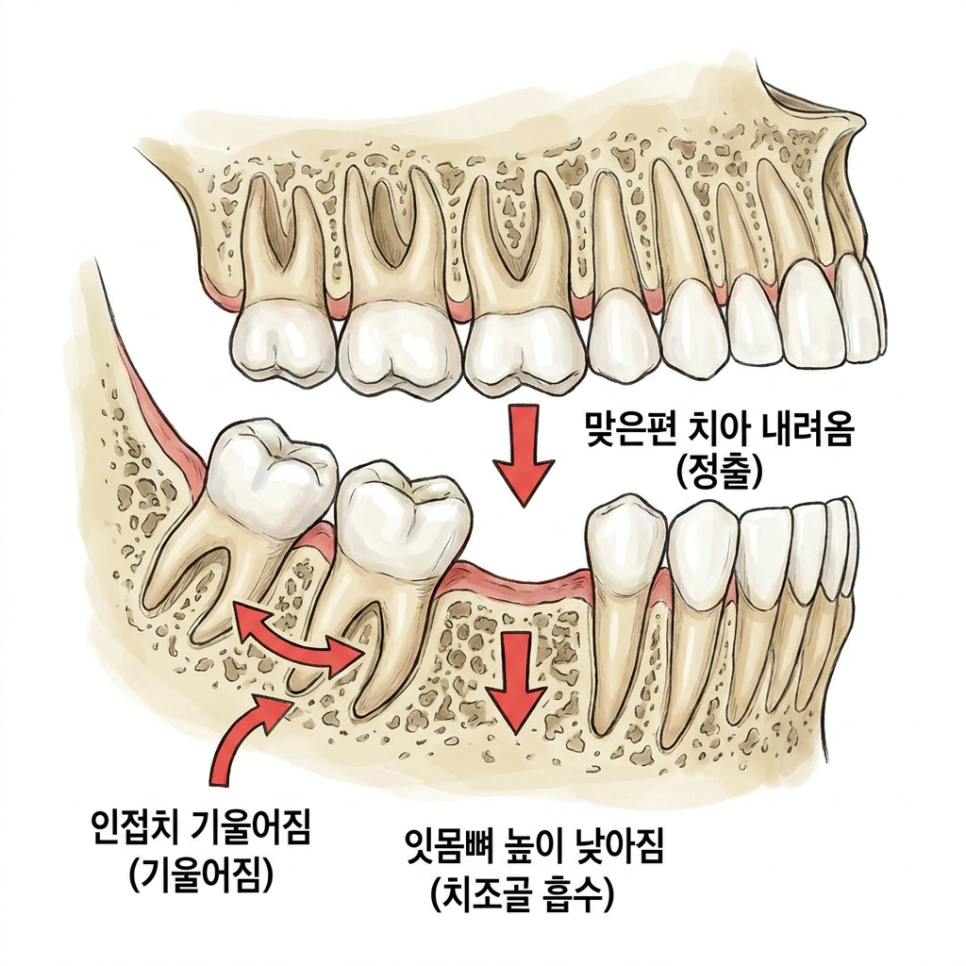
| Change | What happens | Signs you may notice yourself |
|---|
| Tilting of adjacent teeth | The neighboring teeth gradually lean into the empty space | Food frequently gets stuck between the teeth; the tooth next to the gap looks crooked |
| Extrusion of the opposing tooth | The upper or lower tooth that no longer has an opposing tooth may rise or descend toward the empty space | One particular tooth looks longer; it feels as though it touches first when you bite |
| Resorption of the jawbone (alveolar bone) | The bone that supported the tooth root gradually decreases after losing stimulation | The gum feels lower and thinner |
A study worth noting in relation to the rate of jawbone changes was published in the 2003 issue of the international journal International Journal of Periodontics & Restorative Dentistry (Schropp et al.). It found that the width of the jawbone decreased by approximately 50% during the 12 months after a molar was extracted. In particular, about two-thirds of the total reduction occurred within the first three months after extraction.
As teeth tilt and extrusion occurs—the tooth rises or descends—the way the upper and lower teeth meet, known as the bite or occlusion, also gradually becomes misaligned. A tooth that has moved downward may touch before the others, concentrating chewing forces on one side, while food may continue to become trapped in the gaps created by the tilted teeth.
Of course, the speed and extent of these changes vary considerably from person to person. Some people experience little movement in the surrounding teeth even after leaving the space empty for years, while others find that an adjacent tooth has tipped significantly within a surprisingly short period.
The fact that the extent of change varies means that each patient has a different degree of tooth angulation and a different amount of remaining bone. A tooth that has just begun to tilt requires a different amount of correction from one that has already fallen almost completely sideways. Naturally, the scope and method of treatment may also differ.
It is not about being “too late,” but about determining what stage you are at

This is probably what worries people most when they hesitate to visit the dentist.
“What if I waited too long and it is now beyond treatment?”
However, in the dental office, the current condition of your mouth is considered much more important than how long the tooth has been missing. Even if the space has been empty for a long time, treatment may be relatively simple if there has been little tooth movement or bone loss.
Even if the adjacent tooth has already tilted considerably, it does not mean there are no options. Tooth uprighting—using orthodontic appliances to bring a fallen tooth back into an upright position—is a treatment method that has been used in dental practice for a very long time. You can think of it as standing a leaning book upright again.
Once a tooth that had been lying down returns to its original angle, previously inaccessible areas become easier to brush, making gum care much easier. The narrowed empty space may also regain its original width, and chewing forces can be transmitted properly along the direction of the tooth root. This is why dentists often first consider whether it is possible to preserve the patient’s natural teeth and restore their alignment and bite.
On the other hand, filling the space with an artificial tooth such as a dental implant requires sufficient room for the restoration and a strong, healthy jawbone. If substantial bone loss has already occurred, additional preparation, such as bone grafting, may be necessary. In addition, artificial teeth do not have the natural teeth’s characteristic ability to absorb minute impacts, so chewing may feel subtly different. The surrounding gums also need careful management after the procedure.
It is difficult to determine which treatment is right for you through internet searches alone. How much the tooth has tilted, how far the opposing tooth has moved downward, and how much bone remains can be accurately assessed only through examinations such as X-rays. In many cases, the overall bite and orthodontic considerations must also be taken into account.
So the first thing you need to do is find out “what stage I am currently at.”
Things worth checking before visiting the dentist

When you are finally preparing to visit the dentist, you may feel uneasy and wonder, “What should I explain when I get there?” In that case, organizing the following points in advance can make the consultation much smoother.
- Time and location of the extraction
Try to remember approximately when and which tooth was extracted. You do not need to know the exact date; something like “I had the lower right molar removed around spring the year before last” is sufficient.
- Changes you have noticed yourself
Take a quick look in the mirror to see whether there is a particular area where food gets stuck more easily or whether the teeth next to or opposite the empty space look different from before. If you have not noticed any particular discomfort, simply tell the dentist, “I do not have any significant symptoms.”
- Medical conditions and medications
Be sure to tell the dentist about any medical conditions, such as diabetes, osteoporosis, or cardiovascular disease, as well as any medications you take regularly. These are essential medical-history details that must be checked when planning an extraction or surgery.
In particular, antithrombotic medications—medications that thin the blood—and osteoporosis medications are directly related to bleeding and the rate of bone recovery. We recommend taking photos of your prescriptions or medication packets with your phone and bringing them with you.
- Notes about your questions
Write down two or three questions you have been wondering about, such as “Roughly how long will treatment take?” or “Does the adjacent tooth need treatment right away?” This can help prevent your mind from going blank while you are sitting nervously in the dental chair.
Start by going for an examination, not by deciding on treatment
Visiting the dentist does not mean that you have to immediately decide on and begin an extensive treatment.
Having a professional examine how much the surrounding teeth have tilted, how far the opposing tooth has moved downward, and whether the jawbone has been adequately preserved is enough for now.
If the examination shows little change, the alternatives are likely to be simpler. Even if the tooth has tilted considerably, you can calmly discuss with the dental team whether to first straighten it orthodontically to create enough space and in what order to proceed with treatment.
The rate of change in the mouth varies from person to person, but once a tooth begins to tilt, it will not return to its original position on its own. The sooner you check your current condition, even by one day, the more room there may be to plan treatment aimed at preserving your natural tooth.
There is no need to blame yourself for leaving the space untreated for years. From the moment you find the courage to check your current condition, you can take back control of your treatment. If the tooth next to the empty space looks somehow different or food becomes bothersomely trapped whenever you eat, we recommend that you stop delaying and visit a nearby dentist to start with an X-ray.