Throbbing pain that continues for several days after root canal treatment or swelling that worsens on the second day after implant surgery are common symptoms during the recovery process.
Many people schedule their treatment and then type “How painful is it after treatment?” into a search bar late at night. Just like those who searched for a dental clinic in Hak-dong, this is also one of the questions most frequently asked during consultations at any dental clinic.
Much of the fear comes from the vague uncertainty of not knowing “how much it will hurt or how long the pain will last.”
We have organized the range of pain you may experience immediately after root canal treatment and implant surgery, along with the precautions you must follow after treatment, so that you can learn about them in advance.

How Much Pain Is Normal After Root Canal Treatment?
Root canal treatment removes inflamed nerve and blood vessel tissue from inside the tooth and fills the empty space with a filling material.
You may wonder, “Why does it hurt when the nerve has been removed?” In fact, the area where the pain is felt is not inside the tooth but the tissue around the tip of the root. As this tissue temporarily develops an inflammatory response during treatment, it is common to experience throbbing pain or pain when pressure is applied for about 2–3 days. However, this period is only an approximate guideline provided in treatment instructions. If the inflammation had spread significantly beyond the tip of the root, the pain may last somewhat longer.
A dull ache that continues for several days is a natural part of the recovery process.
If the painful sensation gradually decreases over time, it means that the tooth is healing well as expected.
One point to remember is that root canal treatment is almost the last method for saving and continuing to use your natural tooth. A tooth that has had its nerve removed cannot return to its former strength. Even when protected with a crown, if excessive chewing force is concentrated on one side, the root may split and eventually require extraction. Therefore, arranging the teeth so that chewing forces are distributed evenly before further damage occurs is one way to preserve natural teeth for a long time.
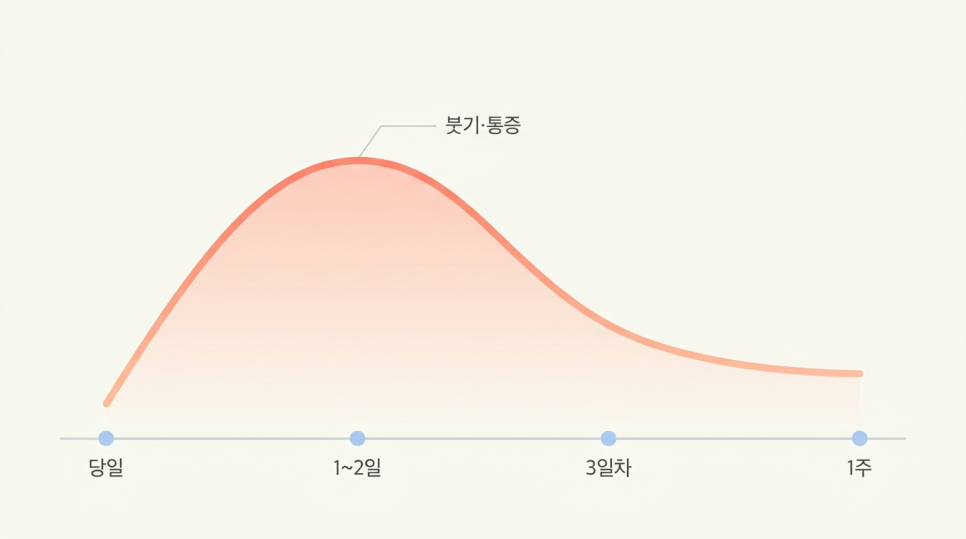
Understanding Pain and Swelling Immediately After Implant Surgery, in Chronological Order
Swelling after implant surgery commonly becomes more severe on the second day than on the following day.
The table below describes the general course commonly explained in post-surgery instructions, but the actual timing and severity vary from person to person. For specific instructions, such as how long to apply a cold compress, follow the guidance provided by your dental office.
| Timing | Common pattern | Response |
|---|
| Day of surgery | Pain begins as the anesthesia wears off, with slight bleeding | Take prescribed medication and begin cold compresses |
| Days 1–2 | Swelling gradually worsens | Repeat cold compresses in short intervals |
| After day 3 | Swelling and pain gradually decrease | You may switch to warm compresses |
| Around 1 week | Symptoms are at a level that does not significantly interfere with daily life | Continue following precautions until the stitches are removed |
Instructions often mention that swelling reaches its peak around 48 hours after surgery and then gradually subsides. However, there can be considerable individual variation depending on whether bone grafting was performed and how extensively the gums were opened.
Knowing in advance when swelling is likely to peak can greatly reduce the chance of being startled when you look in the mirror the morning after surgery.
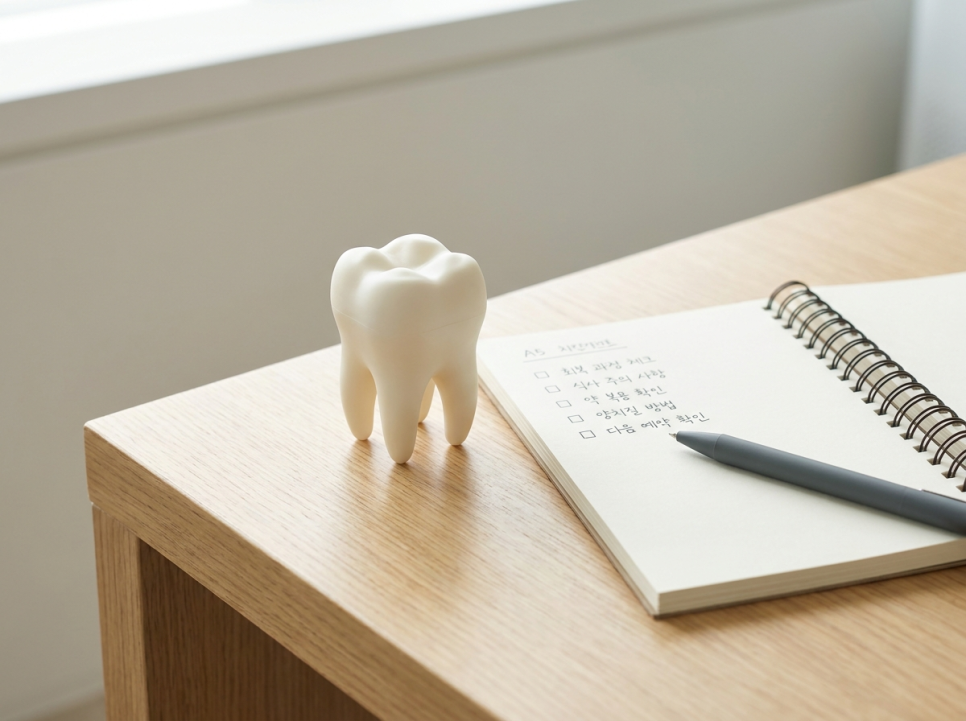
Post-Treatment Precautions Checklist — Recovery Can Be Different When You Know Them in Advance
Even when precautions seem easy to understand at the dental office, it is easy to forget about half of them once you get home.
Reading them in advance of treatment can help you picture how to spend the first week after surgery. The key points are generally similar whether you receive instructions at a dental clinic in Hak-dong or elsewhere.
| Item | Details | Reason |
|---|
| Brushing | Do not brush the surgical site until the stitches are removed | Prevent irritation and infection of the wound |
| Alcohol | Avoid alcohol for about 1 week | It can interfere with recovery from bleeding and inflammation |
| Smoking | Avoid smoking during the recovery period | Reduced blood flow to the gums can slow healing |
| Meals | Start with soft foods and avoid hard or chewy foods | Stabilize the integration of the bone and implant |
| Prescribed medication | Do not stop antibiotics or pain medication on your own | Prevent infection and control pain |
You may hear repeatedly at the dental clinic that smoking can lead to implant failure, but the extent to which the risk increases varies depending on the condition of the patient’s gums.
If you have had root canal treatment, there is one additional precaution to keep in mind. Until the tooth is completely covered with a crown, you should not chew hard foods with that tooth. This is because the tooth is currently very fragile and prone to breaking.
After decay and treatment, a substantial amount of the tooth’s structure may have been removed, significantly reducing its ability to withstand force. It is like leaning against a wall with only a thin pillar left standing, making it easy for the tooth to crack even from a small impact.

Do Not Endure It—Visit the Dentist: Distinguishing Normal Symptoms from Warning Signs
This time, we will look at warning signs that fall outside the normal range of recovery.
The following symptoms require attention after root canal treatment:
After implant surgery, watch for the following symptoms:
-
Bleeding that does not stop and continues to seep out
-
Tingling or unusual sensations around the lips or chin
-
Swelling and pain that had been subsiding but suddenly become worse again
The “one week” mentioned here is also only an approximate guideline and is not an absolute cutoff. If the sensation or pattern of pain changes in a way that differs from usual, it is safer to have it checked promptly rather than focusing strictly on the duration.
In particular, implants do not contain nerves, so warning signs such as pain or mobility may appear much later even if the surrounding bone tissue is breaking down.
The fact that you are not in pain right now does not necessarily mean that everything is safe.
For this reason, even if you have no particular symptoms, you should have regular checkups every few months to assess the condition of the bone and gums. Your dentist will determine the appropriate interval based on the condition of your bone and whether you have gum disease.

Ultimately, Consistent Care That Continues “After Treatment” Is What Matters
Root canal treatment and implants are not finished simply because the immediate pain and swelling have subsided. Rather, they are treatments for which long-term care begins from that point. They are not completed all at once but are closer to an ongoing process that requires checkups and care over the course of several years.
Therefore, whenever possible, preserving and retaining your natural teeth is much more comfortable in the long term. Keeping the teeth properly aligned so that chewing forces do not become concentrated on one side can help prevent a particular tooth from deteriorating first. If you are concerned about the appearance of your front teeth, keep in mind that options such as no-prep veneers can improve their appearance without filing down your natural teeth.
The recovery periods and courses described today are general guidelines. The actual level of pain and rate of healing vary from person to person depending on the condition of the tooth, the extent of inflammation, and the condition of the bone.
If you are preparing for treatment, we recommend that you ask the following three questions during your consultation:
-
How many days of pain should I expect given my condition?
-
Are there any special precautions I should take based on my oral condition?
-
How often should I come in for checkups in the future?
Regular checkups are an ongoing process that continues steadily over the coming years. Therefore, whether you receive treatment at a dental clinic in Hak-dong or elsewhere, it is very important to confirm that your treatment records and condition can be followed continuously without interruption.
If you are concerned about pain and the recovery process after surgery, ask thoroughly about the expected course during your consultation before scheduling the procedure. If you are currently experiencing discomfort due to pain or swelling, do not delay—visit a nearby dental clinic to have your current condition evaluated.