Protruding-mouth orthodontic treatment rarely shows noticeable changes in the mouth moving inward during the early stages.
That is because the stages that change the side profile are concentrated in the middle and latter parts of the overall process.
So, if you have been wearing orthodontic appliances for nearly a year without seeing any changes, it may be a sign that your treatment needs to be checked—but it may also be an entirely normal part of the treatment process.
Today, we will go through the criteria for distinguishing between these two possibilities.
Protruding-mouth correction naturally involves most of the inward movement in the latter part of treatment
Changes appear late because of the order of treatment. The work that changes the side profile is scheduled for the latter part of treatment.
Treatment with fixed appliances generally proceeds in three stages. The periods and sequence below are not absolute standards officially announced by a professional society; they are a simplified division of the clinical process to make it easier to understand, and they can vary considerably from case to case. The actual allocation depends on the diagnosis.
| Stage | What is done |
|---|
| Stage 1: Leveling and alignment | Preparatory work to straighten and properly align crooked teeth |
| Stage 2: Space closure | Closing the spaces that have formed while pulling the front teeth backward |
| Stage 3: Finishing | Refining the bite and fine details |
The key point is that pulling the front teeth backward—the step that changes the side profile—begins in Stage 2, or after the middle of treatment.
A considerable portion of the early treatment period is spent arranging the teeth into proper alignment, so it is actually natural not to notice much change even when looking in the mirror. It may help to think of this as the time spent leveling a wall before wallpaper is applied.
Protruding-mouth orthodontic treatment naturally requires a substantial amount of time.
The feeling that treatment is progressing slowly
also often results from this treatment structure.

When treatment is actually delayed—the causes fall into two categories
Of course, not every delay falls within the normal range. The causes can be broadly divided into two categories.
① Biological factors and treatment-plan variables
Tooth movement is commonly said to occur at around 1 mm per month, but this is an approximate figure used for convenience in clinical settings, not an official standard specifying a particular appliance or method of movement. In reality, the speed at which the bone responds varies considerably from person to person. Even academic reports show different results depending on the subjects measured and the appliances used, so it is difficult to apply a specific figure equally to everyone.
Let us address one common misunderstanding here.
“Does treatment always take longer because I am an adult?”
It is difficult to conclude that orthodontic treatment necessarily takes longer simply because a person is older. The results of various studies comparing treatment duration in adolescents and adults are also mixed. The difficulty of the case and the individual patient’s bone response tend to be much greater variables than age.
From a treatment-planning perspective, loss of anchorage—the force that firmly holds the molars in place—is a representative factor that can extend treatment time. It is the same principle as in a tug-of-war: if the person holding their ground in the back is pulled forward, they cannot properly pull the person in front. If the molars move forward and reduce the available space, the distance the front teeth can move backward becomes shorter. The plan must then be revised, which ultimately lengthens the overall treatment period.
② Patient-related factors
-
Insufficient wear time for elastics (interarch elastics)
-
Postponed or missed appointments
-
Leaving broken appliances unrepaired
-
Habits of pushing the front teeth with the tongue or applying excessive pressure with the lips
Patient cooperation is considered a key factor affecting the overall treatment period in orthodontic literature, no less so than the severity of the malocclusion.
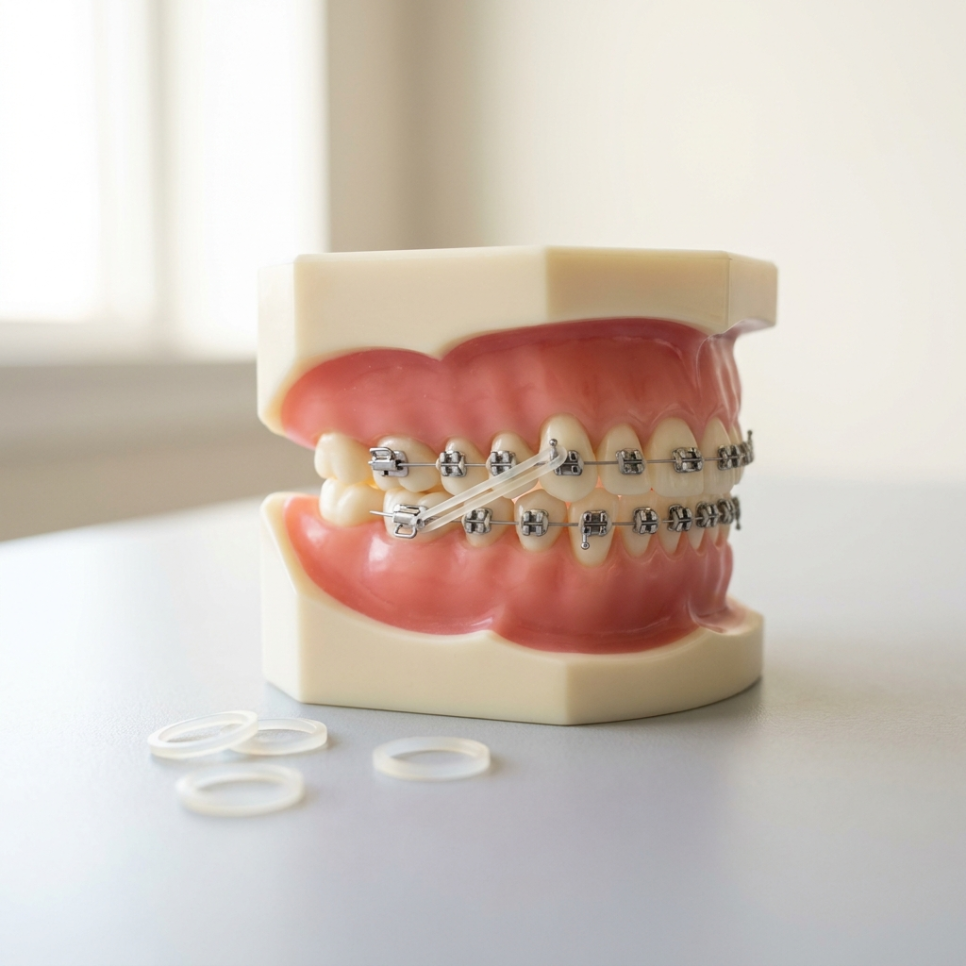
What I can change—the management practices that help keep treatment on schedule
① is difficult to control on your own, but ② is an area that most patients can manage through their own efforts. Understanding why each item affects the treatment period makes it much easier to follow through.
| Action item | Why it affects the treatment period |
|---|
| Wear elastics for the instructed amount of time | Elastics apply force to the teeth, so if they are not worn for enough time, the teeth will not move as much. |
| Keep your appointment schedule | When appointments are delayed, the timing for applying the next force to the teeth is delayed as well. |
| Contact the clinic immediately if an appliance breaks | A tooth whose bracket has come off may move back toward its original position while left unattended. |
| Limit hard and sticky foods | This is the most reliable and basic way to prevent appliance damage. |
| Correct tongue and lip habits | If force is continuously applied in the opposite direction from the force exerted by the appliance, the effect of tooth movement is offset. |
Guidance materials provided to the public by the Korean Association of Orthodontists also emphasize that active patient cooperation, including wearing appliances and keeping appointments, is necessary for smooth tooth movement.
When these management practices are followed properly, treatment can proceed along the originally planned course, and the stress placed on the gums and teeth can also be brought to an end within a safe range. Orthodontic treatment improves both the side profile and the bite by moving the natural teeth into better positions. When chewing forces are distributed evenly, the wear and gum stress concentrated on particular teeth can also be reduced, offering the significant advantage of improving both appearance and function.
How to distinguish normal delays from delays that should be checked
As discussed above, a lack of immediately noticeable change may still be a normal part of the treatment process based on the current stage.
However, if any of the following situations apply, it would be a good idea to have your current status checked.
Of course, neither situation necessarily means that there is an immediate problem with your treatment. Consider it simply a signal that it may be time to have a conversation with your treating doctor. The best approach is to ask your doctor directly at your next appointment. The quickest way to confirm whether your protruding-mouth treatment is progressing as planned is to check with the clinic.
“Which stage of the overall treatment process am I currently in?”
“What stages remain, and how long is each one expected to take?”
“How does my current progress compare with the original plan?”
Orthodontic treatment is one in which the treating doctor has the clearest understanding of the movement history of the individual teeth. Therefore, when questions arise, communicating directly with the clinic where you are receiving treatment should be the first step. If questions remain even after you have received a sufficient explanation, seeking an opinion from another orthodontic specialist may also be an option.
Orthodontic treatment is measured not by its duration, but by the result it leaves behind
It is only natural to feel disappointed when treatment takes several months longer than expected. However, once treatment is completed successfully, the neatly aligned side profile and comfortable bite often remain in your memory much longer than the additional time. Of course, the final result and the degree of retention vary from person to person.
There are three things you can put into practice right away: manage the variables you can control yourself, such as wearing elastics and keeping your appointments; ask your doctor questions so that you can accurately understand your current treatment stage; and, if the delay is a normal part of the process, set aside your impatience for a while.
Once you understand your current situation, your anxiety will lessen, and you can naturally move on to wondering about the next stage. We will also cover topics such as retainer care, pain during orthodontic treatment, and the process of closing extraction spaces step by step in the future.
The ability to stay on schedule during protruding-mouth orthodontic treatment ultimately comes from knowing which stage of the process you are in. If your protruding-mouth treatment seems to be taking longer than expected, it would be helpful to ask at your next appointment which stage you have currently reached.