Doctor,
I have several crowns.
Can I still get orthodontic treatment?
This is a question that adult patients in their 30s and 40s and older often ask during consultations.
To give the conclusion first,
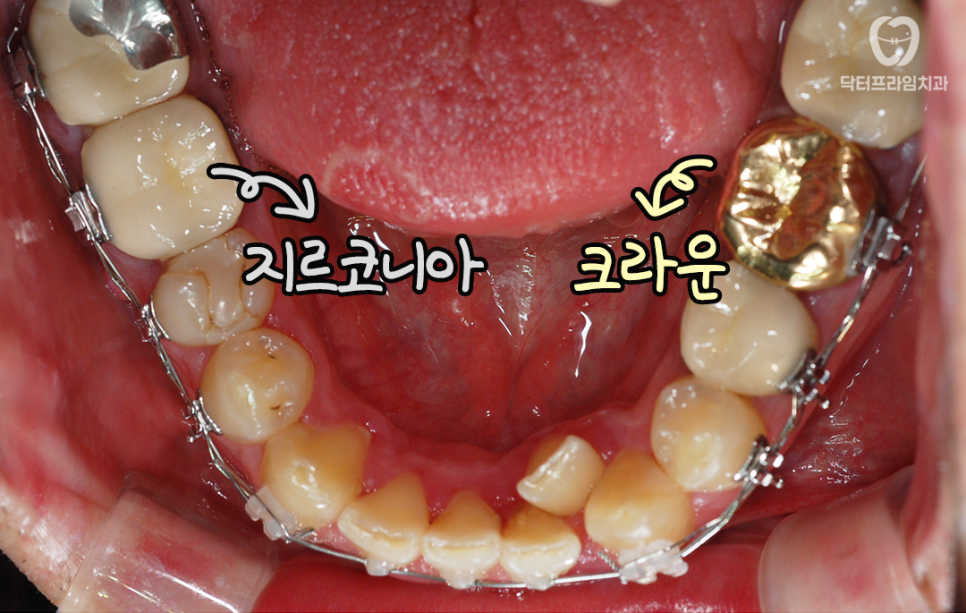
Even if you have crowns or bridges,
in most cases,
orthodontic treatment is possible.
However,
because crowned teeth have slightly different characteristics
from natural teeth,
it is important to understand those differences.
Orthodontic characteristics when crowns/bridges are present
- Brackets attached to crowns can come off easily
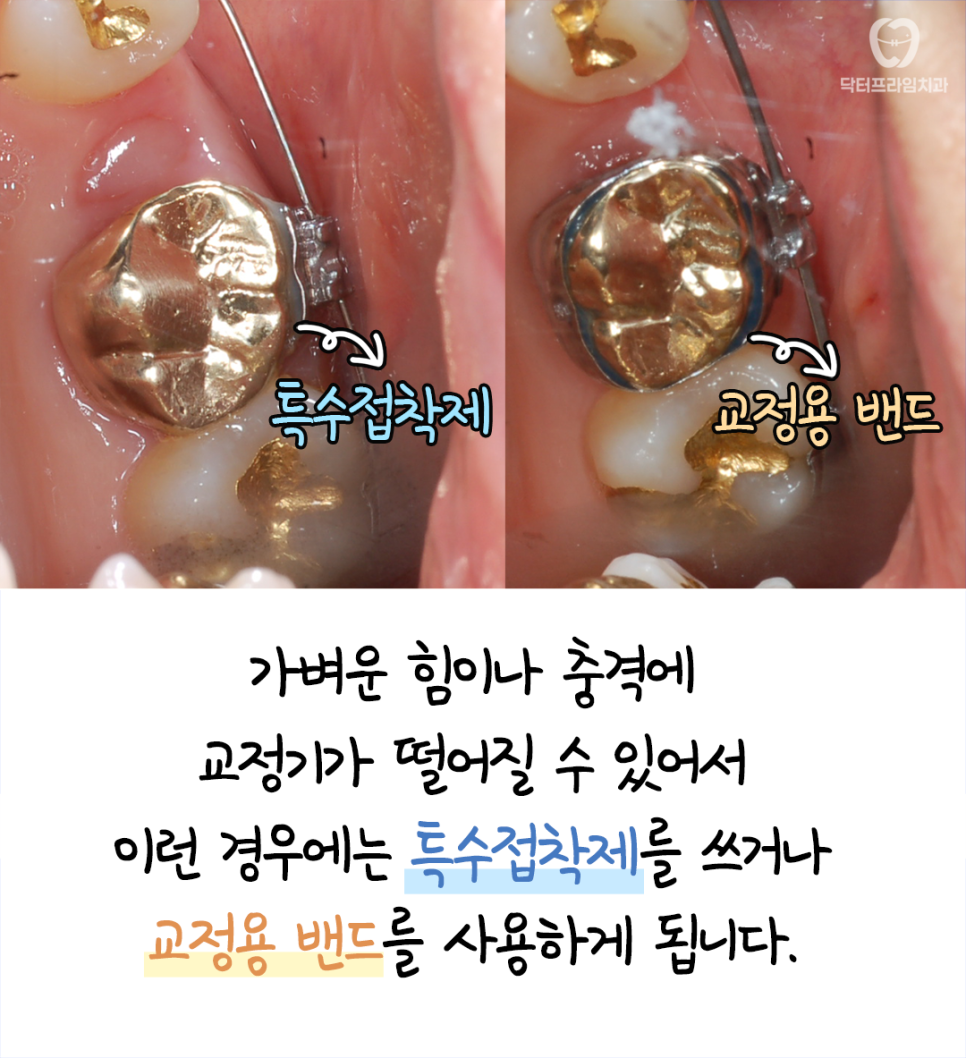
Crowns are made of smooth artificial materials,
so the adhesion of orthodontic appliances (brackets)
may be weaker than on natural teeth.
In particular,
with zirconia or gold crowns, even while brackets are attached and orthodontic treatment is being carried out on the surface,
they can often come off with a light force or impact.
In such cases, a special adhesive is used,
or orthodontic bands are used.
Orthodontic characteristics when crowns/bridges are present
- The force from orthodontic treatment may be weakened as it passes through the crown
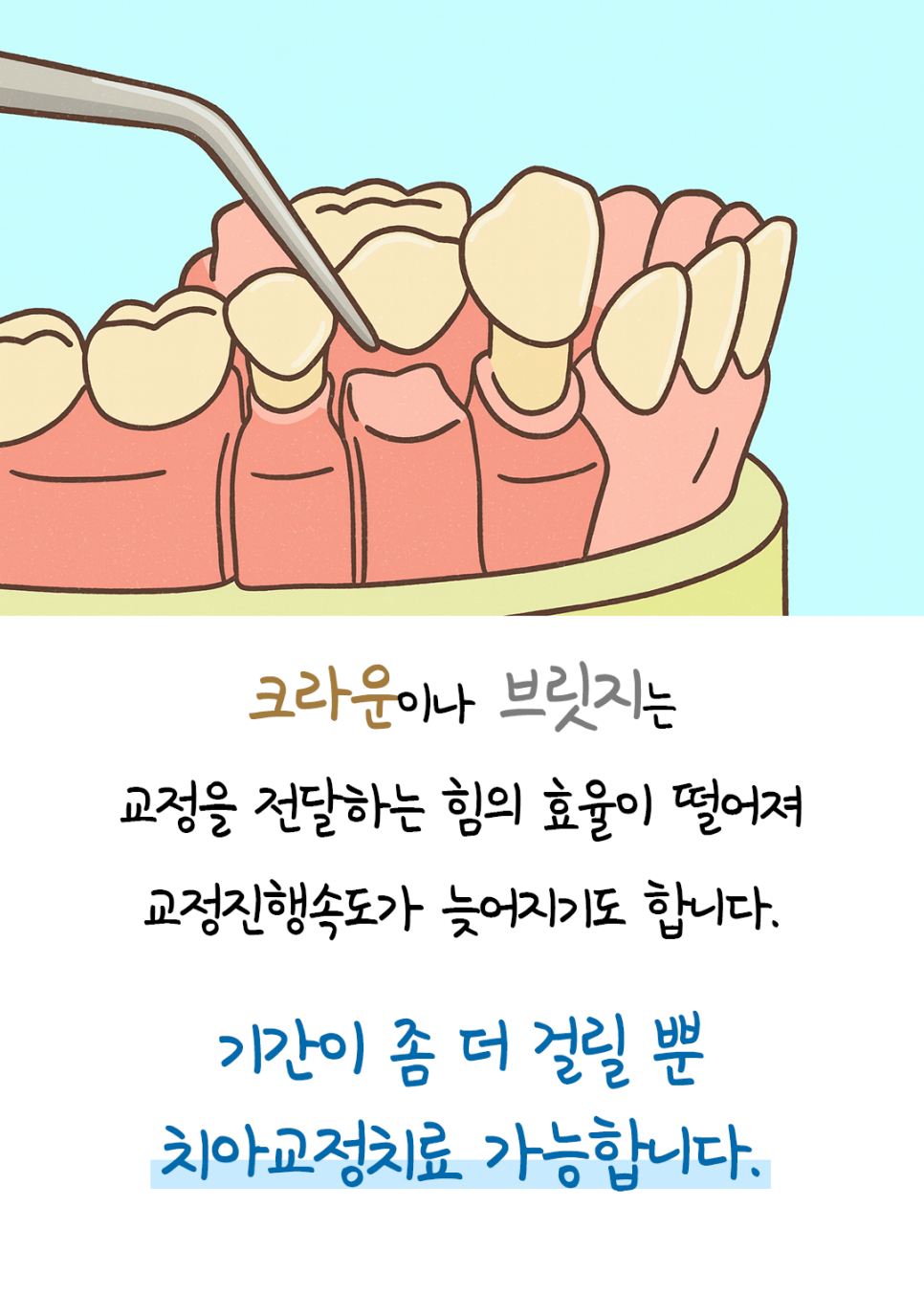
With natural teeth, orthodontic force
is delivered directly to the tooth,
but crowns are structures that are placed as an extra layer over the tooth,
so when force is transmitted to the tooth,
the efficiency of force delivery may be slightly reduced.
In particular,
with bridges
(a prosthetic restoration that connects the crowns of multiple teeth into one unit),
the movement of multiple teeth may be restricted,
so the progress of orthodontic treatment may also be slower.
(In some cases, this may actually work to an advantage,
but the details can be confirmed during an actual consultation with the doctor.)
That does not mean orthodontic treatment is impossible.
Rather, you can understand it as meaning that the treatment period may simply take a bit longer.
Orthodontic characteristics when crowns/bridges are present
- Crowns may come off during orthodontic treatment

During orthodontic treatment,
it is common for brackets attached to crowns to detach,
and in rare cases, the crown itself may separate from the tooth and come off.
In particular, older crowns,
or crowns placed on teeth that had severe damage to the natural tooth at the time of crown treatment,
have weaker retention.
So during orthodontic treatment, they may come off because of orthodontic force,
but that is because the tooth condition was not good to begin with,
not because of the orthodontic treatment itself.
In such cases,
the crown can be reattached right away,
or remade if necessary.
How bands help firmly support orthodontic treatment on crowned teeth
- Use of banding (metal bands) and points to note
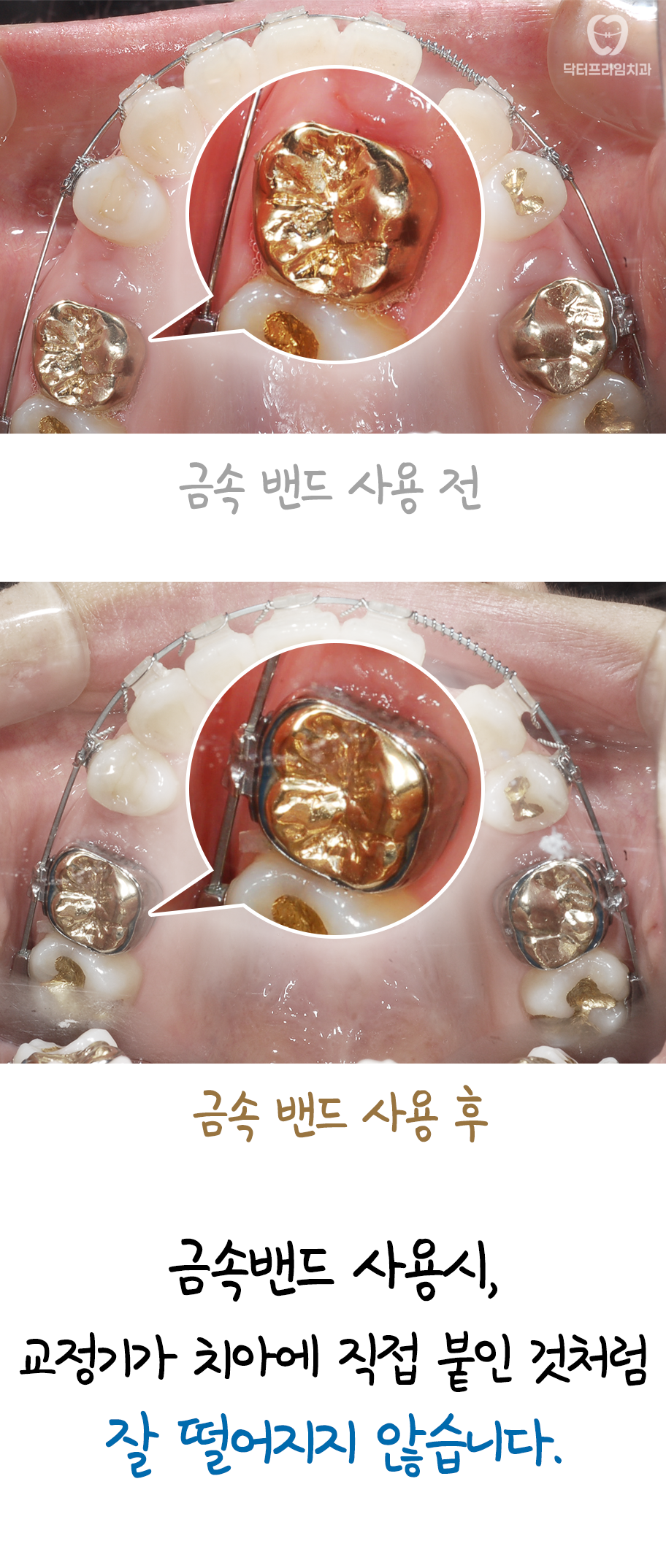
If the brackets attached to a crown keep coming off repeatedly,
it becomes difficult to carry out normal orthodontic treatment.
So in cases where bracket attachment is difficult like this,
a metal band is wrapped around the tooth to proceed with treatment.
(The bracket is firmly fixed to this metal band.)
A major advantage of bands is that the bracket does not come off as easily as when it is attached directly to the tooth.
However,
the fixation between the band and the tooth can weaken depending on the patient’s maintenance and care,
and the band may loosen and separate from the tooth, as if taking off a hat.
In that case,
temporary pain may occur in the tooth,
so you should visit the dental clinic in such cases,
remove the band, clean it thoroughly,
and then have it wrapped around the tooth again.
The pain will go away,
and orthodontic treatment can continue.
Orthodontic characteristics when crowns/bridges are present
- The gums around crowns may be sensitive
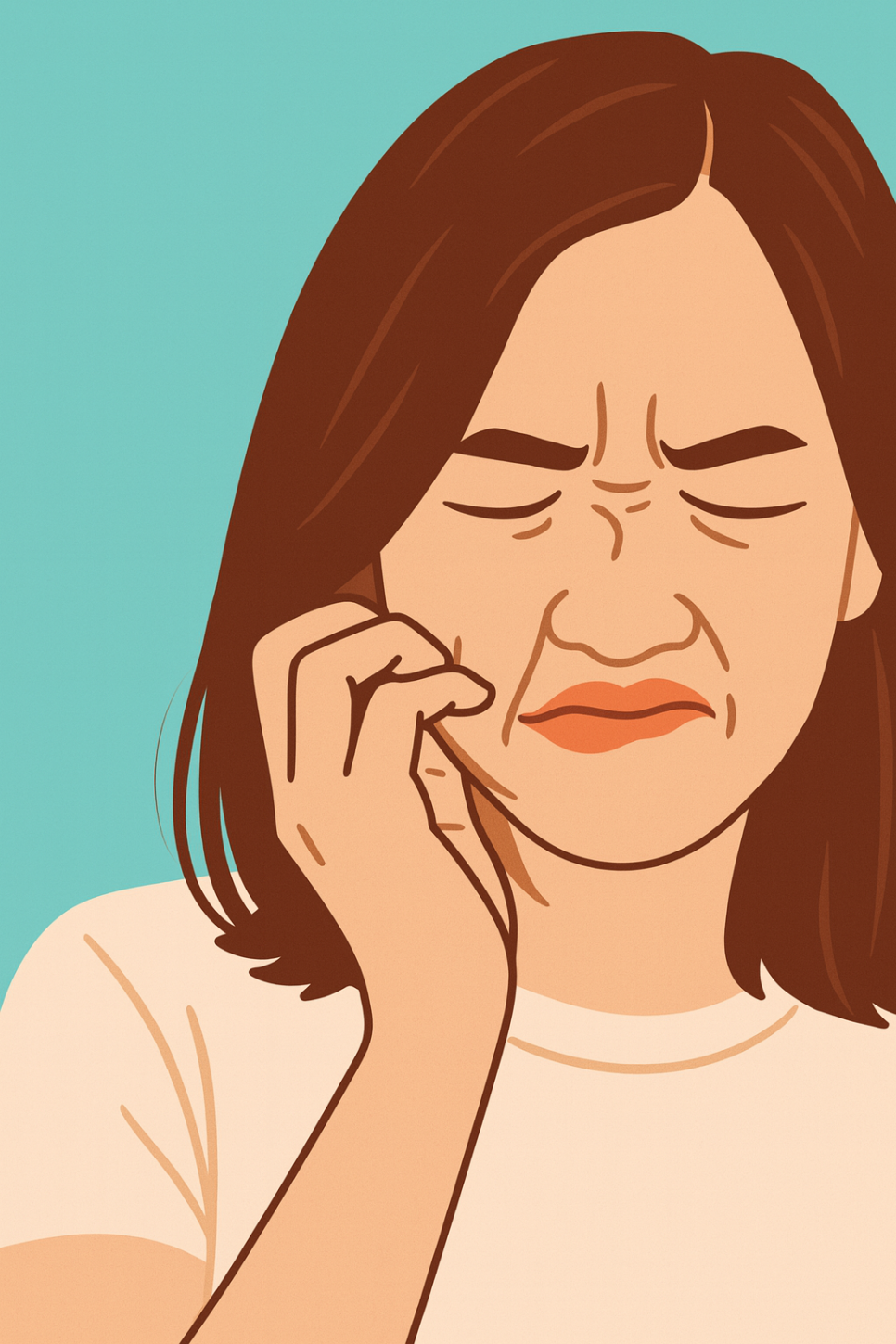
Teeth covered with crowns may have gum conditions around the crown that are weaker than those around natural teeth,
or inflammation may develop more easily.
Also, the contact areas where a crown meets a natural tooth,
or where one crown meets another crown,
are more prone to food getting stuck than contact areas between natural teeth.
So during orthodontic treatment,
a lot of food may get stuck,
and temporary gum inflammation may occur.
These points are not because of orthodontic treatment,
but are structural characteristics of prosthetic restorations such as crowns.
Therefore,
some discomfort may temporarily occur during orthodontic treatment,
but it is not a problem serious enough to cause major difficulty in treatment progress.
Questions about orthodontic treatment when crowns/bridges are present
- Do I need to get the crowns redone after orthodontic treatment?
This is something many patients wonder about.
To answer first,
in some cases,
it is standard to redo the crowns.
Because once orthodontic treatment is finished
and the teeth are aligned neatly,
the crowns made for the original misaligned arrangement may have slightly shifted contact points with adjacent natural teeth.
As a result, food may keep getting stuck
and this can lead to gum inflammation or discomfort.
In such cases,
it is best to remove the existing crowns
and remake them to match the new alignment.
But
that is not the case for every patient,
and if there is no discomfort or problem,
it is much more common to continue using the existing crowns as they are.
✅ Conclusion ✅
Even if you have prosthetic restorations such as crowns, bridges, or zirconia,
orthodontic treatment is fully possible.
Even if you have prosthetic restorations such as crowns, bridges, or zirconia,
orthodontic treatment is fully possible.
However,
1️⃣ adhesion strength
2️⃣ orthodontic speed
3️⃣ gum condition
4️⃣ whether prosthetic work needs to be redone after treatment
If you start orthodontic treatment after understanding these factors in advance,
you can proceed with treatment more comfortably and with greater peace of mind.
If you consult with Dr. Prime Orthodontic Specialist
and set up an orthodontic plan that takes your prosthetic condition into account,
you may achieve a more comfortable and stable result.😊
Recommended video to watch together🎬
Quick reservation and consultation ⬇️



You’re your lifelong family dentist, Park Yeol🩺
Based on 20 years of experience,
I introduce trustworthy dental information.😃

Jeong,