Doctor, my jaw makes a cracking sound
and my jaw hurts every time I eat...
.
.
.
This is a story that many people share with us.
Among the various symptoms caused by poor jaw joint condition,
a typical one is
hearing a clicking sound or
feeling like something is getting stuck
when chewing or opening the mouth.
The causes of jaw joint disorders,
which can present with many different symptoms,
vary widely, but
habits such as grinding or clenching the teeth while sleeping,
or chewing only on one side due to misaligned teeth,
can worsen the jaw joint.
When the jaw joint gets worse,
it becomes difficult to open the mouth,
and pain can occur in the jaw.
The pain may also spread to the shoulders or neck.
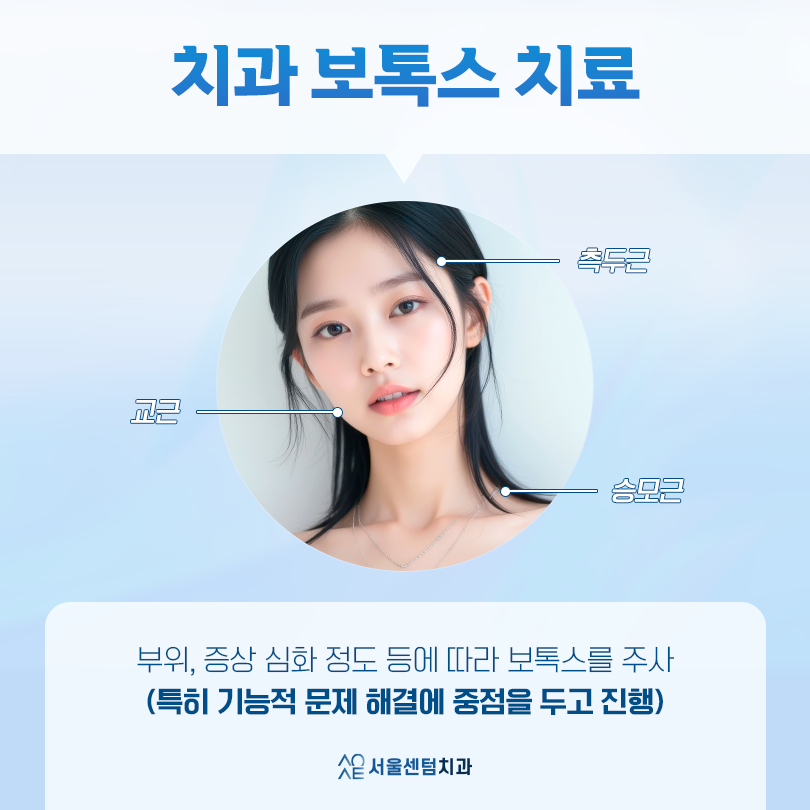
So in cases like this, dental jaw Botox
can be injected into the jaw muscles,
temporalis muscle, trapezius muscle, and other necessary areas
to help relieve fatigue in each area
and ease symptoms.
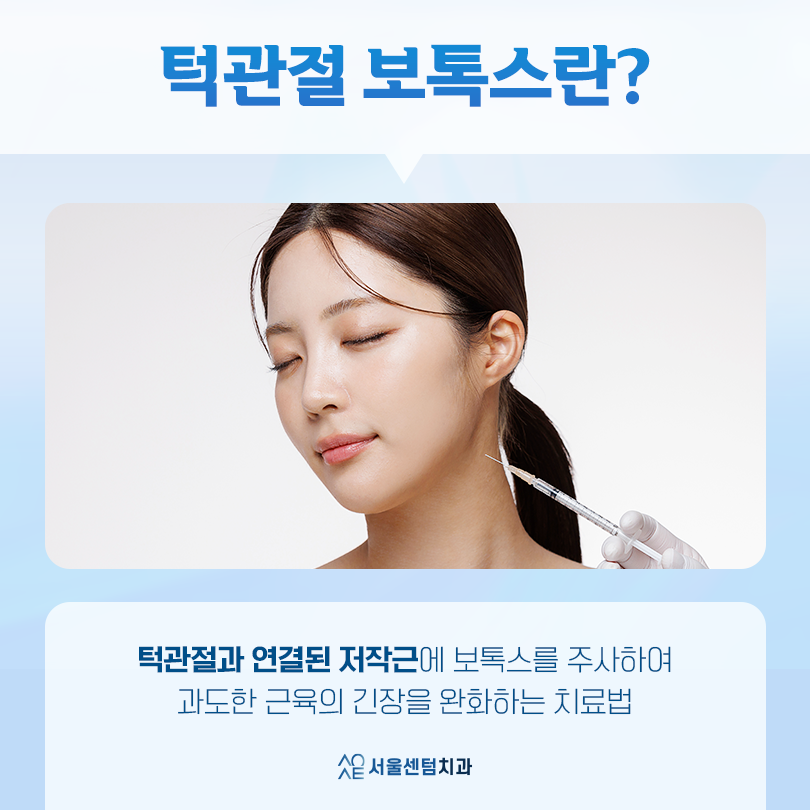
Dental jaw Botox is a procedure that
uses botulinum toxin injected into the overstrained chewing muscles around the jaw
to induce muscle relaxation.
The ingredient in botulinum toxin
is originally a neurotoxin produced by botulinum bacteria,
but when purified in very small amounts,
it can help improve vasoconstriction and muscle tension in the jaw joint,
which is why it is used to relieve various conditions.
There are several types, but the most widely used are
type A and type B.
Jaw joint Botox is generally known as a cosmetic treatment
called 'square jaw Botox,'
but in dentistry it is also injected into areas other than the jaw muscles
to relieve jaw-related symptoms.
Areas where dental Botox can be injected

- Masseter Botox
The masseter is a 대표적인 chewing muscle that moves the jaw.
When this muscle becomes developed, the jaw can look more pronounced.
Injecting Botox into the masseter gradually relaxes the muscle,
which can help create a slimmer V-line jawline.
- Temporalis Botox
The temporalis is a muscle located near the temple.
When this muscle becomes overly developed,
problems such as jaw joint pain or teeth grinding can occur.
So if temporalis Botox is performed together,
the balance of the jaw muscles can be adjusted properly,
and the effect of relieving teeth grinding can be improved.
- Trapezius Botox
Trapezius Botox, which is often done together with jaw treatment,
is effective for shoulder pain,
but it is also effective for treating headaches, including migraines.
So if jaw joint problems make daily life uncomfortable and you also have headaches,
this may help improve the condition.
Why get Botox at a dental clinic?
Because Botox is usually performed in dermatology clinics,
many people are surprised when we tell them that
Botox can also be done at a dental clinic.
Cosmetic Botox performed in dermatology clinics
is generally aimed at improving wrinkles or the jawline,
so if you want to address those concerns,
considering Botox at a dermatology clinic is fine.
However, if the treatment is for jaw joint-related care,
it is better to receive it at a dental clinic that has knowledge of jaw joint anatomy whenever possible.
When therapeutic dental jaw Botox is needed,
it should not simply be injected under the skin;
it is effective only when the exact muscle location is identified first.
Also, if it is injected into the wrong area,
side effects such as pain, reduced jaw function, and discomfort while chewing can occur,
so the approach must be careful.
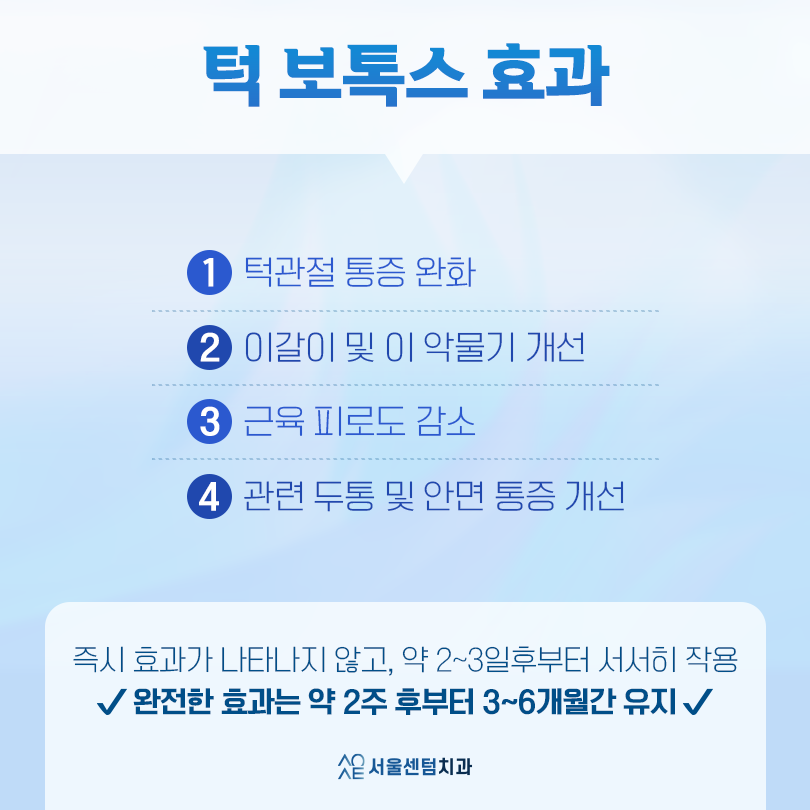
The effects of dental jaw Botox begin to appear gradually
about 2 to 3 days after treatment.
The full effect can usually be seen after about 2 weeks,
and it lasts for about 3 to 6 months.
1️⃣ Relief of jaw joint pain
By relaxing tense jaw muscles,
it effectively reduces pain around the jaw.
2️⃣ Improvement of clenching and teeth grinding
It helps reduce the strain placed on the jaw joint
by improving teeth grinding habits during sleep.
3️⃣ Relief of muscle fatigue
It helps improve and release fatigue in muscles that are overly tight or developed,
and supports the recovery of natural jaw joint movement.
4️⃣ Improvement of related headaches and facial pain
It can relieve headaches and pain caused by jaw muscle tension.
Dental jaw Botox,
recommended for these people.

◽ People whose chewing force is strong due to excessive jaw muscle development
◽ People who have a habit of clenching their teeth
◽ People with facial asymmetry
◽ People who grind their teeth during sleep
◽ People who feel discomfort when opening or closing the mouth
◽ People who feel pain or hear sounds in the jaw
If the problem continues,
it becomes easier for jaw and oral health to worsen,
so it is better not to dismiss it lightly.
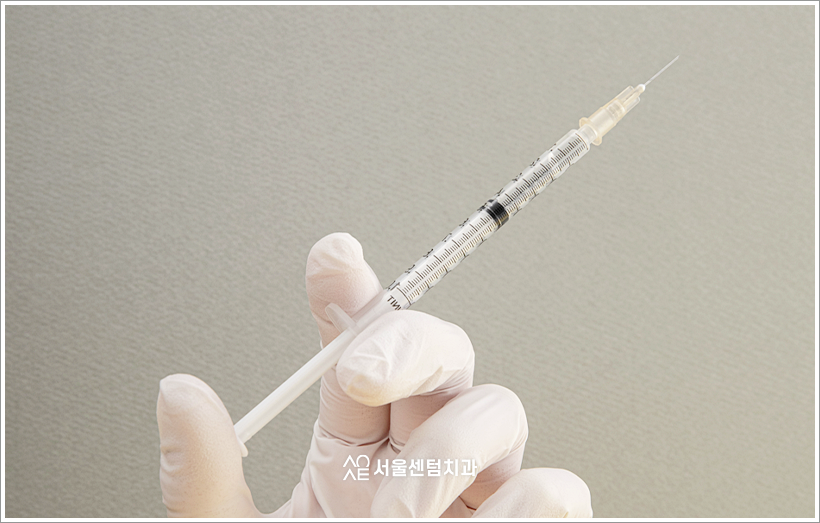
Botox can be considered a relatively simple procedure,
but because in dentistry it is a treatment that can address jaw joint disorders,
it is important to identify the correct muscle layer and dosage
before performing the procedure.
To expect improvement,
consulting with a medical professional who has extensive Botox experience
and a strong understanding of the structure and function of the jaw
is more important than anything else before receiving Botox.
In addition, if you regularly do jaw joint stretching after dental jaw Botox,
it will help even more in solving the problem,
so we hope you will put it into practice.
We hope this post has been helpful in relieving discomfort caused by the jaw joint.
This has been Seoul Centum Dental.
This post was written in compliance with the Medical Service Act.
All treatments may have side effects, so sufficient consultation with a medical professional is necessary.