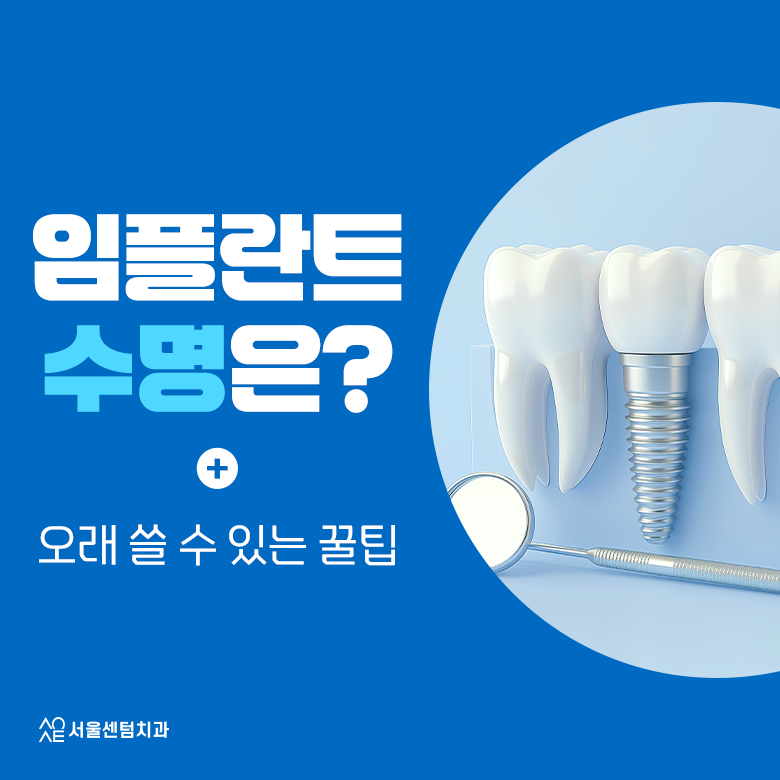
When a tooth is lost,
a replacement method that comes to mind
includes bridges or dentures,
but the method most similar to natural teeth is an implant.
Implants are chosen by many people because
they are similar to natural teeth in both aesthetics and chewing ability.
At this point, we often get questions like,
"How many years can it be used after placement?"
So today,
I’d like to talk about how long implants can actually be used,
and how to extend their lifespan
for as long as possible.
How long do implants last?
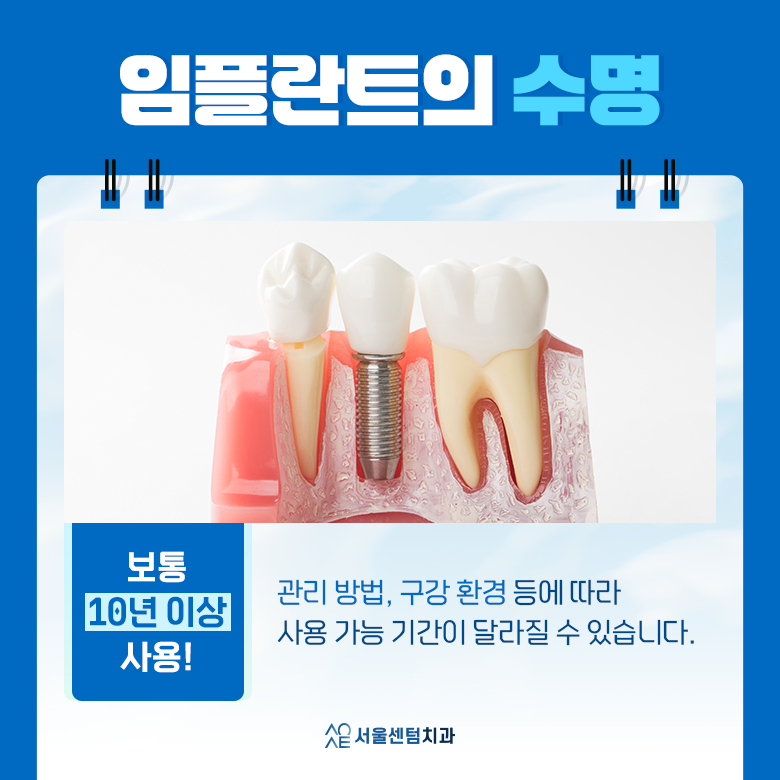
If there are no particular problems,
it is common for implants to be used for more than 10 years,
and there are also cases of people using them for more than 20 years
with proper care supported by a healthy oral environment.
In other words, the period during which an implant can be used
is not fixed at a certain number,
but can vary depending on care, oral environment,
and several other factors.
In particular, when the initial stability is good
and osseointegration occurs steadily,
the lifespan is more likely to be longer.
Factors that affect implant lifespan

A variety of factors affect
the lifespan of an implant.
Representative examples include the following.
✔ Oral hygiene status
✔ Whether or not you smoke
✔ Overall health (osteoporosis, diabetes, etc.)
✔ Eating habits (whether you often eat tough or hard foods)
✔ How often you receive regular dental checkups
Among these, poor oral hygiene and smoking
have the greatest impact on shortening implant lifespan
because they cause inflammation and interfere with osseointegration.
Differences between natural teeth and implants
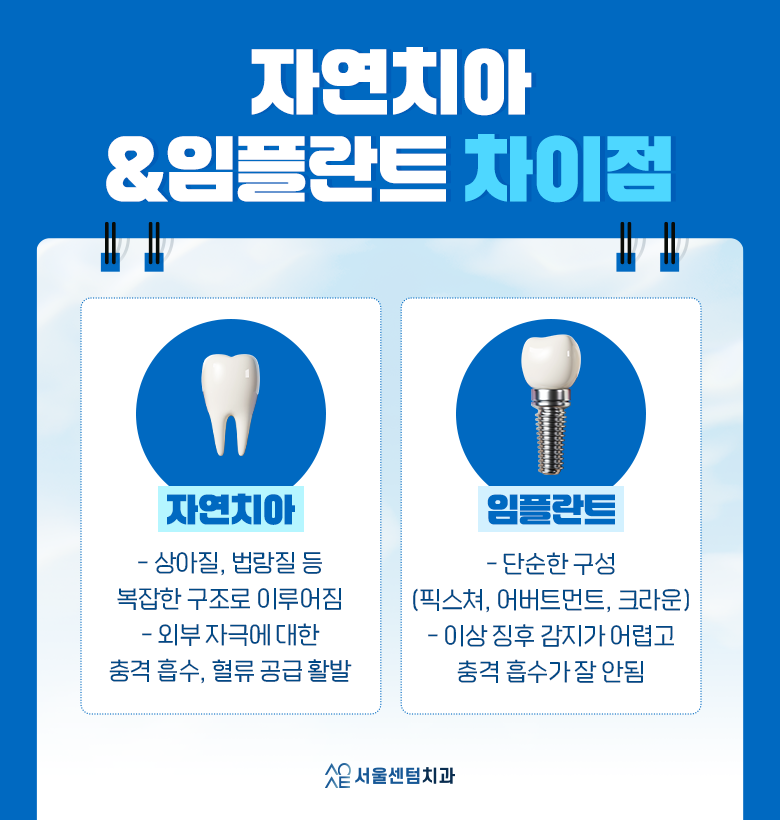
<Natural teeth>
They have a complex structure made up of
dentin, enamel, the dental nerve, periodontal ligament, and more,
allowing for shock absorption against external stimuli
and active blood flow supply.
<Implants>
They have no blood vessels or nerves
and are simply composed of three structures:
fixture, abutment, and crown.
Because the prosthesis is fixed directly to the jawbone,
any impact is transmitted directly to the jawbone.
Also, unlike natural teeth, there is no nerve tissue,
so abnormal signs are harder to detect quickly,
and if gum inflammation occurs,
recovery may be slower.
If you want to extend the lifespan of your implant,
careful maintenance is essential,
so you should pay even more attention than you would with natural teeth.
Be careful of peri-implantitis
One factor that interferes with long-term implant use
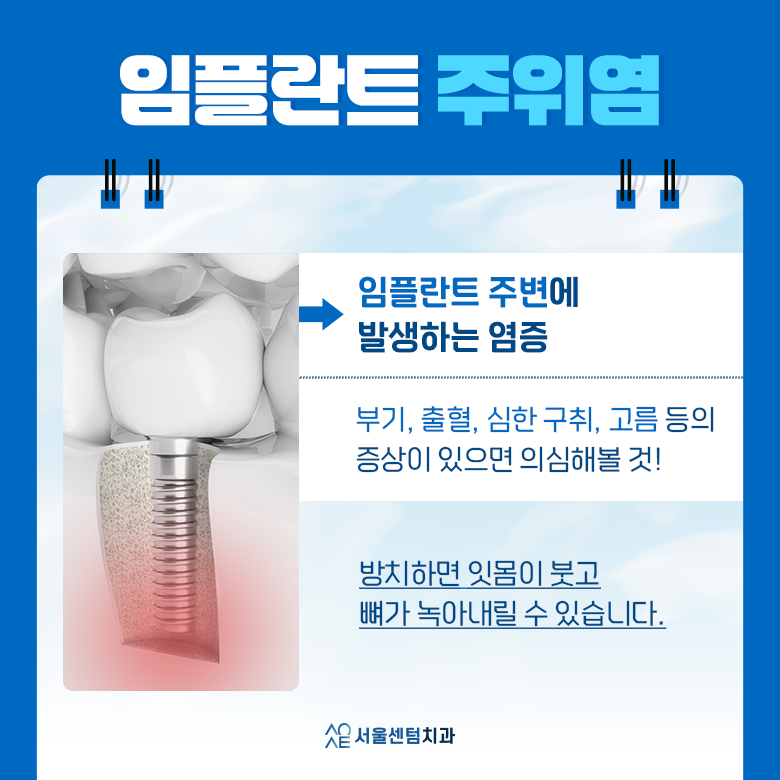
is peri-implantitis.
This is inflammation that occurs around an implant,
and if left untreated, symptoms such as gum swelling
and bone loss can occur.
It would be ideal to notice symptoms quickly,
but in the case of implants, because there is no periodontal ligament,
it is often discovered only after the inflammation has become quite severe.
As a result, the proper time for treatment may be missed,
and the implant may loosen
or even fall out.
Therefore, please do not forget that preventing peri-implantitis
through regular scaling and checkups is
the key to extending the period of implant use.
How can you extend implant lifespan?
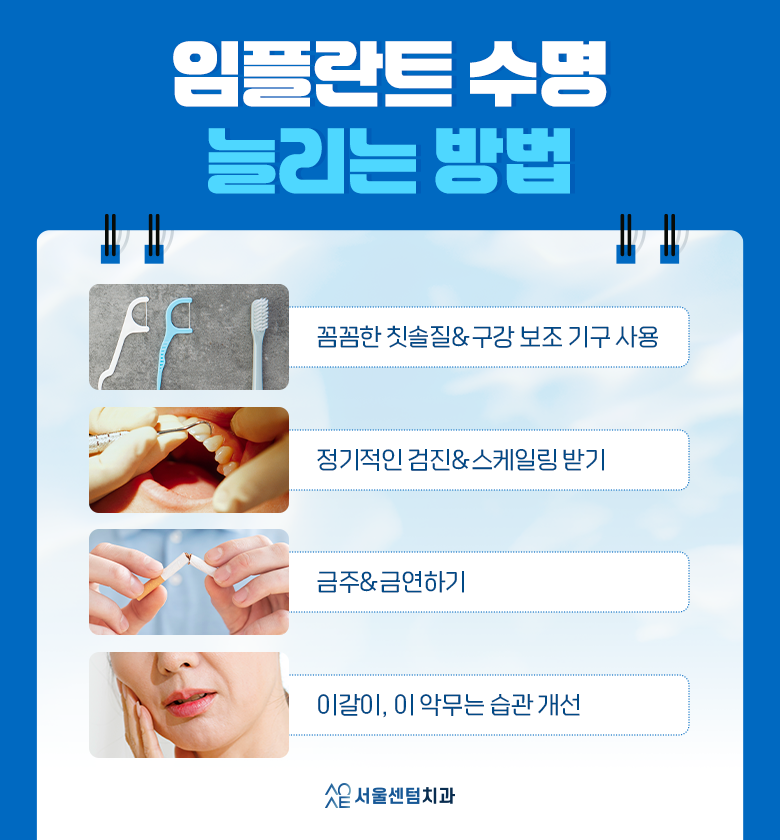
Since plaque and tartar can cause inflammation if left untreated,
you should brush your teeth thoroughly and regularly
at least twice a day,
and use auxiliary tools such as interdental brushes
to remove tartar trapped between teeth
so that your implants can last longer.
If you go for regular checkups every six months
and get scaling at the same time, tartar in hard-to-manage areas,
such as the inner surfaces of the teeth, can also be removed.
Smoking should be avoided.
This is because the components in cigarettes can cause problems with blood circulation
and lead to various gum diseases.
In addition, to reduce the risk of fracture,
please avoid hard, tough foods such as beef jerky
or dried squid as much as possible.
Habits such as clenching your teeth or grinding your teeth
are also best improved.
If the habit does not improve easily,
please consider getting help from the following.
Implants: initial placement is important.

Many people worry about maintenance after placement,
but in fact, implant lifespan can be greatly influenced by the initial placement.
For example, if placement is attempted without enough caution
even when bone grafting is needed,
or if the placement angle and position are not appropriate,
various problems can occur.
Therefore, from the time of implant placement,
after receiving a precise diagnosis from medical staff with a high level of implant expertise,
customized placement should be carried out.

An implant is not a treatment that ends simply with placement.
Depending on the ongoing care and the period after treatment,
implant lifespan can be 10 years, 20 years, or more,
and in some cases, re-implantation may be needed within just a few years.
How much attention you pay
can have a direct impact,
so even if a few months or years have passed since placement,
please continue to maintain a clean condition.
If you continue to care for it sincerely and consistently,
you will be able to enjoy function and comfort comparable to natural teeth
for a long time.