First Appearance on the Medical Channel After Rain
Hello, today I’d like to share a small update and
talk about tooth decay.

Do you know the medical channel After Rain?

The After Rain channel is a channel with 1.97 million subscribers
that introduces non-commercial medical information.
When I first came across the channel, it had around 1 million subscribers,
but before I knew it, it was approaching 2 million.

I had only ever seen the After Rain channel on YouTube before,
but this was my first time appearing on it.

I was very nervous because it was my first time,
and since it was my first live broadcast,

I gradually got used to it as time went on.
Tooth decay hurts, so it’s already late! Tooth Decay Treatment
I had a chance to talk about tooth decay as the topic.


I went through the questions that many people ask
about tooth decay.

I organized them into exactly six questions.
- Why do cavities develop even when I brush well?
This is something many people are curious about,
and they often ask why cavities develop.

It is hard to say that cavities are only a problem of not brushing enough.
The issue of the oral environment and ecosystem is more significant.

The likelihood of cavities developing is higher at night,
and if you eat a snack, do not brush your teeth,
and go to sleep, the chances of cavities
developing in your teeth are inevitably higher.
- Can cavities heal naturally?
Early cavities are difficult to
recover from naturally.

However, it is possible to stop the progression.

By providing remineralization-inducing factors,
you can improve the microenvironment around the lesion.
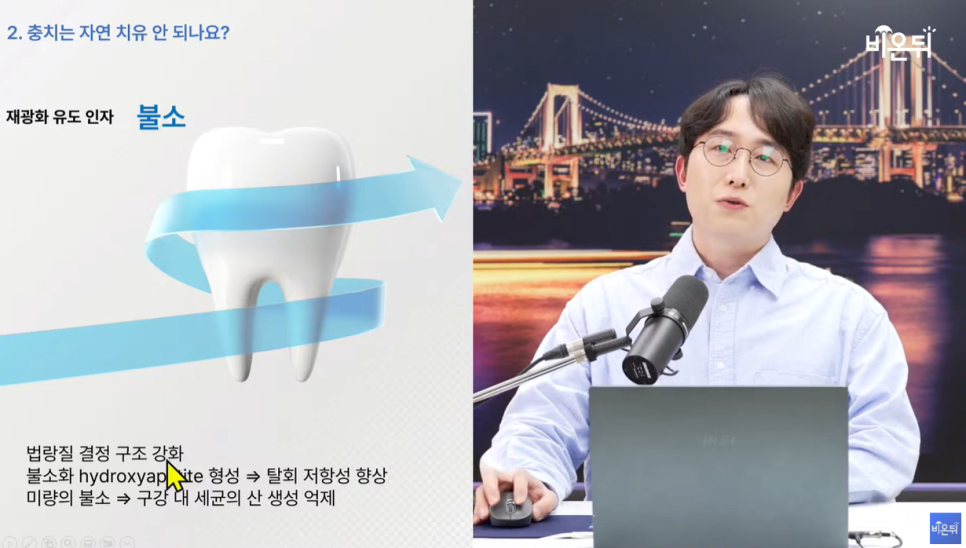
As many of you have probably heard, fluoride
can help strengthen the structure of tooth enamel.
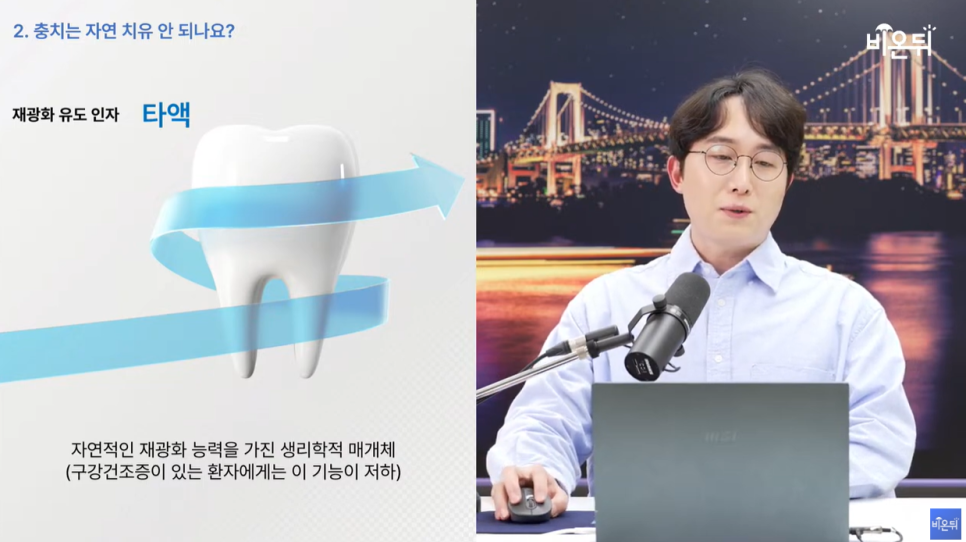
In the case of saliva, it can be seen as a physiological mediator
with natural remineralization ability,
but in patients with dry mouth, this function
may be reduced.
- Are all black spots cavities?

This is probably the question that people who are afraid to go to the dentist
ask most often.
They often wonder whether anything that looks black is a cavity.
Food pigments can stain the tooth surface and cause discoloration,
and amalgam or iron components can also discolor and appear black.

Many people also ask how to tell the difference from cavities,
but since it can be hard to distinguish with the naked eye,
it is often necessary to examine the teeth using X-rays or other auxiliary equipment.
Hidden cavities are especially difficult to identify visually,
because the surface may look fine while the decay has spread internally through the dentin.
In such cases, it can be said that identifying them with the naked eye is absolutely difficult.
- Baby primary teeth are going to fall out anyway, so do we really need to treat cavities?

This is one of the questions mothers ask especially often.
People often ask whether primary teeth, since they’ll be used and then removed anyway,
really need cavity treatment.
In fact, primary teeth are not just childhood teeth;
they have a very specific role.
Because they are important for permanent tooth alignment, jaw growth,
and the formation of eating habits, they definitely need to be treated.

If treatment is delayed, it can spread to pulpitis or an abscess,
becoming a much bigger problem,
or it can negatively affect the enamel formation of the permanent tooth germ.
It is not simply a tooth that passes by and is forgotten;
it is a medium that supports the development into permanent teeth.
- Why is cavity treatment painful and why is it expensive?

This is a rather fundamental question.
There are also quite a few cases where people are too afraid of the cavity itself to get treatment.
Because cavities spread deeper over time,
they become more expensive to treat
and require higher-level treatment.
Of course, the pain also becomes more severe.

In particular, root canal treatment for severe cavities
involves removing the infected pulp tissue,
so it requires a more precise procedure,
and because expensive materials are needed,
the cost inevitably rises.

Cavity treatment is not covered by insurance, so the price
inevitably rises more sharply.
If a cavity is found early, it can be resolved with a simple treatment,
and the treatment cost is not very high, so
please keep that in mind.
Do you have to go to the dentist often to prevent cavities?

Regular dental checkups are not simply about confirming
whether you brushed your teeth;
they are an opportunity to comprehensively evaluate the distribution
of dental plaque, early signs of cavities, and the health of the gums.

To prevent cavities, regular checkups every 3 to 6 months are recommended,
and for low-risk groups, a yearly checkup is sufficient,
so please be sure to visit regularly
and keep up with scaling.

After visiting After Rain once, it felt quite meaningful,
and the studio was so large and spacious that I was very nervous.

It was a new experience, and I hope there will be another opportunity
to communicate with viewers of the medical channel After Rain.
Can I smoke on the day of implant surgery?
Do implants have a warranty period, too?