8 myths about wisdom teeth
Hello, today I’d like to talk about wisdom teeth, which many people fear and are afraid of.
I’ve had all four of my wisdom teeth removed as well, and one of them was a horizontally impacted wisdom tooth, so I remember it being quite a struggle to take out.
Since wisdom tooth extraction is something everyone fears, there are countless myths about it.
Today, let’s talk about what’s true and what isn’t.
- Do wisdom teeth have to be removed?
I’d like to say yes.
In fact, views on wisdom teeth can differ from dentist to dentist.

Some people may say that if the wisdom tooth is fine, there’s no need to remove it.
The reason I tell almost all patients that wisdom teeth should be removed is that most wisdom teeth cause problems over time.
In conclusion, because they can affect the permanent teeth, I recommend extraction.
They often affect the second molar right in front of them.
- Wisdom teeth only need to be removed when they hurt
Wisdom teeth should be removed before they hurt.
Most dental treatments are already too late if you only come in when it hurts.
The later you come, the more pain and the higher the cost, so you should make sure to check through regular dental exams.
- My face shape changed because of my wisdom teeth
Can wisdom teeth change your face shape?
There is also a myth like this. You may have heard sayings such as that the jaw gets bigger or the face gets bigger.
It’s not true, and if the cheek muscles change or if you gain weight, you may feel that way.
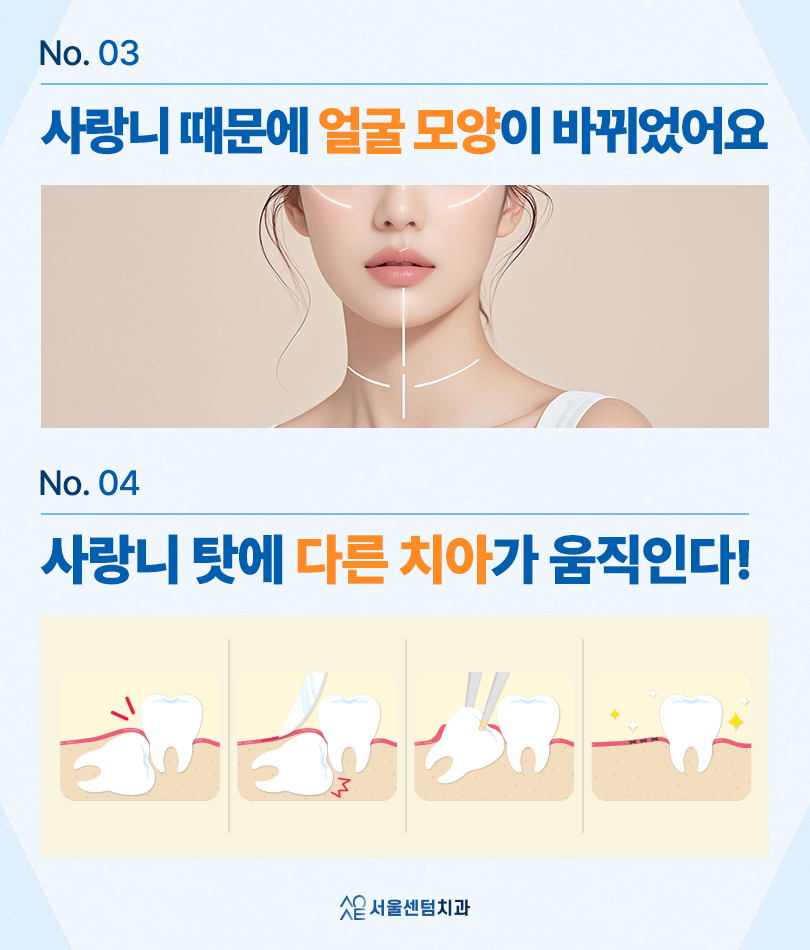
But wisdom teeth do not have the power to change the structure of the jawbone or alter the face shape itself.
If they could, wouldn’t many people’s faces have already changed or become a major problem?
Compared to changing face shape, the effect of wisdom teeth is far too small and insignificant.
- Wisdom teeth push other teeth out of place
You may have heard that as wisdom teeth come in, they push the teeth and move all the other teeth.
I find that hard to agree with.
People who have had braces will probably know.
They know how hard it is for teeth to move and how much pain it involves.
The eruptive force of a wisdom tooth is not strong enough to push other teeth out of place.
If anything, the wisdom tooth gets pushed instead.
- Wisdom tooth extraction causes a lot of bleeding
This is probably why many people are very afraid of having their wisdom teeth removed.
That there is a lot of bleeding after extraction

or that blood keeps coming out for several days
That is not true.
There can be a little oozing of blood for about 2–3 days.
After that, there should be no major problem with daily life.
In rare cases, bleeding may continue, but there may be an infection or another problem after extraction, so please be sure to contact the dental clinic where the extraction was performed.
- After wisdom tooth extraction, you must not drink alcohol or smoke, or something terrible will happen
I’ve really seen this myth a lot as well.
Have you heard people say that if you drink or smoke after extraction, you’ll die or the bleeding won’t stop?
Of course, that is false.
You won’t die just because you drink alcohol or smoke after having a wisdom tooth removed, but it is of course not recommended.
After wisdom tooth extraction, the inside of the mouth is in an inflamed state.
Because it can slow down healing and may lead to infection in the extraction site, I recommend not doing it.
In particular, smoking involves inhaling air, right?
For that reason, it can cause serious side effects such as dry socket, so please be careful.
Please absolutely refrain from smoking and drinking for at least 2 weeks.
- If you remove a wisdom tooth, your headache goes away

A myth that if you get a headache when a wisdom tooth comes in, the headache goes away when it is removed.
This is actually the first time I’ve heard this myth.
If you were experiencing gum pain or toothache, it’s possible you felt that way because the pain disappeared.
Realistically, headaches can have many different causes, so it is hard to determine that this is related to a wisdom tooth.
- When a wisdom tooth comes in, the gums will always swell and you will always get a fever

Just because a wisdom tooth comes in does not mean it will always hurt or cause a fever.
If the wisdom tooth comes in nicely and does not cause inflammation around it, it does not necessarily mean swelling or fever will occur.
Fever is a typical sign of inflammation, so if the inflammation caused by a wisdom tooth is severe, you may also get a fever and your cheek may swell significantly.
In such cases, it is better to first prescribe antibiotics or anti-inflammatory medication to reduce the inflammation and swelling, and then perform the wisdom tooth extraction.
Today, I talked about the many myths surrounding wisdom tooth extraction, something many people fear.
There are quite a few exaggerated myths about wisdom tooth extraction, and perhaps because the fear is so great, many myths and exaggerations have come along with it.

In most cases, wisdom tooth extraction does not involve severe pain afterward, except for a few serious cases, so don’t be afraid and I recommend getting your wisdom teeth examined soon to see whether they need extraction or treatment.
Implant floss
What kinds of implant grades and types are there?