A Dental Implant That Was Fine Suddenly Feels Loose?
Dental implants are widely used as a stable and effective solution
for replacing natural teeth.
However, even after receiving implant treatment, you may suddenly feel one day,
"Something feels strange...?"
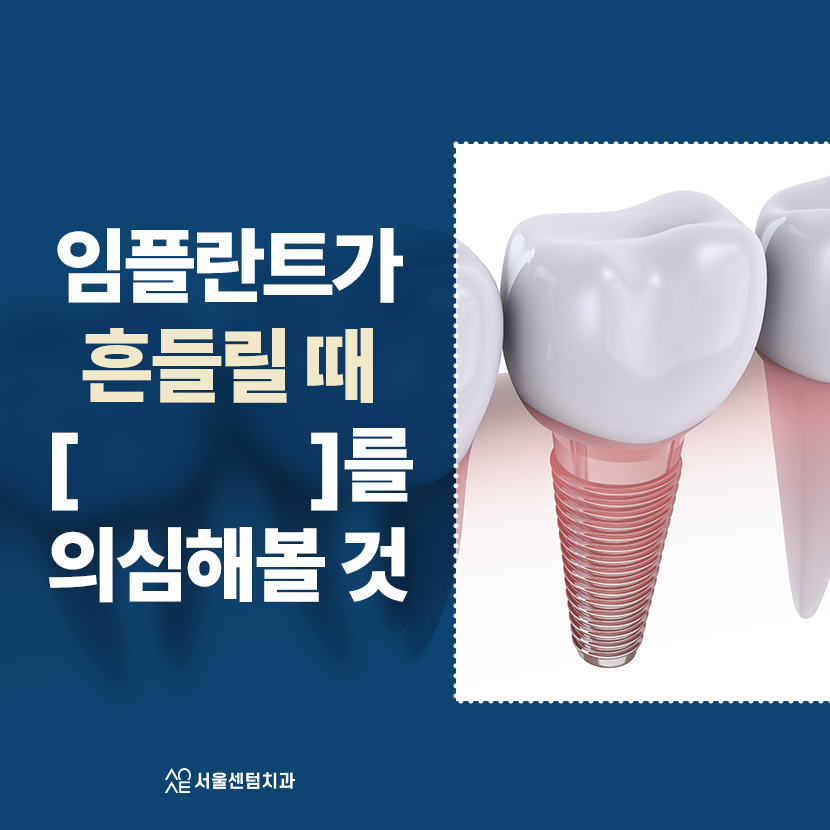
This is implant mobility.
Even if the implant appears fine on the outside, there may be a significant possibility that problems have developed internally involving the gums, bone, or other factors.
"Doctor, once you get an implant,
isn't it semi-permanent?"
Many patients ask this question,
and each time, we explain that its lifespan can vary depending on the oral environment and how it is maintained.
Those of you reading this may not have known that dental implants also have a lifespan.
That is perfectly understandable.
You can learn about it from now on^^
Let me list several causes of implant mobility
that may affect the lifespan of an implant.
⑴ Pain May Appear Late
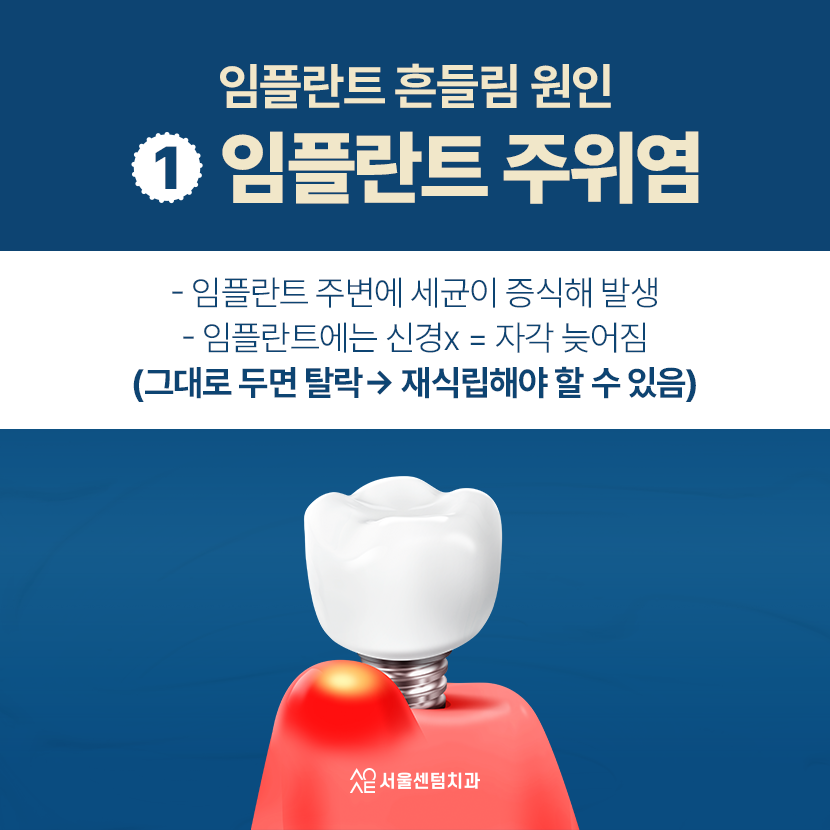
Peri-implantitis should be suspected first when an implant becomes loose.
It is an inflammatory disease that develops when bacteria multiply in the gum tissue and alveolar bone around the implant.
Peri-implantitis weakens the implant's fixation,
which can cause mobility.
The problem is that implants have no nerves,
so pain signals may appear late!
Among the patients who notice the problem and visit our clinic,
we have seen several cases in which a substantial amount of alveolar bone had already been resorbed,
weakening the implant's support.
For prevention, regular visits for checkups,
scaling, and plaque and tartar management are essential,
and treatments such as root planing should be performed when necessary.
⑵ What Should You Do If the Fixation Screw Loosens?
When an implant is placed, a component called an abutment is connected
between the crown and the fixture.
For stronger fixation,
the screw inside the abutment is tightened securely.
Although it is tightened firmly, continuous stress can cause the screw to loosen.
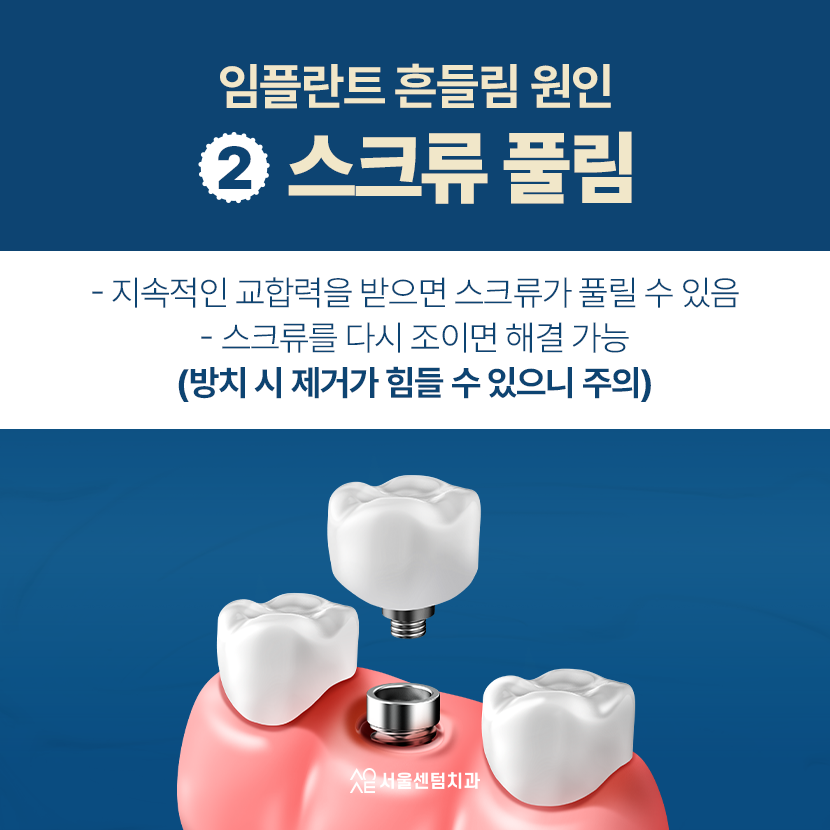
If the screw is loose, the fixture may remain fixed
while the crown moves.
Some people mistake this for the entire implant becoming loose
and even ask whether the implant needs to be replaced.
In this situation, retightening the screw can resolve the problem!
However, if it is left untreated, the abutment itself and the fixture may fracture after the screw loosens.
Therefore, if you feel even slight mobility,
please visit a dentist immediately.
⑶ Osseointegration: This Is the Key Point
Osseointegration is a very important process for dental implants.
The implant must bond firmly with the jawbone
to achieve long-term stability.
If this process does not proceed smoothly,
mobility may occur.
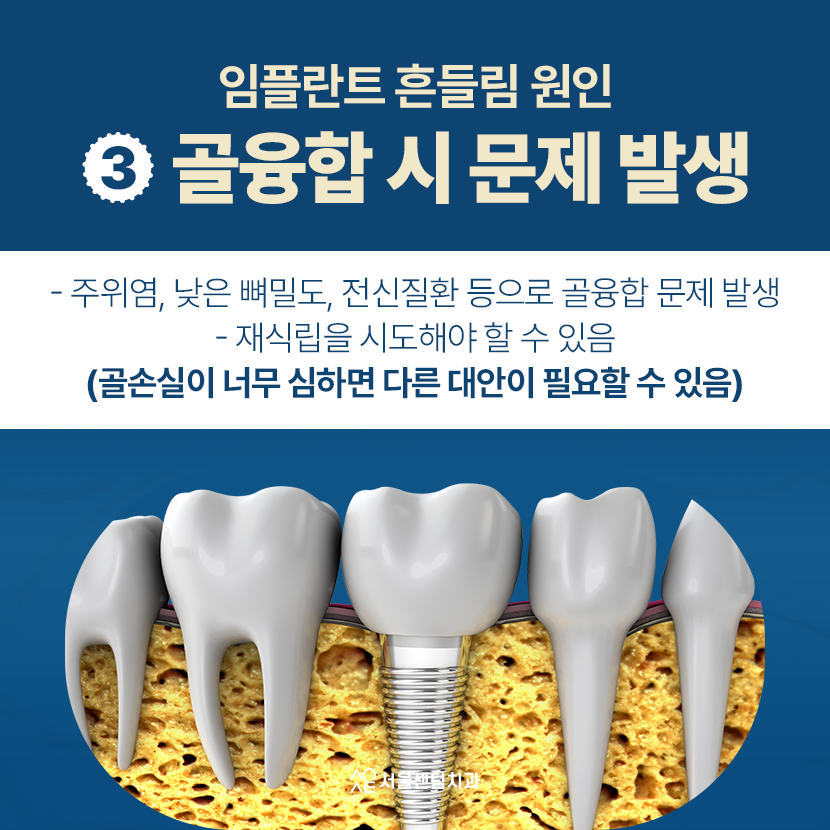
Factors contributing to failed osseointegration include the previously mentioned peri-implantitis,
low bone density, systemic diseases, and poor overall condition.
In particular, patients with osteoporosis may not achieve sufficient bonding with the implant because of reduced bone regeneration.
Patients with diabetes may also experience poor osseointegration because inadequate blood sugar control can reduce their ability to recover.
Therefore, before surgery, it is essential to check whether systemic diseases are present and how severe they are,
as well as to conduct a comprehensive preliminary diagnosis through detailed imaging.
Treatment should proceed only after this evaluation
so that appropriate osseointegration can take place.
⑷ Careful, Consistent Maintenance Is Always Necessary

Because implants are artificial devices,
even slight neglect of oral hygiene
can increase the risk of problems with osseointegration and peri-implantitis!
Incorrect brushing habits, not using dental floss or interdental brushes,
smoking, and drinking are typical risk factors.
Grinding or clenching your teeth during sleep can also place excessive force on implants
and cause microcracks.
When the effects of these lifestyle habits continue over the long term,
they can promote implant mobility.
For people who have difficulty changing these habits, we recommend treatments such as wearing a mouthguard or Botox.
Do not try to solve the problem on your own.

Some people try to resolve the problem themselves
using information they found online.
However, handling the implant arbitrarily can accelerate the damage,
so you should not touch it yourself.
Depending on the cause of the mobility, various methods may be selected,
including refixing the screw, replacing the prosthesis,
treating inflammation, or using a bridge.
Therefore, if your implant begins to feel loose,
the best course of action is to visit a dentist for an examination without delay.
This is especially important because if the implant fixture itself is loose,
replacement may be necessary.
You understand that implant mobility is more than a simple inconvenience,
and is an important sign directly connected to treatment stability, right?

Accurately diagnosing the cause and providing appropriate treatment
can help preserve the implant's lifespan.
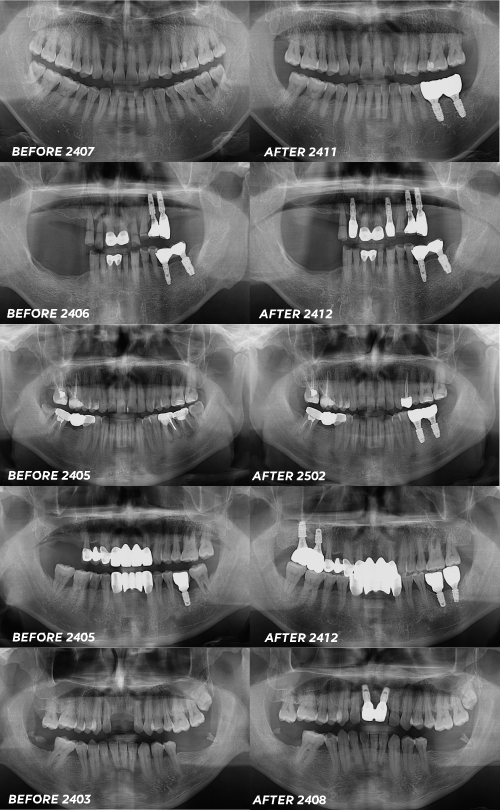
In particular, the condition of osseointegration and gum health
can determine the outcome.
Remember that only with early diagnosis, regular maintenance, and proper lifestyle habits
can an implant continue to function properly for a long time.
Please do not overlook even minor mobility!