You need to determine whether pain while wisdom teeth are coming in is simply an inconvenience
or a warning sign of a serious problem.

Wisdom teeth usually begin to emerge in the late teens
or early twenties.
Because they grow in a mature jawbone
where space is often limited,
they are molars that, unlike other teeth,
may have difficulty growing straight in their proper position.
They often fail to emerge upright and instead grow horizontally
or at an angle,
causing pain in the process.
When wisdom teeth are coming in, it is important
to distinguish whether the pain is temporary discomfort
or a sign that the condition is serious.
Because the effects can extend beyond a problem with one tooth
to affect the entire mouth and even overall health,
it is better not to take the pain lightly!
Why can wisdom teeth hurt as they come in?
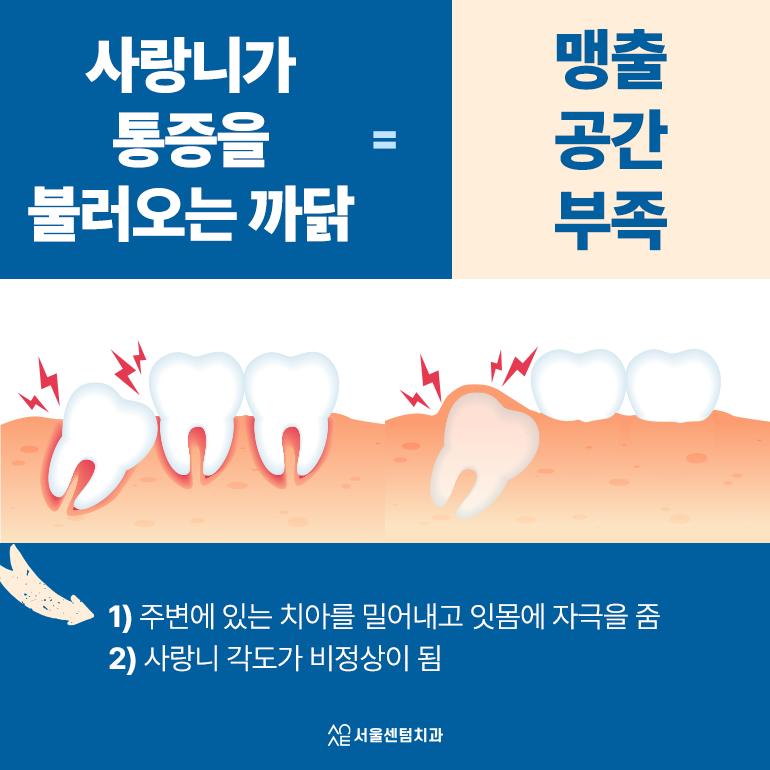
The fundamental reason wisdom teeth cause problems
can be said to be a lack of space for eruption.
Because there is not enough room within the jawbone,
wisdom teeth can cause
various problems as they grow.
This can also result in an impacted wisdom tooth,
which may irritate the adjacent molar
and potentially lead to inflammation and pus formation.
When a tiny space forms between the tooth and gum,
food debris gradually accumulates,
allowing bacteria to multiply and causing pericoronitis.
This inflammation may not stop at mild swelling
or pain, but can spread into complications
such as jawbone infection or osteomyelitis.
If left untreated, the situation could become more serious.
Wisdom teeth can disrupt your daily rhythm.
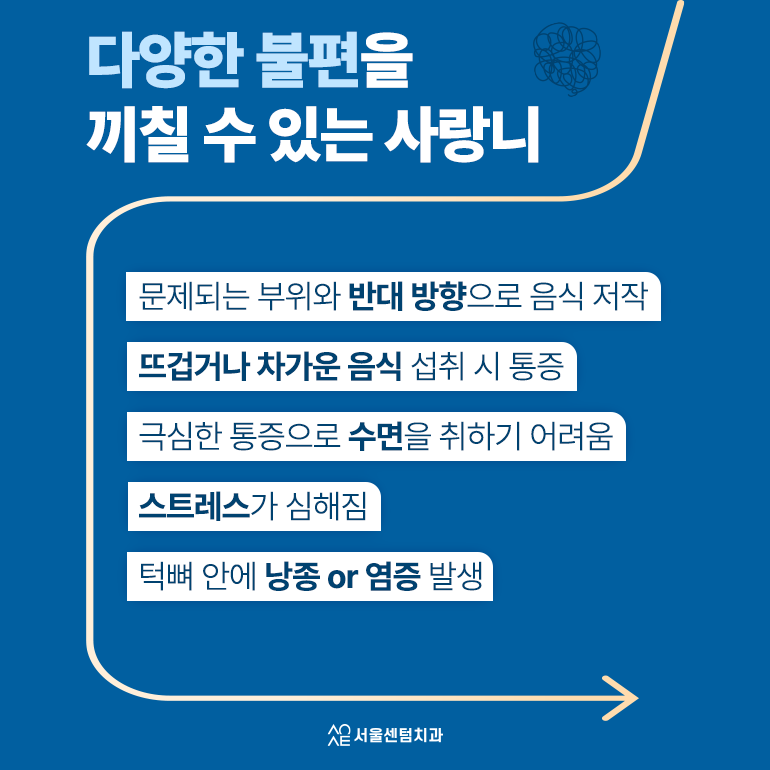
Wisdom tooth pain affects many aspects of daily life.
Because chewing is painful, whenever you eat,
you may chew only on the opposite side,
where there is no particular problem,
and you may be especially sensitive
when consuming hot or cold foods.
Recurring pain
not only reduces concentration
but can also lower sleep quality.
As the discomfort builds up, stress can increase as well.
If the problem is left as it is,
it may lead to a cyst or inflammation.
In this sense, it can be considered a factor
that disrupts your overall daily rhythm.
When is extraction unavoidable?

Whether extraction is necessary is determined
by considering the patient’s anatomical conditions
and long-term prognosis as a whole.
Not every wisdom tooth needs to be extracted,
but extraction should be considered when certain conditions are met.
Typical examples include cases where a wisdom tooth
irritates an adjacent tooth and causes decay,
or causes frequent inflammation that leads to
the formation of a pocket of pus.
This also applies when a wisdom tooth is lying horizontally
or growing at an angle.
Persistent, severe pain that does not improve
even after taking pain medication
may indicate a clear possibility that extraction is needed.
(I also had mine extracted in the past
because I kept developing gum inflammation ^^;)
Did you know that there are cases where extraction can be postponed?

Conversely, if a wisdom tooth is growing in straight,
there is no surrounding inflammation,
and good oral hygiene is being maintained,
it may be fine not to have it extracted right away.
In such cases, it is important to monitor the condition
through regular checkups.
This is to determine whether the eruption pattern is changing,
whether it is affecting nearby teeth,
and whether inflammation or other oral diseases
are developing.
However, please keep in mind that even a wisdom tooth
that appears completely normal can cause problems at any time
if care becomes inadequate!
Self-care as a temporary measure and its limitations,
as well as the fundamental solution

When pain suddenly occurs as a wisdom tooth is coming in,
applying a cold compress and taking a pain reliever with anti-inflammatory properties
may help relieve the pain and swelling
to some extent.
Using an antibacterial mouthwash or Waterpik
can help reduce bacterial growth,
so it is a good idea to do so regularly.
Carefully brushing every corner of your teeth
can also help relieve symptoms.
However, these methods are only temporary measures
and cannot provide a fundamental solution.
If the pain keeps recurring or persists severely,
be sure to visit a dentist for a detailed examination
and have your condition evaluated~
Wisdom teeth can develop in anyone,
but their progression and effects vary greatly from person to person.
Some people have no problems for a long time,
while others suffer from severe pain
and find themselves in a situation where extraction is unavoidable.
The important point is not to decide that they must be extracted unconditionally
or that it is fine to simply leave them alone.
Rather, the decision about extraction should be made reasonably,
taking into account each person’s oral structure,
the pattern of their pain,
and their future health outlook.

The process of caring for your wisdom teeth
is directly connected to protecting your oral health.
Making the wise choice to find the treatment and care methods
that suit you through early diagnosis
can reduce unnecessary anxiety.
When you experience discomfort, rather than simply worrying about it,
visit a dentist first and get a diagnosis.