Many people assume that dental implants are permanent, right?
Before getting an implant, more people than you might expect believe that once it is placed, they will be able to use it permanently.

With implants, if they are placed properly and well maintained, they can last a very long time.
However, if they are not properly maintained, it can be difficult to use them semi-permanently.
So what exactly did I do wrong to end up needing implant retreatment?
Factors That Can Lead to Implant Retreatment
Before the situation progresses to implant retreatment, it is important to carefully check for warning signs that can be noticed early in everyday life.
If the problem is detected early and can be addressed by visiting a dentist, you may be able to reduce the cost of implant retreatment.

First, if your gums frequently bleed while brushing, especially around the implant, this may be an early sign of peri-implantitis.
Second, if the implant is damaged or cracked from eating hard foods, leaving it untreated for too long can lead to bone damage and make retreatment unavoidable.
Third, if gum healing is impaired due to diabetes or smoking, you need to be especially careful during the early period after implant placement. Returning to your previous lifestyle may prevent the implant from becoming firmly stabilized at the beginning.
In addition, if food frequently gets stuck between the implants or you notice looseness or movement, even small changes should be detected and checked by a dentist.
Because implants are not natural teeth, they require consistently thorough care to remain strong and functional for a long time.
Most importantly, do not forget to attend regular checkups.
If a small problem that could have been detected early is neglected and develops into a major problem or condition, you may not be able to avoid the frightening cost of implant retreatment.
“Why Is Retreatment More Expensive When I Already Had the Surgery?”
Many people ask:
“I already paid a lot for my implant, and needing retreatment is shocking enough. Why is the price even higher?”
Implant retreatment is not simply a matter of placing another implant.
First, it is necessary to identify and correct the cause that led to the need for retreatment while you were using the implant.
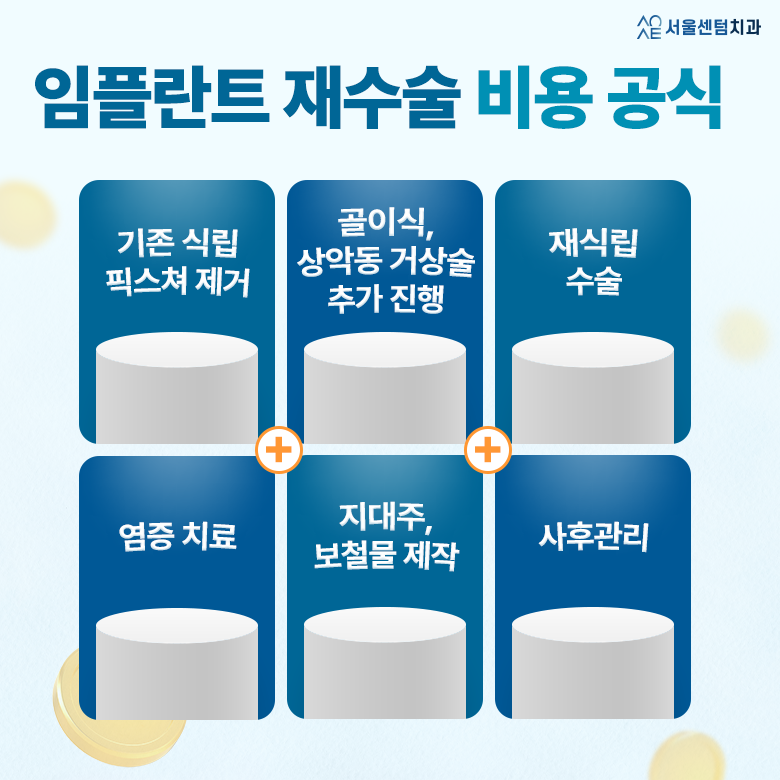
In addition, inflammation or bone loss often occurs, so implant replacement may be needed along with the remanufacture of the prosthesis as part of the same treatment plan.
In summary, the overall implant retreatment cost formula is:
Removal of the previously placed fixture + inflammation treatment
- additional bone grafting and sinus lift procedures
- replacement implant surgery + remanufacture of the abutment and prosthesis
- follow-up care as a new treatment package
In other words, the original implant must be removed, and additional treatment procedures are required.
However, removal does not always involve the same process for everyone.
Although the overall process has been described above, not every patient needs to undergo every type of removal.
There are cases that can be resolved with simple removal. If the fixture has weak stability and can be taken out easily, removal may be relatively straightforward.
However, if peri-implantitis is severe, bone resorption is extensive, and the fixture is already firmly integrated, surgical removal may be unavoidable.

Cases are also divided into severe cases requiring complete removal and cases in which only part of the implant can be removed.
If the inflammation is extensive or the implant has suffered severe damage, complete removal may be unavoidable.
If only the upper part is damaged and there is no problem with the fixture, it may be possible to make only a partial modification.
Implant Retreatment Cost Checklist
Here is a checklist of the individual costs that may be included in implant retreatment.

Save this checklist and refer to it whenever you need it.
✅ Checklist
Fixture removal
(Cost varies depending on the difficulty.)
Inflammation treatment
(Cost varies depending on the extent of infection, number of visits, and medication.)
Bone grafting and sinus lift
(Cost varies depending on the amount of graft material and treatment site.)
Replacement implant surgery
(Cost varies depending on the number of implants and the difficulty.)
Abutment and prosthesis
(Cost varies depending on the materials and manufacturing method.)
Anesthesia (may vary depending on whether it is needed as an optional service)
Follow-up care (may vary depending on whether the number of visits is included)
The actual cost of retreatment may vary depending on insurance coverage and fee policies.
Therefore, the relatively accurate cost can be determined through a consultation during your examination.
How to Avoid Implant Retreatment: A Formula You Will Regret Ignoring
Here is how to manage your implants so that proper care can help you avoid retreatment.
Save this information, and learn how to avoid spending twice as much on implant retreatment.
After receiving an implant, you should make sure to visit the dentist for regular checkups every six months to one year.
Another thing people often forget is thorough daily dental care.

Having an implant does not mean you can stop paying attention to your oral health.
Think of dental care as a lifelong responsibility, and be sure to use your toothbrush and water flosser properly.
Dental floss is also useful during implant care, but if your gums are weak, a water flosser may be recommended.
Smoking is harmful and provides no benefit, so quitting is strongly recommended.
If you notice any difference from the condition of your implant when it was functioning normally, you should visit a dentist without delay.
How to Avoid a Large Implant Retreatment Bill
The most important rule is that taking action early is essential.
Finally, it cannot be emphasized enough: remember that it is important to notice even subtle symptoms and attend checkups regularly.
Did you develop a painful problem when your wisdom tooth was coming in?
Did you go through all that effort to get an implant, only to be told it needs to be removed?