Why is the dental implant impression-taking process important?
For people receiving dental implants,
you may think that the most important part
is the process of placing the implant.
Since this involves surgery
and may include additional procedures
such as bone grafting,
people often focus only
on those aspects.
However, another thing that comes to mind when we think of dental implants
is the crown, or visible head, of the implant.
The prosthetic part placed on top of the implant
is not completed simply by placing
a tooth-shaped structure on top.
How well this prosthesis is made
is also very important.
To make the prosthesis properly, it must go through
the impression-taking process,
which makes this one of the important steps
in dental implant treatment.
The Dental Implant Impression-Taking Process
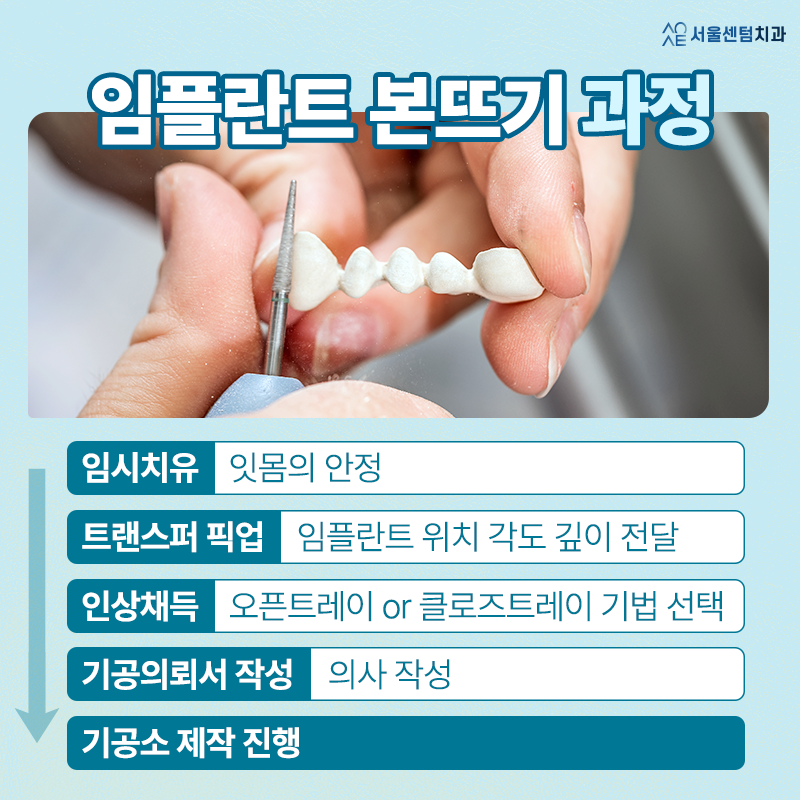
The first step is the temporary healing phase.
Before taking an impression for a dental implant,
the shape of the gums must first become stable.
Therefore, after the implant and jawbone
have properly bonded,
we must wait until the gum tissue stabilizes
before taking an accurate impression.
Next comes the transfer pickup stage.
There is an instrument called a transfer coping,
which conveys the implant’s position, angle,
and depth.
There are two options when taking an impression:
an open tray and a closed tray.
A silicone-based impression material is used.
Polyether material may also be used.
With the open-tray method, a hole is made in the tray,
and after the impression is taken,
the coping is loosened immediately
and sent to the dental laboratory
along with the model.
This method is often selected when
there are significant differences in the angles
of the teeth themselves
or when multiple implants are needed.
With the closed-tray method, the impression is taken first,
and the coping is then reinserted into the impression.
This is a convenient method when
only one implant is being placed
or when the implant is located in a narrow space.
Only after obtaining this information
can the tooth-shaped implant prosthesis
we envision finally be created.
The dental prosthesis is reproduced
as a plaster model at the dental laboratory
where it is made.
Based on this model, the final abutment
and crown are designed.
At this point, you may have the question:
“If the dental laboratory makes it,
what does the dentist do?”
When the dentist takes the impression
and sends it to the laboratory for production,
the dentist provides detailed instructions
about how it should be made.
You can think of the prosthesis as being made in detail
at the dental laboratory
based on the dentist’s assessment.
To put it simply, when constructing a building,
the dental laboratory is like the company
that makes the construction materials,
while the dentist is like the designer
who creates the plans separately.
The Pain Everyone Worries About When Going to the Dentist
Most patients, regardless of their age,
are afraid of dental treatment.

Since taking an impression for a dental implant
is different from the treatments people usually receive,
many people ask whether the process is painful.
In practice, it generally does not cause direct pain.
However, people who are sensitive
may feel uncomfortable because
they have to keep their mouth open for a long time.
People with weak or sensitive gums
may occasionally experience pain or bleeding.
As we have entered the digital age,
more and more dental clinics
are using digital intraoral scanners.
However, for the time being,
directly taking an impression of the teeth
can be considered more accurate
for the precise fabrication of dental implants,
and it remains the standard method.
How Can You Avoid Remaking or Replacing a Dental Implant?
Many people may think,
“If they just take the impression,
the implant treatment will be finished.”

If an impression is taken while inflammation has developed
because the gums have not been properly maintained,
the prosthesis that was made
may no longer fit correctly
once the inflammation subsides.
Therefore, you should take good care of your gums normally,
but especially while undergoing dental implant treatment,
you need to maintain them carefully.
If the Implant Was Placed Properly, Is Impression-Taking Really That Important?
Some people may think,
“If the implant has already been placed properly
and the fixture has adapted well,
is it really that important
what is placed on top?”
If it is not accurate,
the likelihood of inflammation developing
around the implant or of breakage
may increase over the long term.
This is because the bite may not fit properly.

Because teeth are highly sensitive,
even a slight discrepancy
can immediately cause discomfort
when eating.
The aesthetic aspect is also important.
For a tooth to look natural,
it must connect smoothly
with the gum line.
If it is not accurate,
the gum line may not appear properly aligned,
which can create an appearance
similar to a black triangle.
If the impression is taken incorrectly,
the prosthesis will naturally need to be remade,
which will inevitably delay the treatment.
That is why, in dental implant treatment,
the impression-taking process
is one of the very important steps,
right through to the end.

Today, we looked in fairly great detail
at the impression-taking process
as one of the steps in dental implant treatment.
From beginning to end, dental implant treatment
has no unimportant steps;
each stage must be handled with care and attention.
Since implants are also very important functionally
as replacements for natural teeth,
it is important to have the treatment performed
at a clinic that provides meticulous care,
maintain them properly,
and use them for a long time.

This is one of the steps along the way
to the final stage of taking a dental implant impression.
Be sure to continue caring carefully for your gums
right through to the end
so that your dental implant treatment
can be completed successfully.
Affordable Senior Dental Implant Support: The Key to the Price
Cost of Dental Implant Reoperation