When is the best time to go to the dentist for braces, the question people ask most often?
The purpose of orthodontic treatment has, at some point,
in Korea, been known almost as a symbol of beauty.
In fact, it is difficult to say that the main purpose of braces is mostly for facial aesthetics.
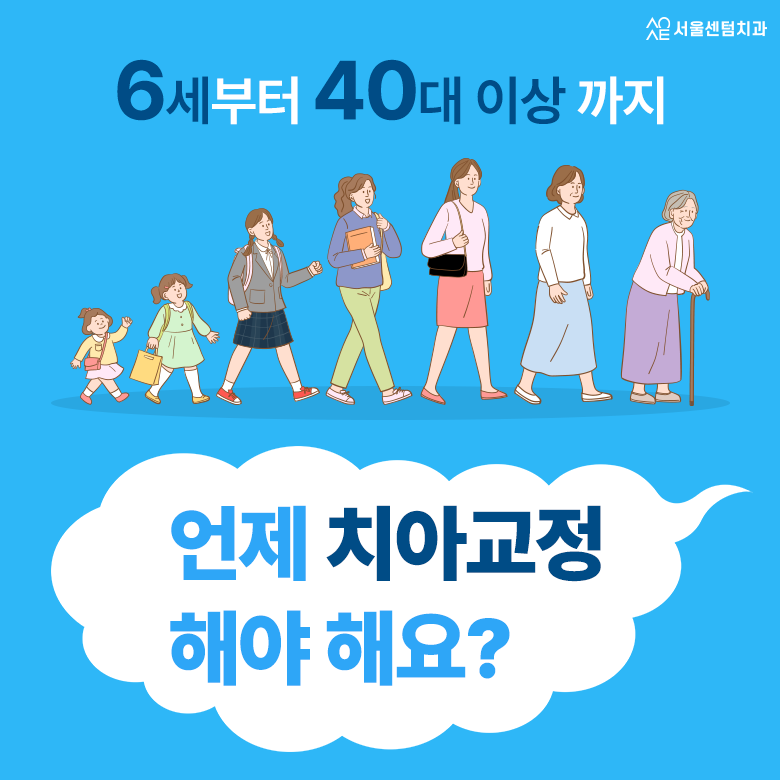
Originally, its biggest purpose is treatment.
Of course, in cases where there are direct problems with the temporomandibular joint or with actually chewing food,
people tend to recognize braces as a form of treatment.
In cases where the bite does not align properly,
there are many cases where there is not a major problem in the teens or 20s,
but it becomes significantly misaligned and issues appear in the 30s or 40s.
Rather than at too young an age,
I usually recommend starting during adolescence to the college years.
Let me organize what should be checked in orthodontics by age group.
Early childhood
If you have a child at home, it is only natural for parents to worry about everything from A to Z.

Many people are especially curious about their child’s teeth.
They want to know when to check whether the teeth are coming in properly,
whether there are any problems, and so on.
Around ages 6 to 8, when the front teeth begin to come in,
this can be seen as the first stage for determining whether orthodontic treatment is needed.
Of course, not every child needs braces.
But if there is a problem, catching it early can allow correction during the growth period.
Because jaw growth has not yet fully finished,
there are parts such as open bite, malocclusion, and underbite
that may be improved in advance by guiding growth suppression and orthodontic direction.
That is why it is important to visit the dentist regularly to check whether orthodontic treatment is needed at this stage.
Teens
In Korea, it seems that people most often choose braces in their late teens.

Or many also make the decision in their early 20s.
If I had to choose between the 10s and 20s for braces age,
I would recommend doing it in the teens.
Because growth is not yet fully complete,
if growth plates are still open, there may be cases where jaw direction and other factors can still be adjusted.
Since the gums are also more flexible,
the speed of orthodontic treatment may differ.
Of course, wearing braces during puberty can look unattractive,
and parents may worry that it could interfere with their child’s studies.
In fact, it may feel difficult at first,
but pain usually subsides quickly as patients adapt,
and because they visit the dentist more often,
they can also take care of their dental health all at once.
On the other hand, in your 20s, many people want to look their best
and want braces, but hesitate.
There may be concerns about interviews or appearance,
and situations such as military service or difficulty visiting the clinic often
can also come up.
20s–30s
Because orthodontic treatment is widely recognized in Korea for aesthetic purposes,
it can be difficult for teens who do not have financial independence to make the decision.

At this age, parental support is usually needed,
and without parents’ support and permission,
it is difficult to proceed with treatment.
As a result, many people in their 20s work part-time jobs and make the decision on their own.
Some do not feel the need in their 20s,
but as they see their teeth becoming more misaligned,
they decide in their 30s.
Once people enter their 20s, it becomes the age when they most want to look beautiful,
so the aesthetic burden of braces also increases,
and many people look for clear aligners.
Around the 30s, after work life and interviews,
many people also prefer clear aligners.
Of course, if clear aligners are worn properly,
they can provide an aesthetic form of orthodontic treatment,
but if they are not managed well in daily life, both cost and time can increase.
So I recommend choosing an orthodontic appliance based on your daily habits.
40 and older
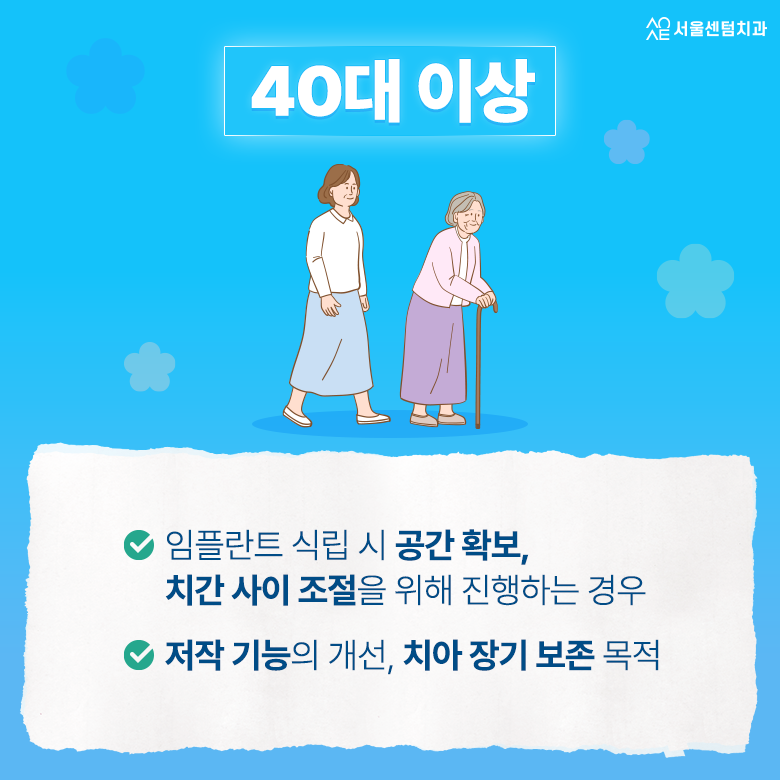
The reason people choose treatment at 40 and older is often due to dental health issues.
In the previously healthy 20s and 30s,
people may not feel discomfort or notice any abnormal signs,
but as they age, the gums weaken and the teeth move more,
so problems develop that are noticeable even to the person themselves.
Some decide because they have teeth that need implants,
or because empty spaces or gaps between teeth become a concern.
Problems such as worsening chewing issues
or areas that cannot be brushed properly for a long period
may accumulate and lead to periodontal disease.
In such cases, people often move on to orthodontic treatment after periodontal treatment.
For those over 40, the goal is not simply aesthetics,
but improvement of chewing function
and long-term preservation of the teeth.

Questions about the age for braces
are also among the most common questions asked during consultations.
Once a problem develops in the teeth, it is hard to reverse,
and teeth are not a body part that regenerates.
So if you are considering dental health,
I recommend visiting the dentist as soon as a problem is found.

Many people visit because of tooth alignment,
but concerns about the aesthetic aspects of alignment in your 20s
can 이어질 수 있으므로 in your 40s into concerns about dental health as well,
so it is important to make a habit of visiting the dentist right away when a problem arises.
When do permanent molars come in?
Pain during the impression-taking process for implants