Tooth loss does not end with inconvenience.
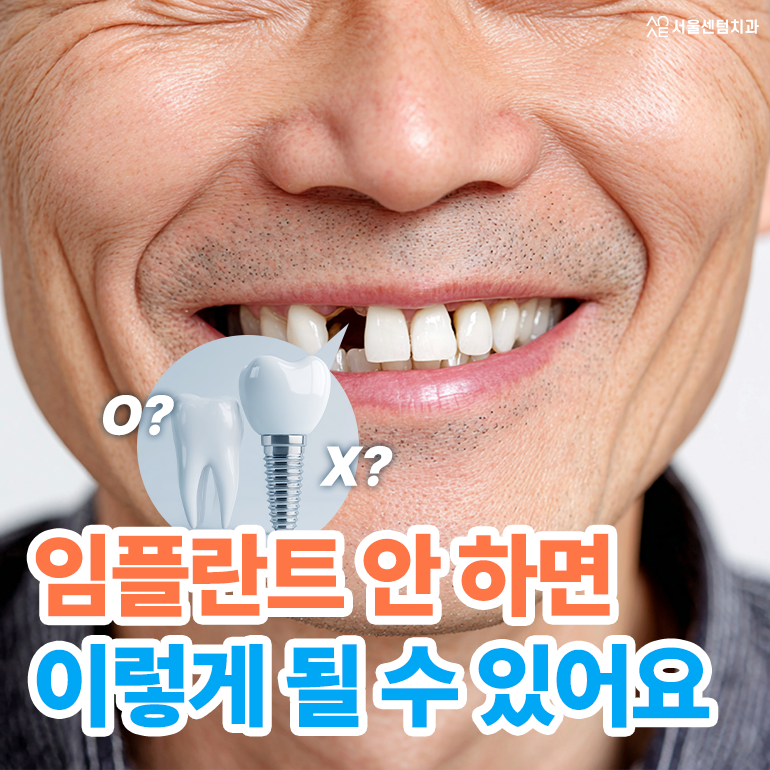
Teeth are essential organs that help you cut food into smaller pieces,
speak with clear pronunciation,
and enhance facial expressions,
while also supporting many other benefits.
When teeth are lost due to cavities, periodontal disease, accidents, and so on,
the impact goes beyond inconvenience and can shake your quality of life itself.
For middle-aged and older adults, as time passes and bodily functions decline,
this can happen with a higher probability than expected.
Losing just one tooth...
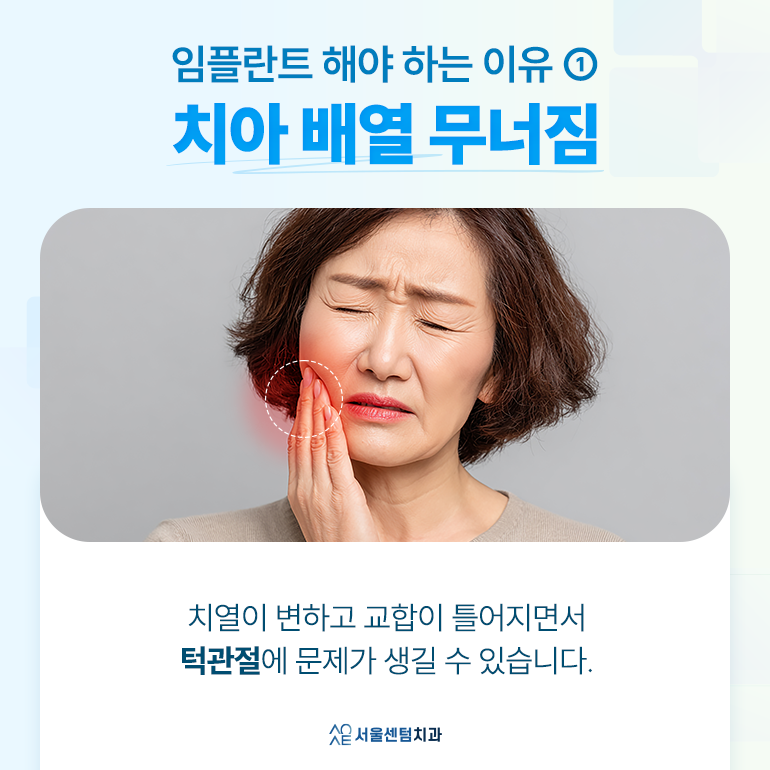
Since the teeth are firmly interlocked, losing one can cause the balance to collapse like dominoes.
As adjacent teeth tilt toward the empty space,
the alignment of the teeth becomes distorted and the upper and lower bite shifts, placing strain on the temporomandibular joint.
As a result, a 'click' may be heard in the jaw or a stiff feeling may develop, and later this can lead to chronic headaches and facial pain.
If the neglected condition continues for a long time,
orthodontic or prosthetic treatment also becomes more complicated,
and the prognosis worsens.
A chain reaction of worsening health
It becomes difficult to eat tough, hard foods,
but in some cases, even soft foods
cannot be eaten properly.

As a result, food is swallowed without being sufficiently ground,
which places a burden on the stomach and can lead to chronic indigestion and gastritis.
The impact is greater in older adults.
According to one study, patients with missing teeth are more likely to experience nutritional imbalance as their intake of protein and fiber decreases.
If you do not get an implant, various problems can arise,
and your physical health can only deteriorate gradually.
Facial asymmetry that can make you look older
Teeth are responsible not only for chewing food
but also for the shape of the facial contour!

If you do not get an implant after losing a tooth,
the lips may sink inward and the jawline may become crooked,
causing the left-right balance of the face to collapse.
This can deepen nasolabial folds,
making you look more tired and even more aged than your actual age.
Pronunciation can become less accurate, which also lowers confidence when talking with others.
It becomes a vicious cycle that negatively affects not only me but also the other person.
The remaining teeth may be damaged faster.
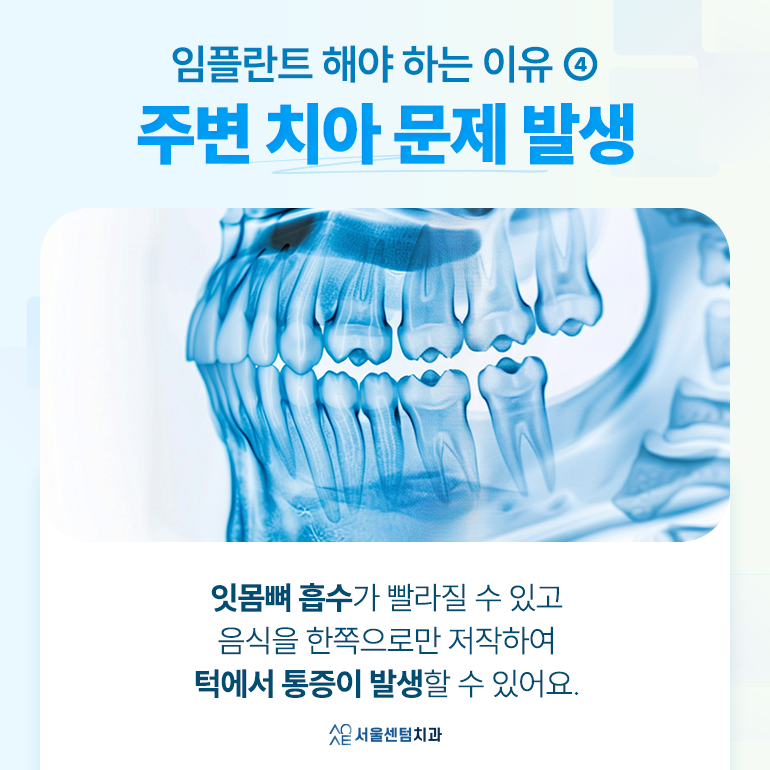
As the condition is left untreated for a long time,
the remaining teeth nearby are forced to bear excessive stress, which may cause cracks and speed up bone resorption around the root gums.
If chewing force is not distributed evenly,
a habit of chewing only on one side may develop during meals,
causing asymmetry in the jaw muscles and temporomandibular joint,
which may make treatment for the joint necessary as well.
The longer the neglect continues, the more the remaining teeth and jawbone may lose longevity,
so we hope you restore function with an early implant.
Is a denture enough to reinforce missing teeth?
No.
Dentures have limitations in that they are difficult to use as a long-term alternative.
Because adjustments are needed for custom fabrication,
multiple visits are required.
Even after using them, visits are still needed.
Even if you adapt at first, over time problems such as foreign body sensation, the inconvenience of removal, food getting trapped, and inaccurate pronunciation can occur.
In particular, dentures have a major drawback in that they cannot stimulate the alveolar bone and therefore cannot prevent bone resorption.
By contrast, implants are fixed directly to the bone,
making them more stable and capable of restoring functions closer to natural teeth, so if you want a fundamental solution,
implants are the superior choice.
Start treatment as soon as possible so it does not lead to bigger problems!
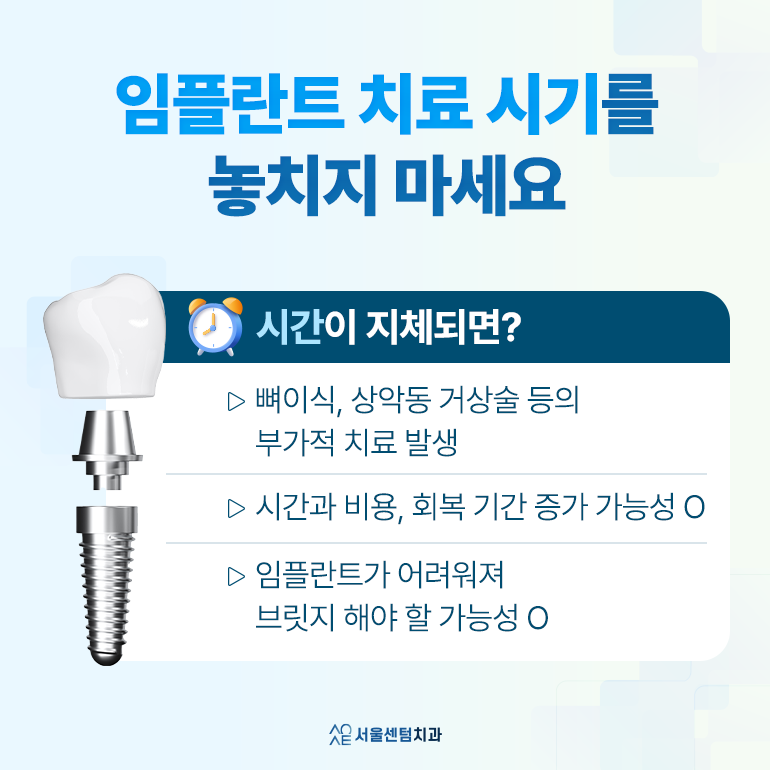
The most important thing after tooth loss is to start treatment at the right time!
The longer you delay, the more the jawbone gradually decreases,
and additional procedures such as bone grafting may become necessary.
This process increases both time and cost,
and because the recovery period grows proportionally,
if you do not get an implant, the process becomes more complicated and you will inevitably face higher expenses.
The faster treatment is carried out,
the sooner you can enjoy a more comfortable life,
and the success rate will also be higher, right?
The long-term prognosis will also be better.
Once teeth are lost,
they do not regenerate naturally, so the longer they are left untreated,
the more the problems may snowball.
Implants, which help prevent this,
can be seen as an investment in life that preserves healthy chewing function, a beautiful smile,
and social confidence.
We hope you will reflect on your current oral health
and, through consultation with medical staff,
set the most appropriate direction.