If you think dental implants will last forever just by getting them, that’s not correct.
Dental implants are not permanent devices.
They are usually usable for more than 10 years if properly maintained,
but it is not uncommon for problems to arise around the 1-year mark.
Because many people do not know this, when looking into implant placement,
they sometimes choose a clinic based only on the lowest price.
But implant placement failure is not just someone else’s problem.

Implant placement failure usually shows warning signs before a problem occurs,
but when those signs are not noticed,
it often ends up being left alone until time passes and the failure happens.
One of the biggest reasons is that,
unlike natural teeth, implants are not real teeth with nerves that actually exist,
so inflammation can develop inside, beneath the tooth.
That is why cases of failure can sometimes occur in less than a year after placement.
Early and later-stage reviews of implant placement failure
Implant placement failure is often divided into early and later stages.
Early failure is considered to occur between 3 and 6 months,
while later failure is considered failure after 1 year.
Early failures are often caused by problems with the procedure or insufficient bone fixation,
so they are sometimes treated as a clinic warranty issue.
But such cases are rare,
because a failure this early, before 1 year, due to a poorly placed implant,
is not common.
However, later failure after 1 year can have various causes.
Let’s go through them one by one.
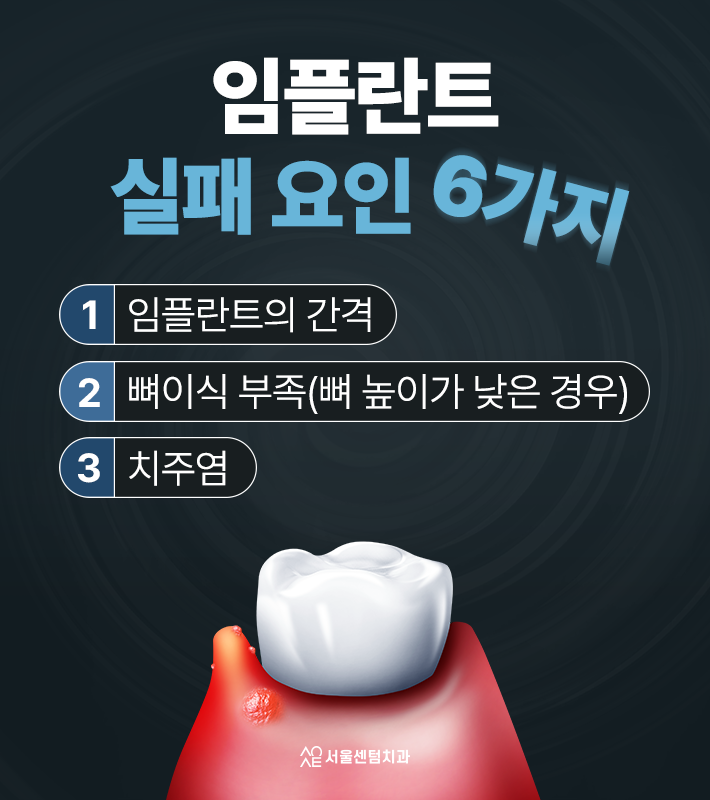
- The spacing of the implant
The space between the implant and the teeth is a very important factor.
If the implant is placed too close to the neighboring teeth,
the bone in between may be resorbed and the case can end in failure.
There was actually a case where someone visited after being treated elsewhere,
because the implant had been placed too narrowly.
When placing an implant initially,
it is important not to place it too tightly.
- Insufficient bone grafting / low bone height
If the maxillary sinus had descended before the implant procedure,
a sinus lift should be performed before proceeding.
If the procedure was done without that,
or if the bone density was already low before surgery,
or if a bone graft was performed but the condition was so deficient that more was needed,
in these cases, the implant may become loose around the 1-year mark.
If you feel that the implant is loose,
you should visit the dental clinic as soon as possible.
- Periodontitis
Periodontitis is something many people have heard about before implant placement.
It is one of the most commonly mentioned causes of implant failure.
Because it is inflammation, people naturally think the pain would be severe,
but in reality it is often hard to feel pain,
which makes early detection difficult.
Symptoms can include swollen gums,
bleeding while brushing,
food getting stuck between teeth,
and odor coming from gaps around the prosthesis.
In many cases, the condition starts so subtly that people miss the signs and lose the chance for timely treatment.
If symptoms continue, the bone begins to resorb,
which can lead to failure.
That is why after getting an implant, you need to keep seriously checking your condition.
- Smoking, drinking, and chronic disease

In principle, patients are told not to smoke or drink after implant placement,
but in practice, many people do not follow that advice.
If you do not follow it, blood flow decreases,
recovery after surgery is delayed,
and the likelihood of gum inflammation can increase significantly.
In the end, the bone is affected first,
and when fixation decreases,
it inevitably creates a situation that can lead to implant failure.
Chronic diseases can also contribute to failure.
- Height and angle
When adjusting implant height,
the condition is checked after placement and at follow-up visits.
Although it can still be adjusted,
if the patient overlooks minor discomfort,
and the height or angle keeps interfering during chewing,
it can affect the bone.
That is why, after implant placement, if the height or angle does not seem right in daily use,
or if it feels like pressure is being applied,
you should definitely get it checked.
- Missed regular checkups
The biggest reason of all, more than any of the above, is missing regular checkups.
Once the big hurdle of implant surgery is over,
many people feel like everything is finished
and then become careless with care afterward.
In particular, among the warning signs after implant placement listed above,
many cases can be resolved early if they are found during regular checkups,
but once that timing is missed,
it often leads to implant failure.
A complete summary of the warning signs of implant placement failure you must know before getting an implant
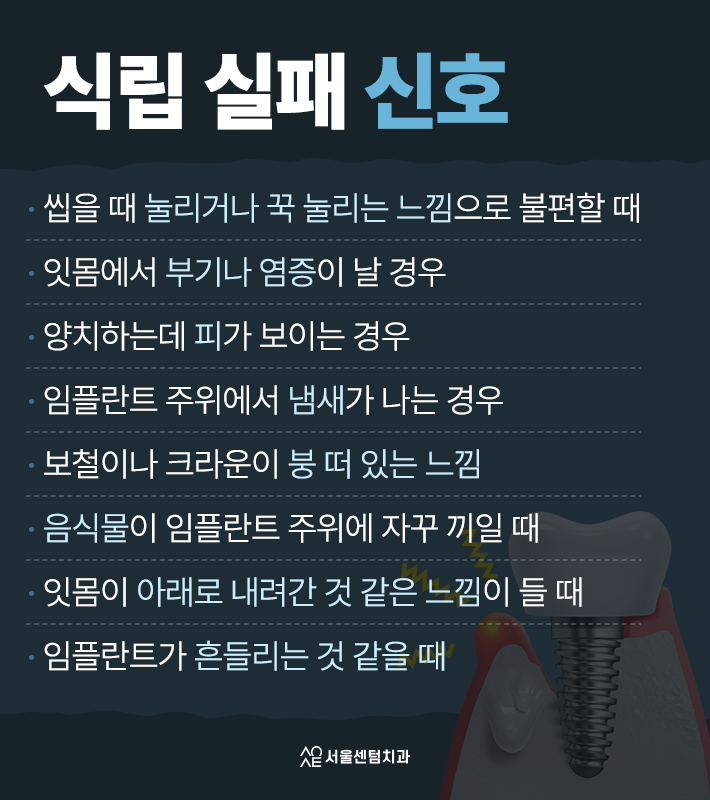
Before getting an implant, remember that there is no such thing as 100% safety,
and depending on how it is used,
care can go well or not.
That is why it is wise to know the warning signs of failure.
Feeling pressure or a pressing sensation when chewing, causing discomfort
Swelling or inflammation of the gums
Seeing blood while brushing
A smell coming from around the implant
The prosthesis or crown feeling like it is floating
Food keeps getting stuck around the implant
Feeling like the gums have receded downward
Feeling like the implant is loose
If you notice even one of the above abnormal symptoms in your teeth,
you must visit the dental clinic as soon as possible.
Treatment for implant placement failure

In general, implant failure cannot be self-checked at home.
You must visit the dental clinic, take an X-ray panoramic image,
evaluate the fit of the prosthesis,
and check the periodontium and chewing force,
and also determine whether occlusal adjustment is needed.
If you visit the clinic early while it is still just a simple inflammatory stage,
you can often recover easily with simple treatments such as scaling, antibiotics, prosthesis adjustment,
and gum treatment,
which can prevent progression to complete failure.
If some bone has been resorbed,
methods include a micro bone graft in the affected area
and remaking the prosthesis.
If the implant itself has begun to loosen and no longer has fixation,
re-implantation is necessary in many cases.
In such cases, the procedure is repeated along with a sinus lift,
and the implant is re-placed after moving it from the original placement position.
When it is judged to be a complete failure, the process becomes larger.
After removing the failed implant, the inflammation is cleared,
the bone is reinforced again,
and after waiting until it has recovered to a certain extent,
re-implantation is performed.
If the condition of the bone is still suitable for surgery,
immediate placement may also be possible.
How to respond before implant failure occurs

To keep it simple, but mention the things that must be followed:
be sure not to skip regular checkups.
Even if it is not a regular checkup, if a problem occurs,
you must visit the clinic right away.
You should also brush carefully every time,
and use dental floss or interdental brushes.
If you already had a habit of grinding your teeth,
a mouthguard is essential.
Please, I strongly urge you to stay away from hard foods!
Implant placement failure is not something that happens very often if you keep up with regular checkups
and stay attentive, but it is also not an especially rare case.
Most failures are problems that can be resolved if the clinic is visited early after they are discovered.

That is why, rather than worrying from the start before getting an implant,
you should save this post and make sure to check carefully
so that implant placement failure does not happen.
If you keep up with regular checkups and maintain good daily care,
and visit the dental clinic quickly if anything seems abnormal,
an implant can be used for a long time.
For everyone planning to get an implant in the future,
and for those who are worried before getting one,
please remember that if you visit the dental clinic quickly,
it may be an easy problem to solve.
Previous post
Seeing brown teeth in the mirror?