When eating food, plaque forms
and sticks to the teeth.
Over time, it turns into tartar,
and because it is difficult to remove on your own,
it is better to have it removed with scaling at the dentist.
How often do you get scaling?
If the interval is long, such as once every 2 years or once every 3 years,
tartar and plaque can build up thickly and
may cause various oral diseases.
That is why I would recommend getting it at least once a year.
Once a year, the out-of-pocket cost is also low at around 30%,
so please get it so you can enjoy great efficiency
with a minimal investment!

Sometimes after scaling, something like white spots
may be visible.
You may wonder whether the procedure was not done properly
or whether there is a health problem.
I prepared an answer because there was a question related to this.
Let’s go over it step by step below.
You had scaling,
do you see white spots?
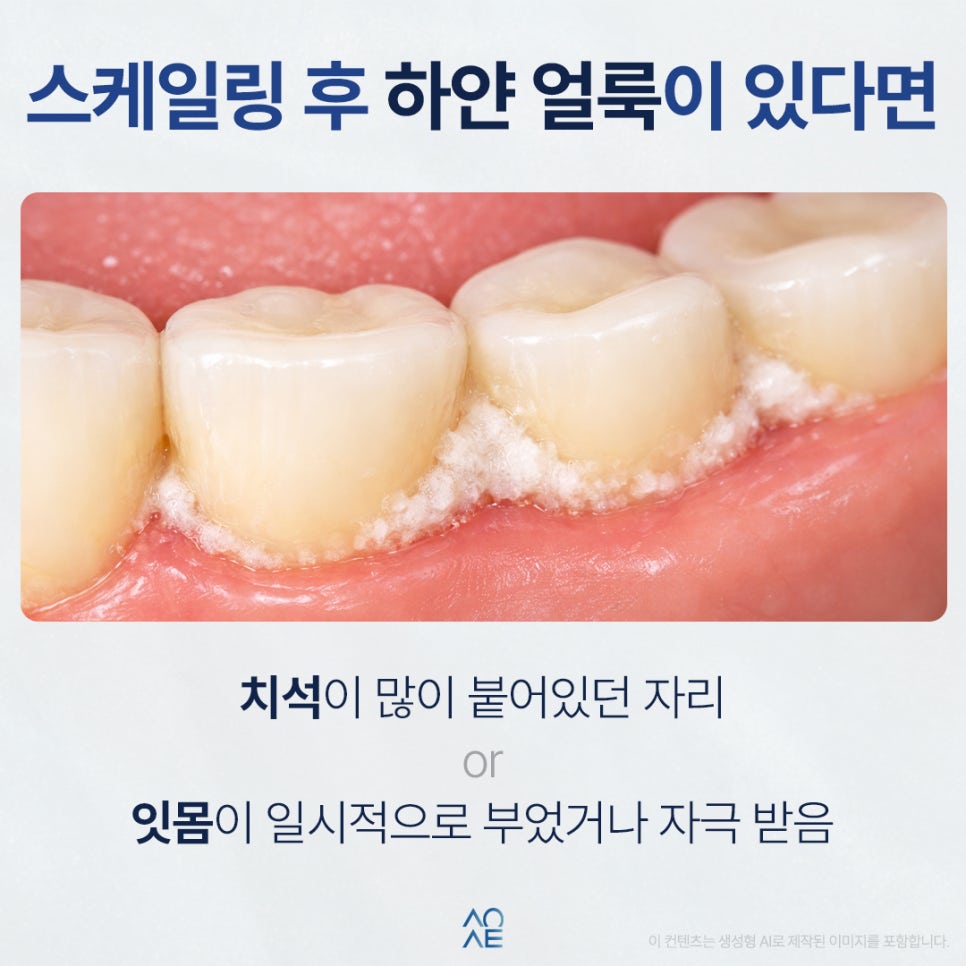
The area where tartar or plaque had built up
can reveal the underlying surface after removal, and the color difference
from the surrounding area
may appear more noticeable.
In particular, the longer plaque had accumulated on the surface,
the more pronounced that difference can seem.
During the procedure, the gums may be temporarily irritated,
causing slight swelling,
or the boundary between the teeth and gums may become more distinct,
making the white areas appear more emphasized.
This can gradually improve naturally.
It is necessary to check whether you have been brushing too hard.

If the white spots after scaling are bothering you,
it is also necessary to check your recent brushing habits.
If you brush repeatedly with too much force,
the enamel can be microscopically worn down
or the gums can be pressed, causing swelling.
As a result, part of the tooth may appear
whiter,
and it can look like tartar is stuck there,
so you should maintain a brushing habit
with appropriate pressure.
After that, thorough management is still necessary.
Right after tartar removal,
the tooth surface becomes much cleaner, so depending on how you care for it,
the outcome can differ.

First, choose a toothbrush with soft bristles
and carefully brush the
gum-tooth boundary.
Rather than applying too much force,
you should use proper pressure to reduce damage~
If you use oral aids such as dental floss or interdental brushes together,
it becomes possible to effectively manage plaque
that tends to remain between teeth.
It is best to avoid foods that cause staining
as much as possible.
If you maintain these habits,
the symptoms may improve and the likelihood of various oral diseases
may also decrease,
so please keep this up over the long term.
If discomfort continues, seek treatment

It would be great if management alone could solve it,
but if not and the discomfort continues,
please visit a dental clinic and receive treatment.
If symptoms such as sensitivity, pain, or bleeding also occur,
the symptoms may not improve due to a specific cause,
so you should have it addressed.
It is also possible that the cervical area has worn down due to demineralization,
that cavities have developed,
or that gum inflammation is continuing.
Since the necessary treatment differs depending on the cause,
checking the condition as quickly as possible, even by one day,
will help reduce your worries.
Scaling can be seen as a process of
tidying up the oral environment,
but as mentioned above,
different outcomes can result depending on
how you act afterward.
When the tooth surface becomes smooth,
if you properly care for it before bacteria settle again,
plaque formation may be delayed.
Becoming sensitive to changes such as white spots after scaling
is a good sign, I think.
It becomes an opportunity to recognize your oral condition
and respond to it.
I hope you check whether it is temporary or whether something needs to be done,
and continue taking care of it.
I hope this has resolved your questions, and I’ll wrap up here.
If you want to know whether diabetics can get implants?
Please also read the post below when you are experiencing jaw pain.