If you are getting implants and the number is not just one,
but several—4 or more—
won’t the pain be worse if the teeth are extracted and the implants are placed at the same time?
Many people worry about this.

In actual consultations,
I receive many similar questions.
"It’s not just one—if we do four at once,
won’t it hurt a lot?"
"After the procedure, when the anesthesia wears off,
will I be able to handle it?"
Today, I’ll organize and explain how pain, swelling, and the recovery process differ when multiple implants are done at the same time,
and what actual patients’ reactions were like.
If 4 implants are done at the same time, will the pain be worse?
Whether it’s 1 implant or 4,
the pain does not increase fourfold.

This is a part that surprises many people, but the pain from implants is influenced more by the extent of the surgery and the tissue response than by the number of implants.
For example, even with the same 4 implants, if the gum incision area is wide or if bone grafting is performed,
the pain and swelling can feel greater.
Patients’ actual reactions are similar.
The responses that come up most commonly are:
It was better than I expected.
The pain decreased a lot after one day.
The swelling itself was more uncomfortable than the pain.
Overall, these kinds of reactions are common.
Most people feel swelling, discomfort, or a foreign-body sensation more than pain.
What does it actually feel like after the anesthesia wears off?
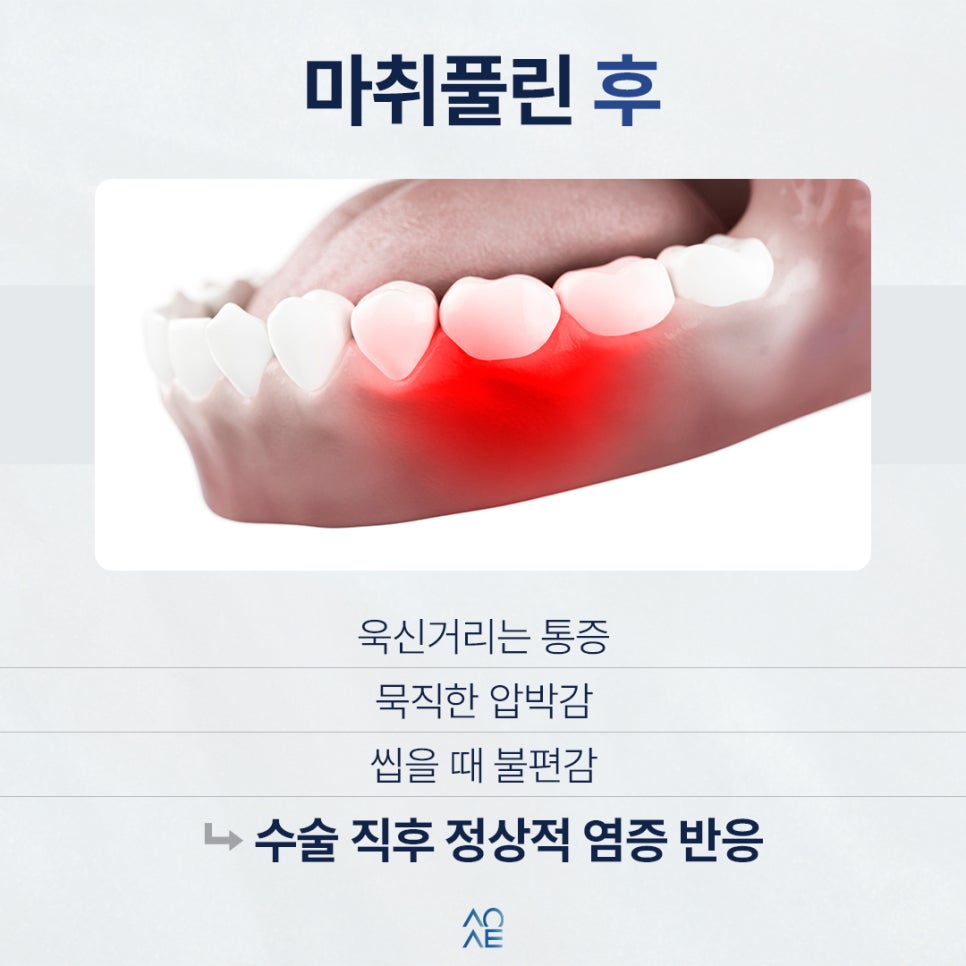
The point when the anesthesia wears off is usually within a few hours after surgery.
At that time, you may feel a throbbing pain,
or a heavy pressure sensation,
or discomfort when chewing.
These reactions can generally be understood as a normal inflammatory response immediately after surgery.
Some people may not understand why the pain difference is not very noticeable even when several implants are done at the same time.

In implant surgery, because it is performed under local anesthesia,
there is effectively no pain during the procedure.
Postoperative pain is caused by the inflammatory response that occurs during the tissue healing process.
This inflammatory response does not increase sharply beyond a certain level,
so even if the number increases,
the pain does not increase proportionally.
Rather than pain, you should pay more attention to swelling here.
When multiple implants are done at the same time,
swelling may be more pronounced than pain.

A typical course is that on day 1, the anesthesia wears off and discomfort begins,
day 2 to 3 is when swelling peaks,
and then it gradually decreases after that.
This is the usual pattern.
This is a normal recovery process.
Isn’t it better to do the surgery in several separate sessions?
This is the most common concern patients have.
Many people ask, "If we divide it up, won’t it be easier on the body and less exhausting?"

In reality, if the surgery is split into several sessions,
the recovery process is repeated multiple times,
so it can actually be more difficult.
If the conditions allow it, there is an old saying that it is better to get the unpleasant thing over with at once.
In that sense, doing it in one session can be a way to reduce the overall treatment period and burden.
Even so, there are cases where the pain can feel greater.

If bone grafting is performed together with the procedure,
if there was severe pre-existing inflammation,
if the gum incision area is wide,
or if there are systemic conditions such as diabetes or high blood pressure,
the recovery may be somewhat slower.
In these cases, the pain may feel greater not because of the number of implants,
but because of other factors.
So how should the pain be managed?

After implant surgery, pain can mostly be controlled with the painkillers and antibiotics prescribed by the dental clinic.
In addition, applying cold compresses immediately after surgery,
avoiding irritating foods,
and getting enough rest can also help.
Even if 3, 4, or 5 implants are done at the same time,
the pain does not increase dramatically in proportion to the number.
Rather, one advantage is that treatment is not split up and the recovery period can be shortened.

What is most important here is the current condition of the gums and bone,
an accurate diagnosis,
and a proper treatment plan.
Even with the same implant procedure,
the recovery process can differ depending on the condition it is performed under.
If you need detailed diagnosis and treatment,
please feel free to visit our clinic anytime.
How can you prevent stomatitis or gingivitis?
Check whether implant bone grafting is necessary.