Many people, before getting implants,
whether they are in their 40s, 50s, 60s, or 70s,
feel burdened by implant surgery.
Even the surgery itself is a concern, but
when it comes to having more than one or two
at the same time, people worry even more.

In such cases, many people ask whether it is okay
to have several done at once or whether they should be done one by one.
Today, I’m answering a question from a real patient:
someone in their 50s asked whether it is okay to have 8 implants placed at once.
Does age affect the number of implants?
Simply being in your 50s does not limit the number of implants.
In fact, placing multiple implants at once is
by no means impossible.

Thinking about having several teeth implanted at once
may seem very difficult, but
in the end, doing the procedure multiple times
can actually be more physically taxing.
Depending on the situation, it is possible to
place 8 or more implants at the same time.
However, this is not something that can be decided
simply by the number alone.
The condition of the gum bone is the most important
In practice, the condition of the jawbone is the most important factor
during implant placement.
Because implants are treatments that are fixed into bone,
the key questions are whether the bone has enough
height and density, and whether there is any inflammation.
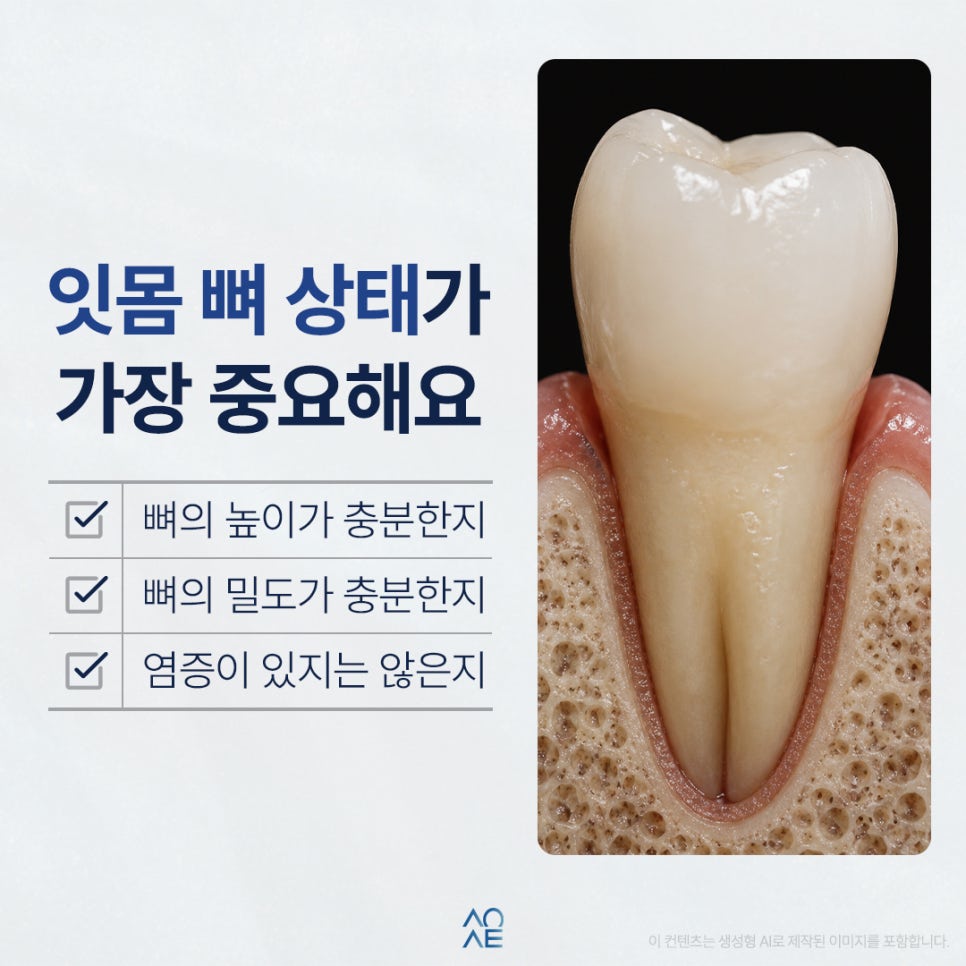
Based on this, it is determined whether multiple implants
can be placed at once.
If the bone is insufficient or weak,
bone grafting may be necessary, and in that case,
it may be safer to proceed in several stages.
Surgery time? Recovery? It can feel overwhelming.
When having multiple implants placed at the same time,
surgery time and the burden of recovery also need to be considered.
If several implants are placed at once,
the surgery time naturally becomes longer,
and bleeding, swelling, and pain
may feel even more intense.

The patient’s physical strength and recovery status
are also important factors.
If the patient has systemic conditions such as
high blood pressure or diabetes,
it may not be recommended to do everything at once;
instead, it may be advised to proceed in stages.
On the other hand, if the gums are stable
and there are no overall health issues,
a plan may be made to place multiple implants at once
in order to shorten the treatment period.
This is especially considered as a way to reduce
the overall treatment duration and number of visits
when the condition of the teeth is poor and
multiple implants are needed.
In conclusion, whether 8 or 9 implants can be placed at once
differs greatly from person to person, so it is not a matter
that can simply be expressed or divided by numbers as
possible or impossible.

It is important to first perform a detailed examination
to check the condition of the bone and the patient’s
overall health before making a surgical plan.
Proceeding with a safe method that matches the current condition
may be more helpful for long-term results.
Why is the cost of partial dentures high?
A white line on a child’s tooth? What is it?