Today, I would like to talk about lumps that develop on the gums, which are referred to by the technical term “lesions.” Many people become alarmed and visit the dentist when they notice one.
Today, I would like to discuss lumps on the gums.
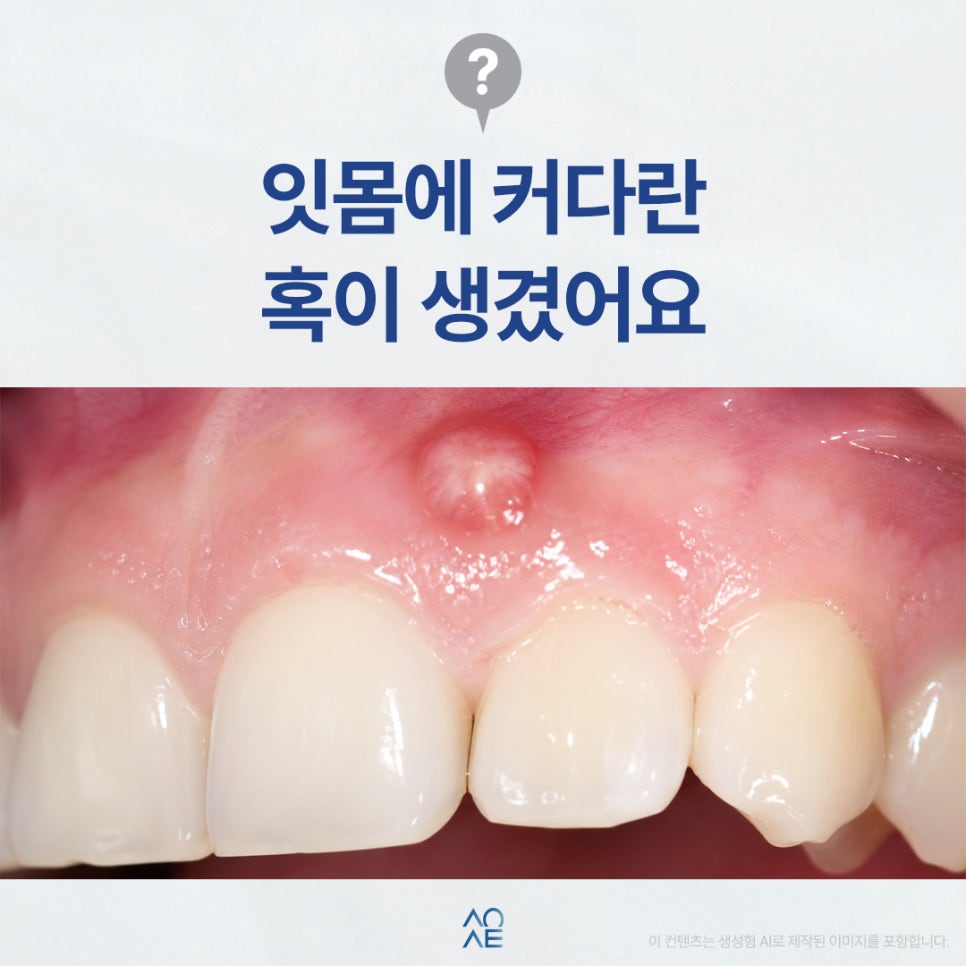
The visitor had received a crown because of tooth decay, and a lump was found on the gum above the crowned tooth. They came in because they wondered whether it might have been caused by the crown.
They had spent some time wondering whether they should go to the dentist at all before deciding to visit.
Let’s take a closer look at what this may be.
A Round, Raised Lump (Lesion)
A raised lump on the gum is called a lesion.
Because it was located on the gum above the tooth, the visitor wondered whether the dental treatment itself had caused the problem and came in for an examination.

This lesion was found on the gum above a crowned tooth.
Considering its location and shape, it would be difficult to view it as simple gum inflammation. It is much more likely to be an inflammatory lesion originating near the tooth root.
What is the cause in this case?
I think many patients are probably even more curious about the reason.
It may be a problem with the root canal treatment of the tooth beneath the crown, or it may be inflammation at the tip of the tooth root.

This is called apical periodontitis.
Other possibilities include a secondary infection caused by bacteria entering through the crown margin, or inflammation originating from the periodontal tissues.
Taken broadly, there are four possible causes to consider.
In cases involving a problem with the root canal treatment of the tooth beneath the crown, the treatment may have been incomplete or the tooth may have become reinfected.
Do not assume everything is fine just because there is no pain when it looks like a drainage tract
In particular, a more prominently protruding lump may be a type of drainage tract, also called a pus-draining tract.
Even if there is no pain, it is often difficult to say that there is nothing to worry about. This is more commonly seen in cases that have progressed chronically.

Ultimately, even if you are not currently experiencing pain, if you can feel a protruding lump on your gum, it is advisable to visit a dentist as soon as possible to have it examined.
Could it disappear on its own?
For a gum lump like this, a detailed examination is necessary to make a definite diagnosis. However, in cases like this, it is generally difficult for the lump to disappear on its own.

If the underlying cause is not addressed, it may continue to recur.
If it is left untreated, it may also affect the surrounding bone, so caution is needed.
In conclusion, I recommend visiting a dentist promptly.
At the dentist, an X-ray is usually taken to check the condition of the root. If necessary, the dentist then determines whether retreatment of the root canal or extraction is needed.
It can be difficult to view a lump on the gum simply as a gum problem.
Because there is a strong possibility that the problem is inside the tooth or near the root, I recommend receiving an examination as soon as possible.
Is a Cracked Tooth Caused by Tooth Decay?
Is It Possible to Receive Eight Dental Implants at Once in Your 50s?