A sudden toothache can feel even more overwhelming when you are already busy.
Tooth pain caused by cavities or inflammation
can often worsen without warning.
If you have a schedule that is difficult to miss,
such as classes, evening self-study, or work,
even finding time to receive treatment
can feel burdensome.
Some people wonder whether they can go to the dentist,
receive only a local anesthetic injection, and leave,
hoping it will help them endure the pain
for at least a few hours.
When the pain is severe, it is natural to want
to reduce the painful sensation right away.
However, it is better to understand what a dental anesthetic injection does
and how the pain may return before making that decision.
I will explain this in detail below.
Is it possible to receive only a dental anesthetic injection and leave?
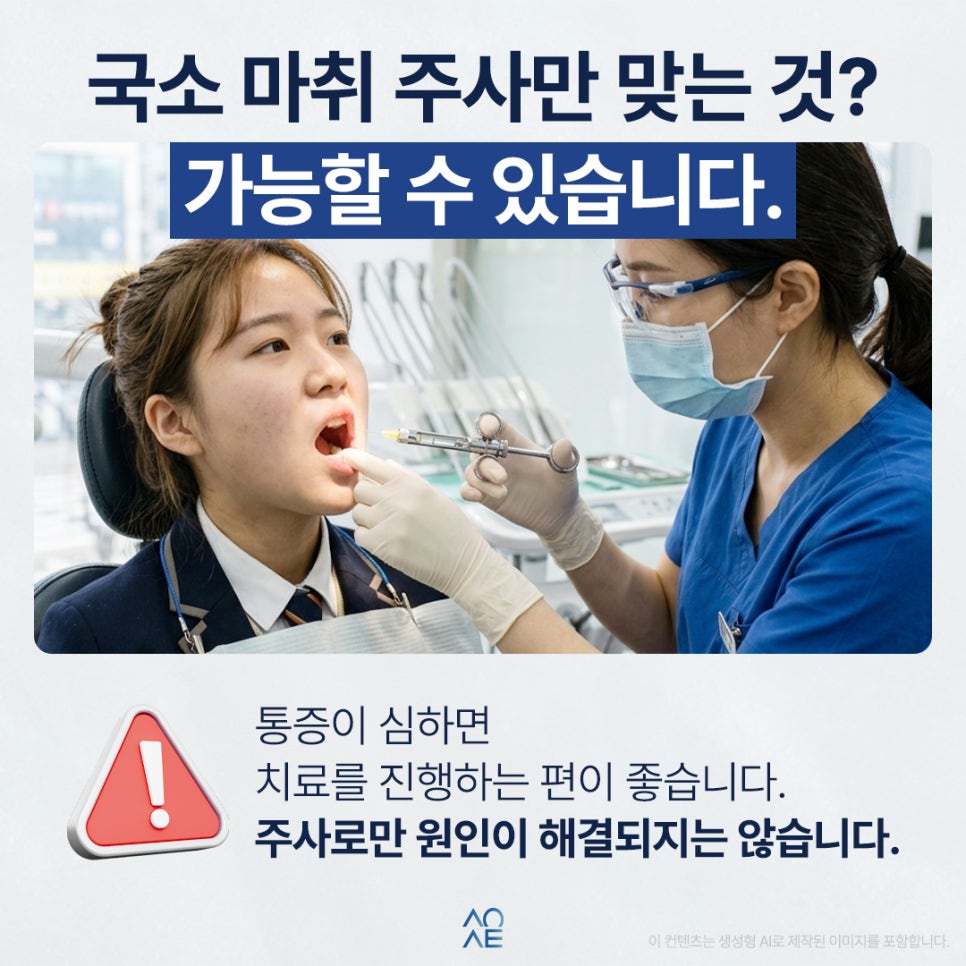
It is not impossible to do this.
However, if the pain is severe,
it is better to receive whatever treatment is possible
along with the injection
rather than having only the anesthetic.
A dental anesthetic injection only temporarily blocks
pain signals transmitted through the nerves;
it does not remove the cause of the cavity or inflammation.
If the tooth throbs even when you are still
or the pain makes it difficult to sleep at night,
the cavity may have progressed close to the nerve.
In such cases, treatment to reduce the pressure inside the tooth
may be necessary.
How long does the effect last?

The duration of local anesthetics used at the dentist
varies depending on the tooth's location,
the type of medication, and the individual's metabolic rate.
Pain sensation around the area
may be reduced for approximately 2–4 hours,
while reduced sensation in the lips, cheeks, or tongue
may last longer.
During this time, avoid biting your tongue or the inside of your cheek,
and refrain from eating.
Is there emergency treatment available even when I have no time?
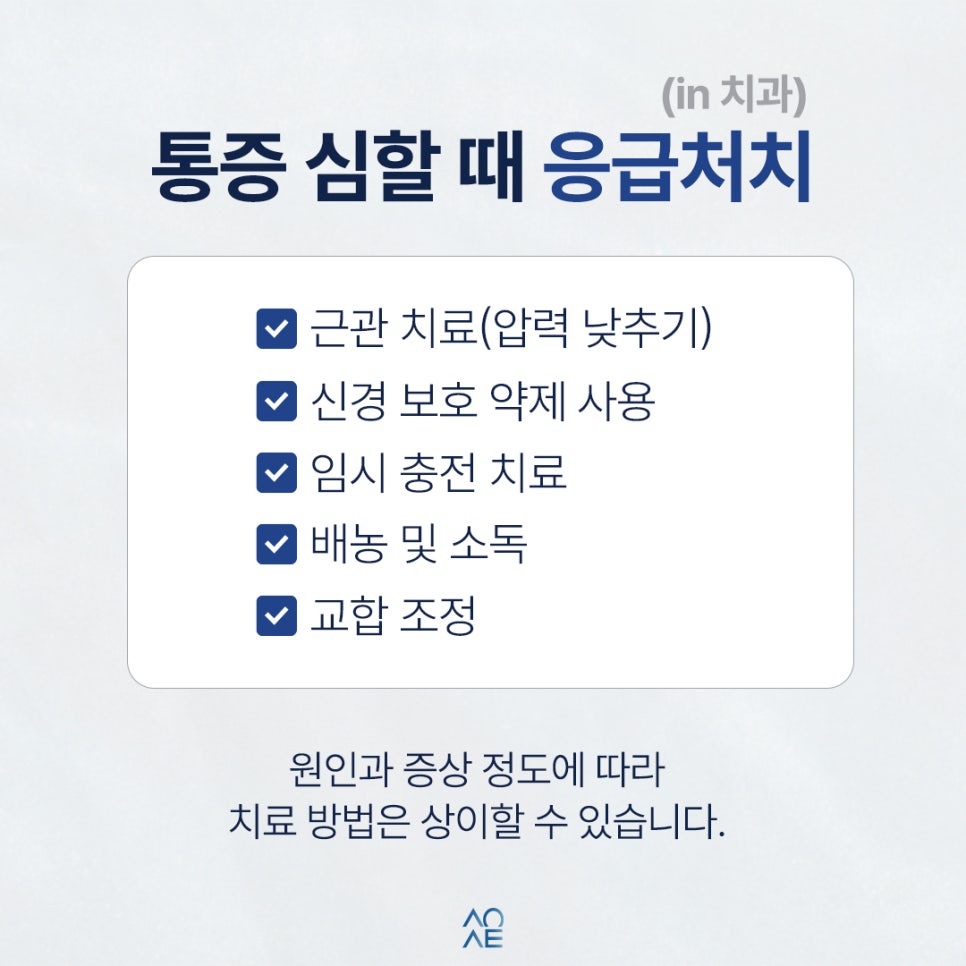
If the pain is severe, the root canal may be opened
to lower the pressure inside the tooth.
Depending on the condition, some inflamed nerve tissue
may be removed,
or protective medication may be placed and the tooth sealed
with a temporary material to reduce external stimulation.
Another option is to temporarily fill
a fractured area or a deep cavity
so that food and temperature stimuli
do not come into direct contact with it.
These procedures do not complete the entire treatment at once,
but because they address the cause of the pain more directly
than receiving anesthesia alone,
they can reduce discomfort more significantly.
Afterward, you will need to continue with root canal treatment,
prosthetic treatment, or other care according to the scheduled plan.
Why does the pain return after receiving only anesthesia?

As a cavity becomes deeper, inflammation may develop
in the nerve and blood vessel tissue inside the tooth.
Because the inside of the tooth is surrounded by hard tissue,
there is very little room for swelling.
As the condition worsens, the internal pressure can rise,
causing throbbing pain that feels like a pulse.
If the pain persists for a long time after eating hot food,
worsens when you lie down at night,
or quickly returns even after taking pain medication,
the possibility of nerve inflammation should be considered.
Therefore, even if pain transmission is blocked temporarily,
the internal pressure and bacteria remain.
The pain may begin again later,
leading to continued discomfort in daily life.
How should I request treatment if I have limited time?
If you do not have much flexibility in your schedule
because of school or work,
contact the dental clinic before your visit
and explain your situation.

If you explain that your toothache is severe
but ask whether treatment focused on emergency care
is possible because of your busy schedule,
the clinic may be able to tell you
how long the visit is expected to take
and what types of treatment can be provided.
However, even a short appointment
may require examinations such as X-rays.
The treatment differs depending on whether the cause is
a cavity, a fractured tooth, or gum inflammation,
so a thorough examination may be necessary.
It may also be possible to receive temporary treatment that day
and schedule the definitive treatment separately afterward.
Please remember that after temporary treatment,
you should not postpone the final treatment for a long time.
Is it okay to just take pain medication and endure it?

Pain medication may help temporarily reduce the pain,
but that does not mean the condition has improved.
In some cases, the pain may temporarily lessen
because the nerve is becoming damaged.
It is best to receive whatever treatment is possible first
and then take the medication prescribed by the healthcare provider.
If you are taking any medications or have any allergies,
be sure to tell the healthcare provider in advance
so an appropriate prescription can be provided.
When taking medication, follow the dosage and intervals,
and avoid arbitrarily taking several types of pain medication together.
Please also avoid irritating or hard foods,
as well as eating on the affected side.
Even if your schedule is tight,
receiving treatment within what is possible first
and then continuing with the remaining care
can help reduce recurrent pain and additional damage.
A problem that could initially have been resolved
with a relatively simple procedure may require root canal treatment
if it is postponed for too long.
There is a possibility that the treatment period and cost
could increase substantially while you are trying to save time.
Therefore, I hope you will proceed with treatment as necessary,
even if you need to divide the treatment stages
to fit your current situation.
[Previous post]
Can Orthodontic Treatment Make the Angle of Small Teeth Perpendicular?