Hello,
I am Kim Min-young, a specialist in conservative dentistry at Dangsan Station Dental Clinic.
Have you ever felt relieved after completing your treatment, only to experience pain in the same spot again a few years later?
You may have had a filling or a crown placed and wondered why it started hurting again, leaving you feeling frustrated and confused.
You may also have been unsure whether the clinic responsible for your treatment made a mistake or whether you had neglected your oral care too much.
Not knowing the reason may have left you feeling troubled.
In fact, in most of these cases, the issue is not with the treatment itself but with a phenomenon called “secondary caries,” or recurrent tooth decay.
This occurs when decay begins again in the extremely small marginal gap between the treatment material and the tooth. Depending on how it is managed, it can occur in anyone.
Today, together with Dangsan Station Dental Clinic, we will take a detailed look at why secondary caries develops and how to deal with it.
- Why Does Secondary Caries Develop?
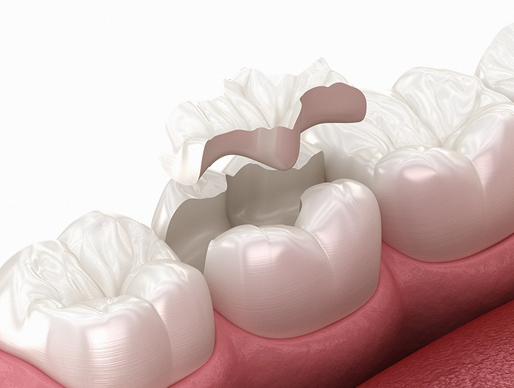
No matter how precisely restorative materials such as composite resin, inlays, and crowns are fitted, they do not become completely one with the tooth.
Over time, a microscopic gap may form at the boundary between the material and the tooth. Bacteria and food particles can enter this space, causing decay to begin again.
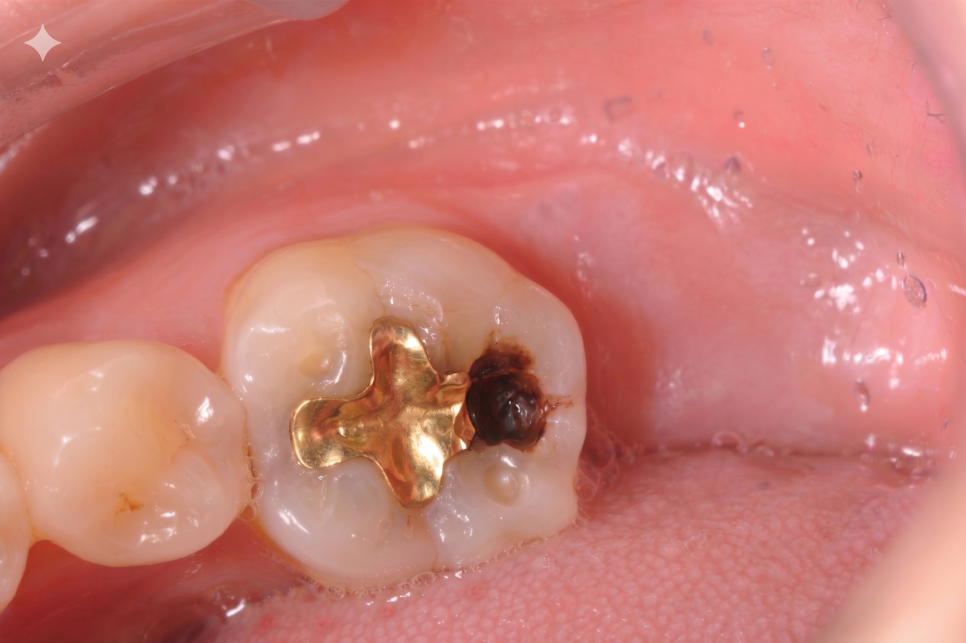
The same thing can happen when the material shrinks or wears down over time, or when microscopic cracks form at the margins due to strong biting forces.
In particular, composite resin repeatedly expands and contracts slightly in response to temperature changes, so its marginal seal can become weaker over time.
The fact that restorative materials do not last forever and that a boundary between the material and the tooth always exists is the fundamental reason secondary caries develops.
At Dangsan Station Dental Clinic, we would like to point out that even after receiving proper treatment, these changes can occur over time, so it is helpful to be aware of this in advance.
- The Biggest Problem Is That It Is Difficult to Notice on Your Own
One of the reasons secondary caries is difficult to manage is that it causes almost no symptoms in its early stages.
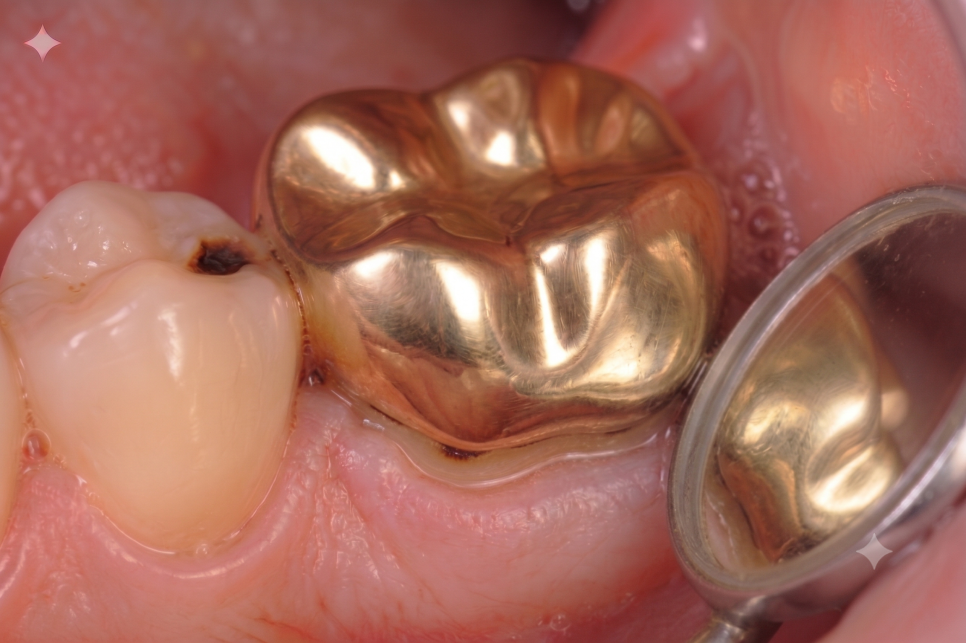
Because it progresses beneath an existing restoration, it is difficult to detect simply by looking at it or feeling it with your tongue.
By the time pain is felt, the decay has often already progressed considerably deep into the tooth.
Unlike ordinary cavities, it cannot be immediately identified on the surface, so if you do not suspect it yourself, detection is easily delayed.
It may also be hidden by the shadow of the restoration on an X-ray, delaying detection. Images from multiple angles and a detailed examination are therefore necessary.
As secondary caries becomes deeper, the scope of treatment inevitably becomes wider, and in some cases it may eventually lead to root canal treatment or replacement of the restoration.
At Dangsan Station Dental Clinic, we consider it important to carefully examine the area around existing restorations and detect changes at an early stage.
- Things You Can Do to Reduce Secondary Caries
Neglecting a treated tooth because it has already received treatment increases the risk of secondary caries.
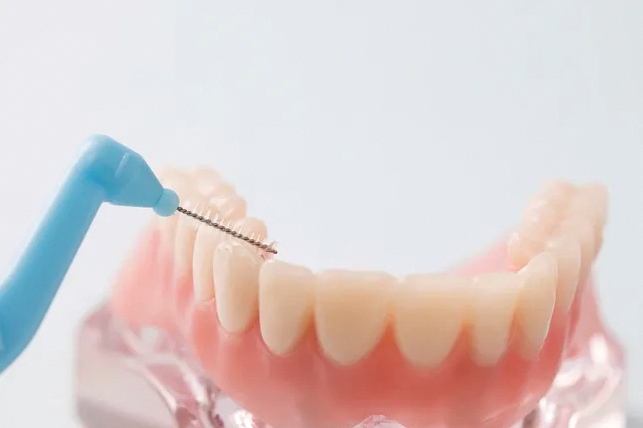
Because the boundary between the tooth and the restoration is an area that a toothbrush cannot reach easily, it is important to consistently use dental floss or an interdental brush to remove the bacterial film from this area.
Using toothpaste containing fluoride can also help protect the tooth surface.
Hard foods and excessive chewing force place unnecessary stress on the restoration margins, so caution is needed.
It is also a good idea to have older restorations checked to assess their condition, even if you have no symptoms.
In general, composite resin can be used for 5–7 years, while crowns can last 10 years or longer, but their lifespan varies considerably depending on how well they are maintained.
At Dangsan Station Dental Clinic, we explain that after treatment, regular checkups should be conducted to carefully examine both the condition of the restoration and the surrounding teeth.
- In Closing
Secondary caries is not an issue that ends simply because treatment has been completed successfully.
Teeth with restorations require more careful management and more thorough observation.
It is helpful to understand that treated teeth require even more attentive care than healthy teeth.
Once a cavity develops, the more often it is treated, the more tooth structure is lost.
Preventing it from the beginning and detecting it early are the most practical ways to preserve your teeth for a long time.
At Dangsan Station Dental Clinic, we believe that continuously monitoring the condition after treatment is just as important as completing the initial treatment.
To keep treated teeth healthy for a long time, it is important to continue with regular checkups and consistent care.
This has been Kim Min-young, a specialist in conservative dentistry.
Thank you.