Hello~ I’m Kang In-jeong, director of The River Dermatology Clinic.
Today, after thinking about what topic to write about...
I’d like to briefly talk about MD products for hospital use, which are currently being prescribed most often in my clinic these days.ㅎ
When winter comes, our skin has to endure a very difficult..ㅠㅠ process.
The main complaints from patients who come to the clinic are
itching, rash, dryness, hives, and so on—so many different symptoms.
The reason various skin problems appear in winter is not simply because the weather is cold,
but because
▶ low humidity and frequent heating (the large temperature difference between outdoors and indoors),
▶ reduced sebum secretion
▶ weakened skin barrier function
work together, weakening the skin’s ability to retain moisture.
This is also why simply applying a “moisturizing cream” during this season does not solve the problem.
Many people think that moisturizing means keeping the skin hydrated, and that this alone makes for good moisture care.
However,
what really matters is how stably the skin barrier can be restored.
When the skin barrier breaks down,
even if you apply good cosmetics,
the skin quickly becomes dry again, and irritation, itching, and redness repeat, making winter skin troubles easily worsen.
That is why using moisturizers is also very important.
So,
what exactly is the difference between MD (= medical device) products that are commonly sold in dermatology clinics and products sold in stores? (The staff actually asked me about this.ㅎ)
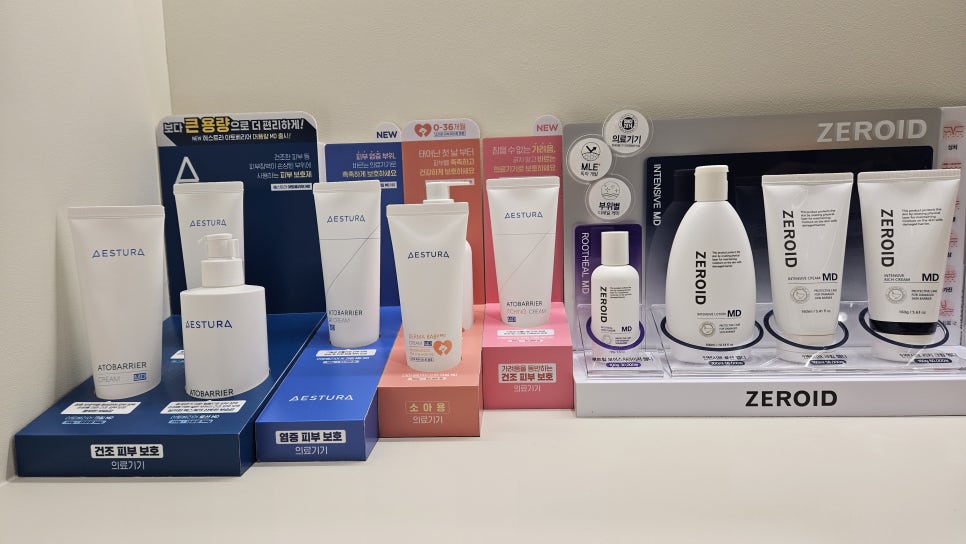
First of all, store-bought products and hospital-use products differ somewhat in their development purpose.
Store cosmetics are usually developed with a focus on:
✔ a moist feel
✔ quickly noticeable hydration
✔ fragrance, spreadability, and trendy ingredients
On the other hand, hospital-use MD products are designed on the premise of:
✔ restoring a damaged skin barrier
✔ calming skin that has become sensitive to various irritants
✔ minimizing irritation caused by cosmetic application
In other words, they go through a slightly more rigorous certification process than store-bought products,
and because the ingredients are developed for people with skin conditions,
they also contain almost no allergy-triggering ingredients.
Here is one more important point.
It is the ‘ratio of lipids’ that make up the skin barrier.
Our skin barrier is maintained by a balance of these three lipids in a 3:1:1 ratio:
ceramide : cholesterol : free fatty acids
Many MD moisturizers used in hospitals are made by precisely blending ingredients based on this healthy skin lipid structure’s “golden ratio (3:1:1).”
In particular, products such as Atobarrier (MLE technology) and Zeroid (MLE/Adfence technology)
help supplement this lipid ratio externally,
which damaged skin has difficulty restoring on its own, and help stably recover a weakened skin barrier.
In contrast, ordinary moisturizers sold in stores often contain ingredients such as ceramides,
but in many cases they are included only in small amounts as part of marketing,
or they are formulated more for spreadability and immediate hydration than for the balance between lipids.
However, MD products used in hospitals are
not so much “products that are unconditionally good for everyone,”
but rather products that are meaningful when used according to the current skin condition.
That is why a doctor’s diagnosis and prescription are necessary.
Those products we know that are also sold in stores,
do you understand them a little better now?ㅎ
In winter, when skin becomes especially sensitive,
let’s all take care of our moisture according to our own skin condition
and protect our precious skin barrier well~ㅎㅎ