Following the prologue, I’ll now begin the main story about flat warts.
*Flat warts (VPJ, verruca plana juvenilis)
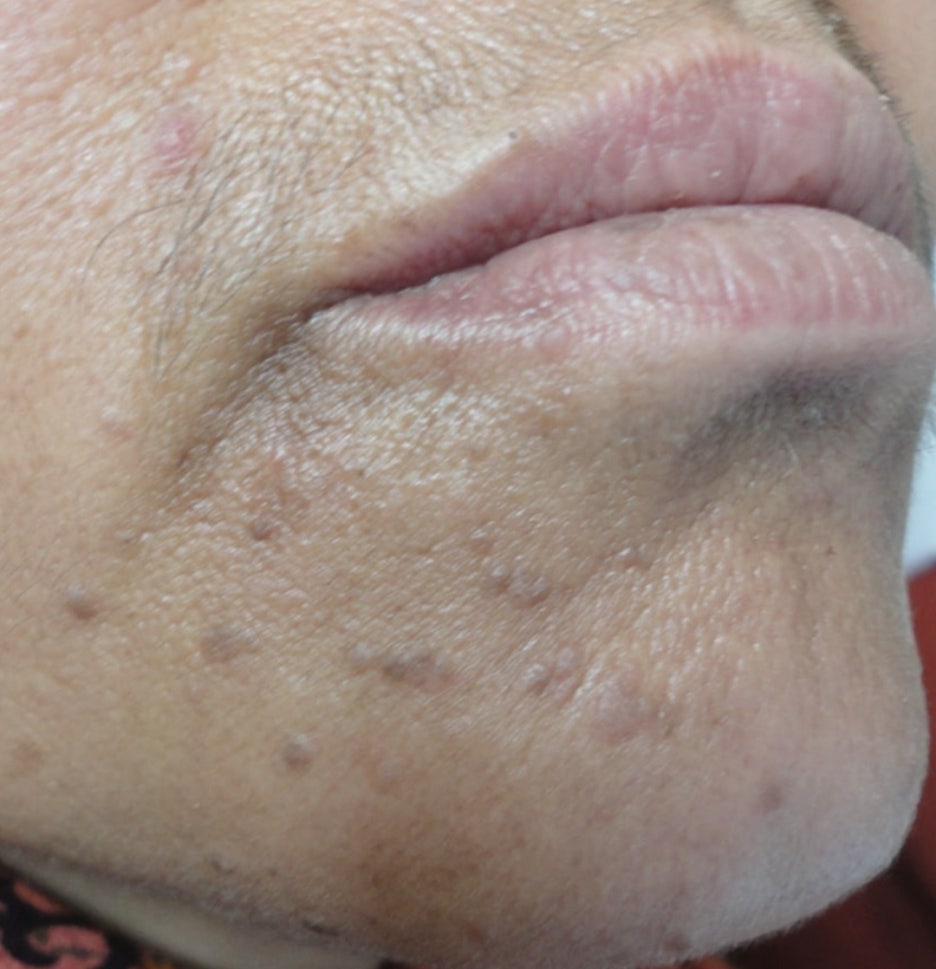
(The image above is the first one that appears when searching for verruca plana on Google, and you can see the flat papules of a typical brown flat wart.
Judging from how it has already spread to the surrounding area, it seems to have been there for quite some time.)
Flat warts are viral warts that appear on the skin as small flat spots or slightly raised flat papules.
-
Color: white, skin-colored, light brown, dark brown
-
Common sites: face, neck, chest, backs of the hands
-
In cases of weakened immunity: they can also spread to the lower chest, abdomen, and back.
In the early stages, they are easy to mistake for tiny acne, milia, or spots, but warts are caused by infection with human papillomavirus (HPV), so if left alone, they can keep spreading, making early treatment very important. HPV! It’s probably a virus you’ve already heard of as the cause of other diseases. Each virus subtype is different, and here is a brief summary.
-
Common warts (hard, broccoli-like warts that appear on the hands and feet) → HPV types 1, 2, 4, 7, 26, 29, 57
-
Genital warts (small protruding lesions) → HPV types 6, 11
-
Cervical cancer → HPV types 16, 18
-
Flat warts → HPV types 3, 10, 28, 49
Flat warts are transmitted through direct contact or indirect contact (contaminated items such as towels, razors, makeup brushes, etc.). In particular, people with a weak skin barrier are easily infected when their immunity is low (overwork, stress, colds, pregnancy, etc.).
*How can you tell flat warts apart?
The most accurate way is to visit a dermatology clinic near you and get examined. However, in today’s busy society, it is not easy to find time to go to the hospital. I’ll introduce a way to initially tell at home whether it might be flat warts.
- Are the number of lesions gradually increasing and spreading?
Because flat warts are a viral infection, they spread to surrounding areas. Other lesions do not spread sideways just because you leave them alone. A “tendency to gradually spread outward” can be considered the most important distinguishing point.
- How to distinguish them from tiny acne:
| | Distribution | Can it be extracted? | Associated lesions |
|---|
| Flat warts | Face, neck, coexist | Nothing comes out when squeezed | Unrelated to acne or inflammatory lesions |
| Tiny acne | T-zone with many sebaceous glands, around the mouth, chin | Comedones come out | Whiteheads + blackheads, inflammatory lesions |
① Acne mainly appears in areas with many sebaceous glands (the forehead, nose T-zone, around the mouth and chin, and the butterfly zone of both cheeks), while flat warts appear on the face regardless of whether the sebaceous glands are well developed, and lesions are often seen on the neck as well (if someone who has never had even a single pimple suddenly develops tiny lesions that spread around, that would be a situation where flat warts should be considered more strongly).
② Acne can release comedones when extracted, but flat warts yield nothing even when squeezed.
③ In the case of tiny acne, different types of acne often appear together on the face, such as blackheads, inflammatory acne, and large nodular acne.
- How to distinguish them from milia and lentigines
-
Milia: round, smooth, bead-like, pearl-colored or ivory-colored
-
Lentigines: flat pigmented lesions without any protrusion
-
Flat warts: the surface is slightly raised and they are not round like milia.
- How to distinguish them from syringoma and skin tags
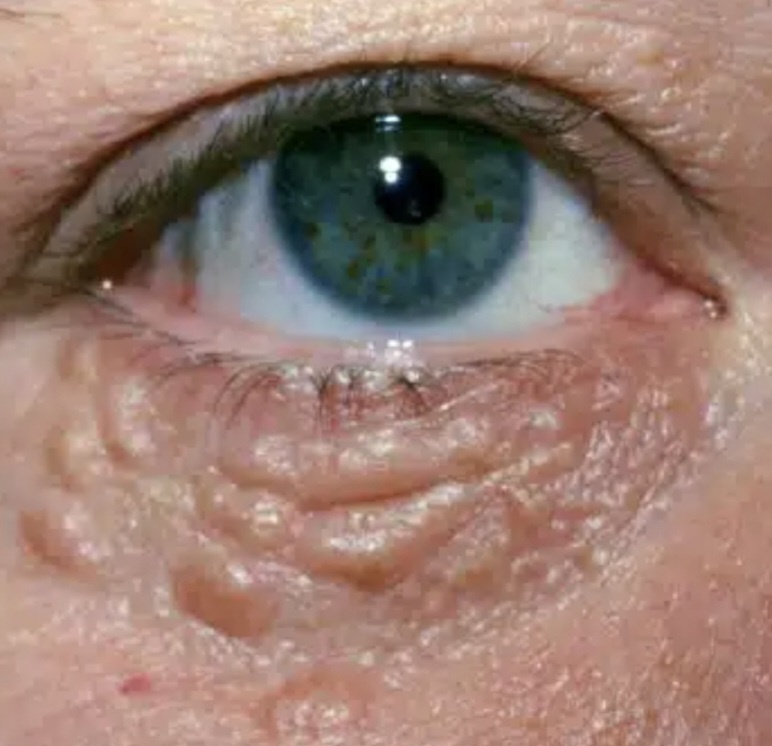
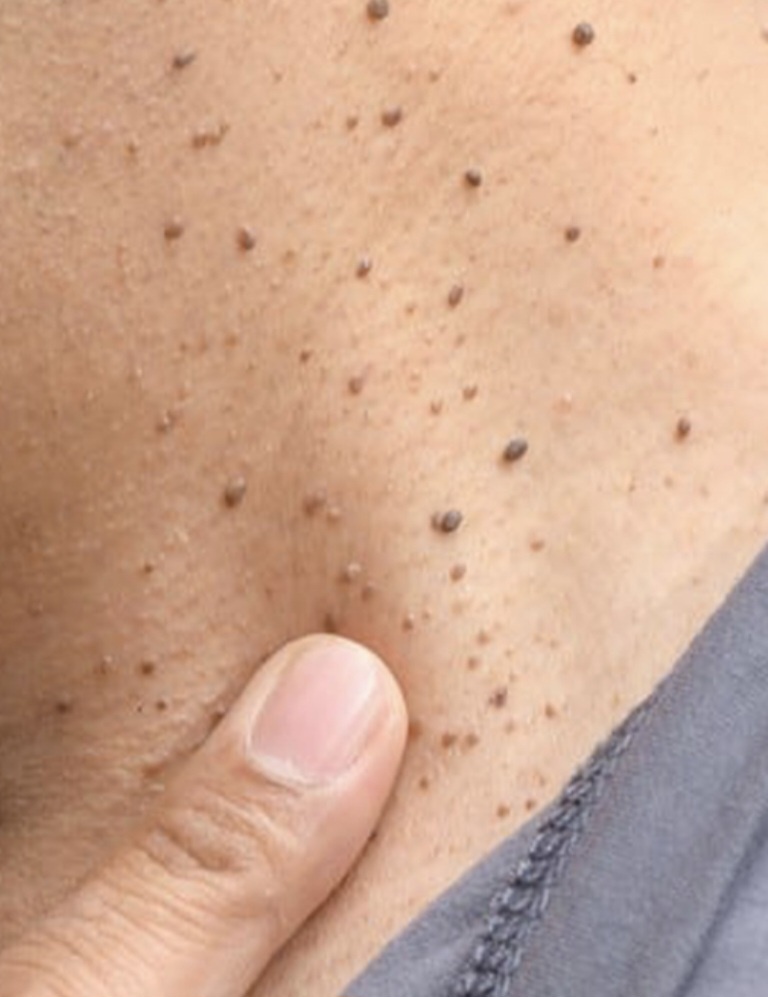
Syringoma, a benign sweat gland tumor, also appears as multiple skin-colored papules, so it can be difficult to distinguish from skin-colored flat warts. Syringoma appears more symmetrically on both sides than flat warts, and is mainly concentrated around the eyes and forehead. It can be differentiated from flat warts, which do not show bilateral symmetry and appear scattered across the face. Skin tags are also skin-colored to brown, bumpy lesions, and many people have multiple lesions on the neck, so they can be difficult to distinguish from flat warts on the neck. However, skin tags have a stalk that connects the lesion to the skin, like a flower stem, which helps distinguish them from flat warts.
The photos below are, in order: typical tiny acne, milia, lentigines, syringoma, and skin tags.
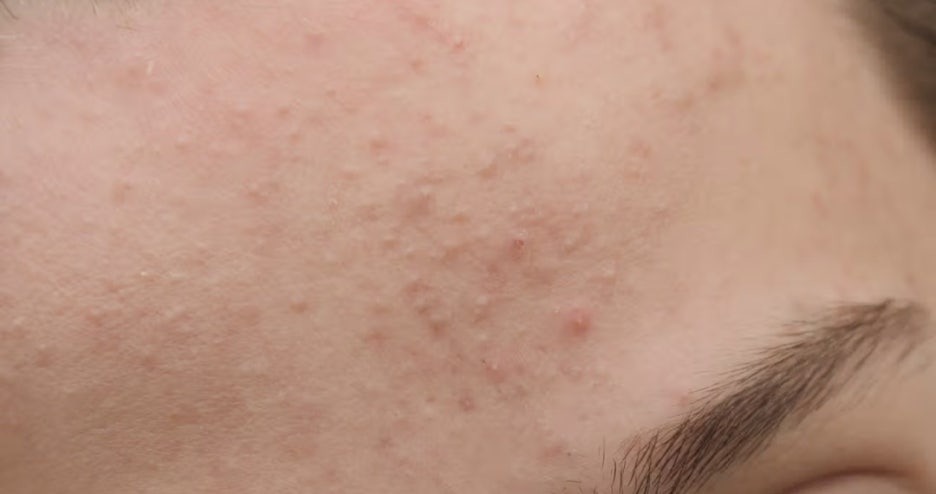
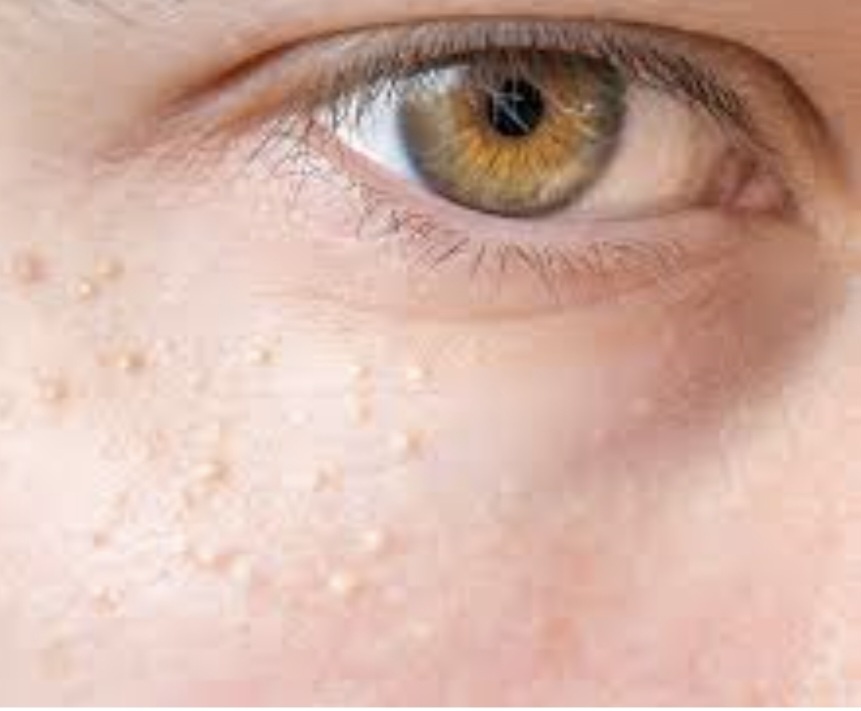
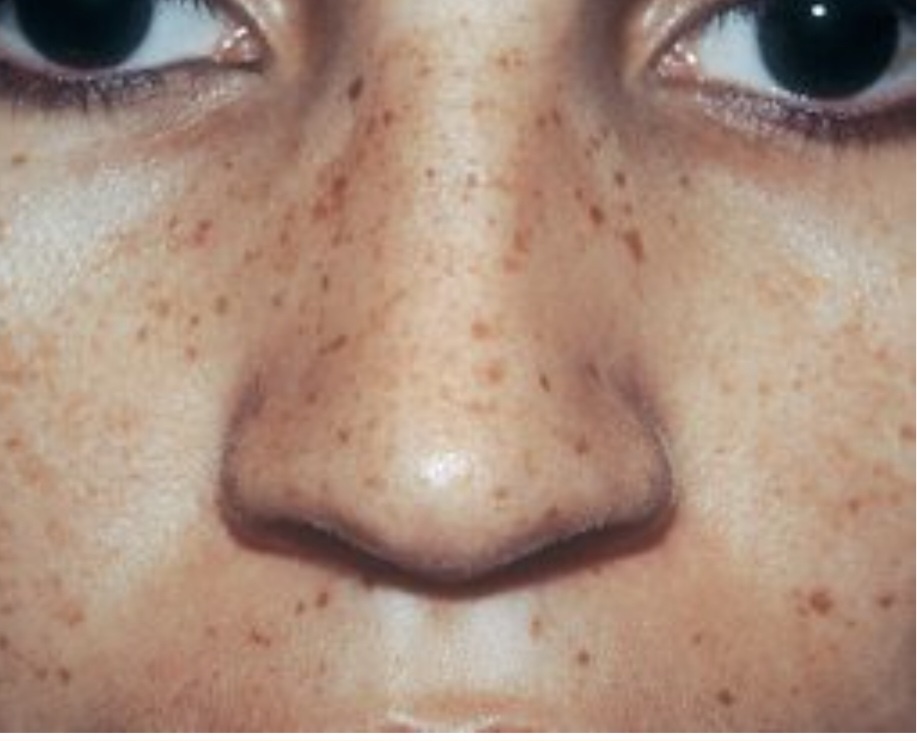
Previous image
Next image
If I also cover the treatment and prevention of flat warts, this post will probably get too long, so I’ll split it into separate posts. In this part, I hope this becomes a chance to clearly learn how to distinguish flat warts from other lesions that can be confused with them.