In the previous part, the main topic was differentiating flat warts. There are many things to consider, such as where they are distributed, their detailed shape, whether they tend to spread, and their feel, so it may have seemed a bit difficult. In this part, we’ll look at the treatment and prevention of flat warts, and I think it will be a little easier to read than the last one.
*Treatment of Flat Warts
① Cryotherapy:
It’s a different type, but if you’ve had experience with cryotherapy for hand or foot warts, you may think of cryotherapy here too. If we look only at the aspect of simply eliminating the virus, it may be effective, but cryotherapy is not chosen because it has a high chance of leaving scars or pigmentation on the face and neck.
② Topical medicine:
Topical immunotherapy such as DPCP is not a practical option because it is difficult to perform in Korea, and it can also cause contact dermatitis. The treatment rate is not as high as expected, so it is not used for treating flat warts.
③ Oral medicine:
As for oral medicine, there is high-dose cimetidine therapy. In the clinic, I get quite a few questions about whether flat warts can be treated with oral medicine, so I’ll explain this part in a bit more detail.
Let me briefly go into a less interesting explanation. You can skip this part if you’d like. Cimetidine is originally an H2 receptor antagonist used as a gastrointestinal medicine. It is used to treat gastric ulcers and gastroesophageal reflux disease (GERD) by reducing stomach acid. But since this drug can supposedly be used unexpectedly for wart treatment, it may seem confusing. Cimetidine helps wart treatment by activating immune T cells to induce the removal of HPV (human papillomavirus) and by regulating the inflammatory response around the wart. In other words, the drug itself does not directly attack the wart, but it can help the body’s immune system guide it toward getting rid of the wart.
The wart treatment dose is 20–40 mg/kg/day, and the daily dose must be divided into 2–4 doses. For example, an adult weighing 50 kg would need to take 1000–2000 mg per day. Common side effects include indigestion, diarrhea, and nausea, and rarely it can also cause gynecomastia, elevated liver enzymes, or decreased kidney function. There are quite a few side effects to endure in order to get rid of flat warts, and the treatment effect is not consistently shown depending on the study results, so it is not considered a first-line treatment.
So what is the treatment for flat warts that works better than other treatments, has milder side effects, and is commonly used? It is the CO2 laser.
④ Laser:
Among lasers that remove by burning, there are two types: Er:YAG laser and CO2 laser. Erbium is a laser with a wavelength of 2940 nm and is suitable for removing lesions without damaging surrounding tissue. However, in the case of flat warts, the fatal drawback of using an erbium laser is the high possibility of recurrence, so CO2 laser is the best option for removing flat warts. Even if you carefully find and remove the visible lesions as thoroughly as possible with a laser, flat warts are difficult to eliminate completely in one session because latent viruses can come back up again. Then wouldn’t it make sense to use a CO2 laser, which thoroughly cauterizes and removes the visible lesions at least when removing them? People who previously had moles removed with CO2 and suffered from red erythema, pigmentation, or scars may still be afraid of CO2 laser. In relation to that, I’ll briefly explain the histopathological findings of flat warts.
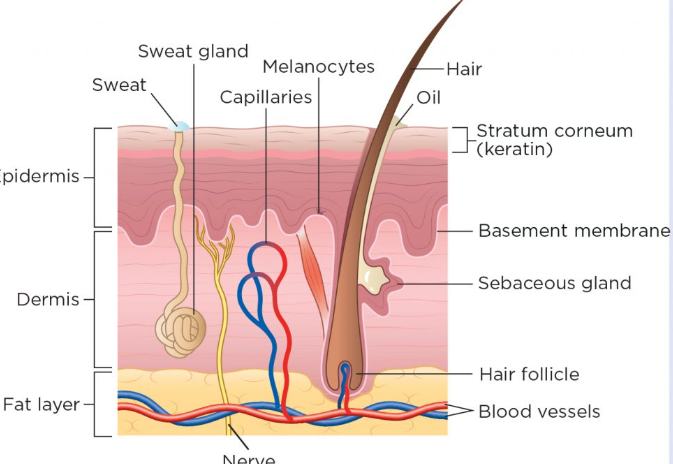
Our skin is made up, from the outside, of the epidermis and dermis, and below that are subcutaneous fat, muscle, and bone. In general, when laser treatment leaves marks or scars, it is when damage is done below the dermis.
If you look at a tissue biopsy of a flat wart, the various histological findings are limited only to the epidermis, and even then only to the upper epidermis. The flat wart virus does not affect the area below the dermis. In the first place, when removing it with a laser, unlike other lesions, the laser is performed by targeting only a very shallow layer at a very low output, so if you manage the area well for about a week after the laser, you can selectively remove only the flat warts without marks or scars.


These are images that appear when searching Google for histopathological findings of flat warts. Compared with normal tissue, the upper epidermis is thicker and more wavy. Cells infected with the flat wart virus are
characteristically seen with a pale halo-like appearance around them. All of these changes are confined to the epidermal layer, and even then only to the upper epidermis, so when removing them with a laser, the target depth for removal is very shallow.


Previous image
Next image
Someone I know recently had flat warts that were so visible that I took photos. If you look at the heart mark in the first photo, several typical skin-colored flat warts can be seen under the left eye, and the second photo is after removal with a CO2 laser. For this person too, some erythema is expected to be observed for a while as the scabs fall off, and then it will gradually fade.
*Prevention of Flat Warts
As a preventive measure, it is important to avoid direct and indirect contact with the flat wart virus, minimize minor skin damage, and keep the skin barrier strong.
① Avoid direct and indirect contact
It is best to avoid close skin contact with family members or friends who have flat warts. For example, if a mother has many flat warts on her face during pregnancy, it is better not to rub her face directly against the baby before the warts are treated. Examples of avoiding indirect contact include not sharing items that directly touch our skin, such as towels, razors, cosmetics, and massage devices. It is also good to wash your hands often.
② Make the skin barrier strong
First, minor skin damage should be minimized. Even if you are exposed to the flat wart virus directly or indirectly, if the epidermal layer acts as a strong shield, you will not be infected. It is better not to scratch your skin hard with your hands and to avoid actions that create friction on the skin, such as gua sha or acupressure massage. Examples of caring for the skin barrier include applying enough moisturizer to the face and body on a regular basis and not scrubbing off dead skin.
③ Maintain good overall condition
Since warts are ultimately a viral infection, if the overall immune system is strong and functioning properly, infection does not happen so easily. Therefore, getting enough high-quality sleep, eating a balanced and healthy diet, and managing stress can also help improve immune function.
But.... how can anyone possibly keep all of this up throughout life? Even I have too many things on that checklist that I can’t give up. If the flat warts are already there, the most realistic preventive measure is probably to get rid of them as quickly as possible and prevent them from spreading secondarily.
This was supposed to be a light first topic, but the content has become longer than expected. Next time, I’ll post the final article about flat warts, especially about flat warts that appear during pregnancy and how to deal with them, which is a concern for pregnant women and those who have recently given birth.