Hello. This is Skin ON Air from Jamsil On Dermatology, run by a married couple who are board-certified dermatologists!
What do you consider most important when looking for a clinic for tattoo removal?
There are several factors to consider, but the equipment used is also important, right?
If you have done even a little research, you have probably noticed that pico lasers are currently the most commonly used treatment for tattoo removal :)
Let’s take a closer look at why pico lasers are used for tattoo removal!
To answer this question, we first need to understand the concept of TRT (Thermal Relaxation Time).
What Is TRT?
TRT refers to the time it takes for the temperature of a target heated by a laser to decrease by approximately half as it releases heat into the surrounding tissue.
In simple terms,
it can be thought of as the “time it takes for a heated material to cool down.”
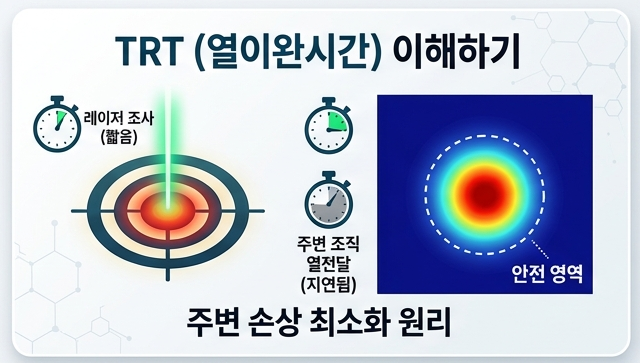
One of the basic principles of laser treatment is to selectively destroy only the target while minimizing damage to the surrounding healthy tissue.
To achieve this, the laser exposure time must be shorter than the target’s TRT.
If the laser is applied for longer than the TRT, heat can spread to the surrounding tissue, potentially increasing the risk of unnecessary burns or scarring.
How Short Is the TRT of Tattoo Pigment Particles?
Tattoo pigment particles are very small.
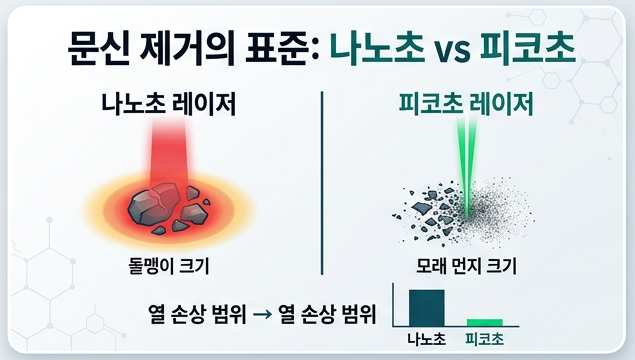
In general, the smaller the particle, the shorter its TRT. The TRT of tattoo pigment particles is known to be approximately several nanoseconds (ns, 10⁻⁹ seconds).
In other words, to effectively destroy tattoo pigment, high energy must be delivered in an even shorter period of time.
The Standard Treatment of the Past: Q-Switched Lasers
Before pico lasers emerged, Q-switched Nd:YAG lasers were the standard treatment for tattoo removal.
Q-switched lasers use extremely short pulses measured in nanoseconds to destroy tattoo particles.
They represented a groundbreaking advancement over earlier lasers and remain effective equipment for tattoo removal today.
However, as tattoo particles become increasingly smaller, there may be limitations to further breaking down the remaining pigment into even smaller pieces.
And Then Came the Pico Laser
As its name suggests, a pico laser uses pulse widths measured in picoseconds (ps, 10⁻¹² seconds).
This is approximately 1,000 times shorter than a nanosecond.
Because it can deliver energy over a period much shorter than the TRT of tattoo particles, it applies a powerful impact to the pigment particles before heat has time to spread.
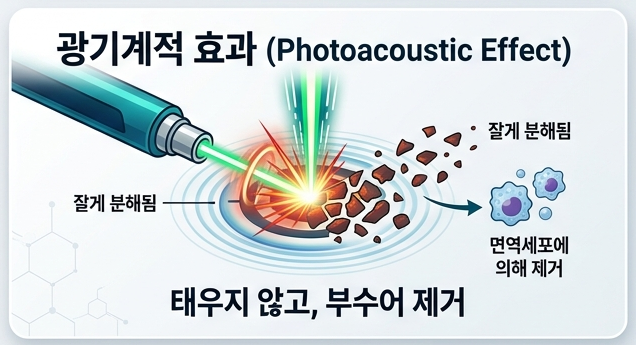
What occurs during this process is the Photoacoustic Effect.
Simply put, rather than “burning away” the pigment,
it more closely resembles breaking it into tiny pieces through instantaneous pressure and shock waves.
As a result, the pigment particles are broken down into smaller fragments, making them easier for the immune cells in our bodies to remove.
So, how much difference do the pulse widths of pico- and nanosecond lasers make in tattoo removal effectiveness?
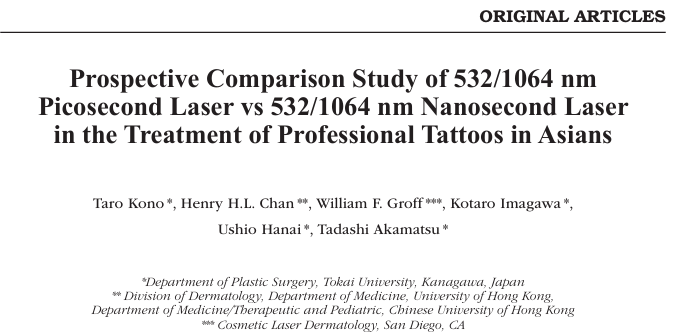
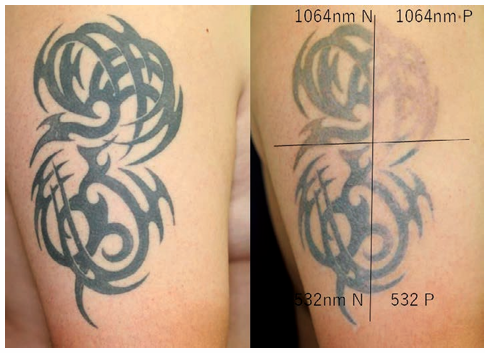
A study compared a pico laser with a Q-switched Nd:YAG laser using nanosecond pulse widths for tattoo removal.
As you can see in the photos, the pico laser (1064 nm P) removed tattoo pigment more noticeably than the nanosecond laser (1064 nm N)!
You can also see the use of a 532 nm wavelength laser. We will discuss this later in a post about colored tattoo removal :)
Advantages of Pico Lasers
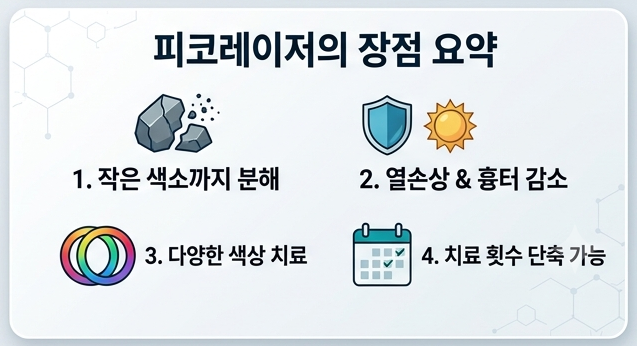
- Can break down smaller pigment particles
This may be helpful for removing residual tattoos that have already undergone several treatments or for treating difficult-to-remove tattoos.
- Reduced thermal damage
Because relatively less heat is transferred to the surrounding tissue, pico lasers may be advantageous in reducing the risk of burns or scarring.
- Treatment of tattoos in various colors
Pico lasers using specific wavelengths may produce good results with some colored tattoos that have responded poorly to conventional treatment.
- Potentially fewer treatments
This does not apply in every case, but some patients achieve satisfactory results in fewer sessions than with conventional Q-switched lasers.
Are Pico Lasers a Universal Solution?
Not necessarily.
The results of tattoo removal are affected not only by the type of laser but also by factors such as the following:
-
The depth of the tattoo
-
The type of tattoo color
-
The amount of tattoo ink
-
The location of the tattoo
-
The tattoo removal treatment method
-
The patient’s immune response
Therefore, even when the same pico laser is used, the removal rate and number of treatments can vary greatly from patient to patient.
Above all, it is also very important how carefully and appropriately the treating physician adjusts the intensity and performs the procedure according to the patient’s skin condition, right?
That is why, when receiving tattoo removal treatment, you should consult with and receive treatment from an experienced board-certified dermatologist :)
Summary
The key to tattoo removal is delivering energy selectively to the tattoo pigment alone.
Because the TRT of tattoo particles is extremely short—approximately several nanoseconds—
pico lasers, which use pulses shorter than this, can break down the pigment more effectively.
Pico lasers have become a highly useful tool for tattoo removal because they break pigment into tiny pieces through the Photoacoustic Effect rather than relying primarily on heat-induced damage.
However, more important than the laser equipment itself is accurately analyzing the characteristics of the tattoo with a board-certified dermatologist and developing a treatment plan that includes the appropriate wavelength, laser intensity, and treatment method.