Hello! This is Skin ON Air from Jamsil On Dermatology, run by a husband-and-wife team of board-certified dermatologists.
Today, we will take a closer look at colored tattoos, which are widely known to be particularly difficult to remove.
“Why are colored tattoos more difficult to remove than black tattoos?”
You may have often heard that colored tattoos are more difficult to remove, but you may have wondered why they are harder to remove completely.
The short answer is that each pigment differs in how well it absorbs laser energy and in the characteristics of its particles.
Difficulty of Colored Tattoo Removal
In general, the difficulty of removal is as follows:
Black < Red < Blue·Green < Yellow·Orange < White
Of course, the difficulty can vary depending on the type of pigment used, its depth, and the treatment method. However, the general order is as shown above.
How Does Laser Tattoo Removal Work?
Laser tattoo removal works by breaking up pigment particles beneath the skin into smaller pieces, which are then gradually removed by the body's immune cells.
You have probably heard this many times before, so you already know it, right? Haha.
However, black and colored pigments have different properties.
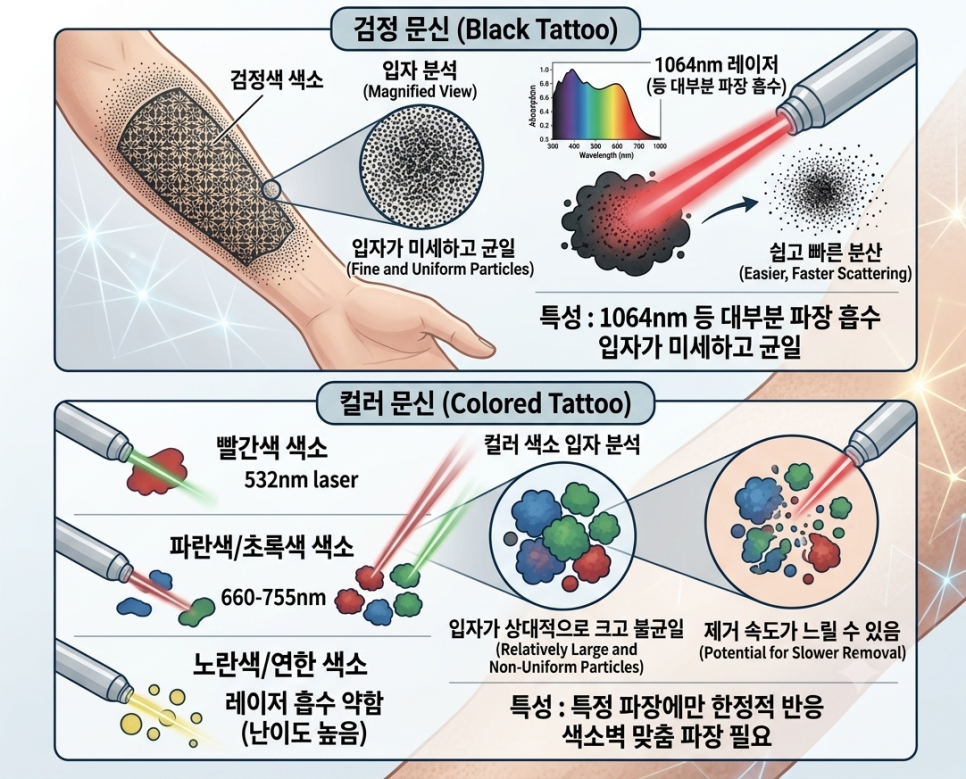
Black pigment particles are relatively small and absorb a wide range of laser wavelengths well, so black tattoos tend to be the easiest to remove.
Colored pigments, on the other hand, are often larger or respond only to specific wavelengths, which can make the removal process slower.
Each Color Responds Best to Different Laser Wavelengths
Some representative examples are as follows:
-
Black → Absorbs most wavelengths well, including 1064 nm
-
Red → Responds best to a 532 nm wavelength
-
Blue·Green → Effective at wavelengths in the 600–700 nm range, such as 660 nm, 730 nm, and 755 nm
-
Yellow·Orange·Light colors → Respond to 532 nm, but are relatively difficult to remove because they absorb laser energy weakly
-
White → Barely absorbs laser energy and may instead temporarily turn brown or black, a phenomenon known as paradoxical darkening.
Why Colored Tattoos Are More Difficult—Differences in Pigment Particles
In laser tattoo removal, what matters is not only how well the pigment absorbs laser energy, but also the characteristics of the pigment particles.
Black tattoos generally use carbon black-based pigments, whose particles are extremely fine and efficiently absorb laser energy.
As a result, the pigment tends to break into small pieces with just one laser pass.
Colored tattoos, on the other hand, use various inorganic or organic pigments, including iron oxide, chromium oxide, cadmium-based pigments, and titanium dioxide.
These pigments often have relatively larger particles than black pigments, or multiple particles that are tightly bound together. Therefore, even when exposed to the same laser, they require more energy to break down into smaller pieces, and the number of treatments may also increase.
In other words, colored tattoos are difficult to remove because:
-
Each color responds to a different laser wavelength,
-
Some colors have a low rate of laser absorption, and
-
Some colored pigments have particle structures that are harder or larger, making them more difficult to break apart.
Even Colored Tattoos Can Be Lightened Considerably!
Although colored tattoos have been known to be extremely difficult to remove, treatment results have improved significantly in recent years through the appropriate combination of picosecond lasers, which can use various wavelengths, and other devices.
Of course, colored tattoos may require more treatments than black tattoos and may not be removed completely. However, with consistent treatment, most can be lightened considerably.
Rather than giving up on removing a tattoo simply because it is colored,
it is most important to consult a board-certified dermatologist with extensive tattoo removal experience, a thorough understanding of which lasers are appropriate for each color, and a good knowledge of the reactions that may occur with different colors,
and to establish an appropriate treatment plan!