Two Treatments Developed to Speed Up Tattoo Removal
Hello. This is Skin ON Air, presented by the dermatologist couple at Jamsil ON Dermatology Clinic!
Today, we’ll talk about tattoo removal for the first time in a while.
If you have looked into tattoo removal, you may have come across the term R0 at least once.
You may have seen explanations such as:
“Applying the laser multiple times in a single session.”
“Reducing the number of treatment sessions.”
However, understanding why this method is needed makes it much easier to understand.
Why Multiple Tattoo Removal Treatments Are Necessary
When a laser is applied, the tattoo pigment in the skin is broken into small particles. Macrophages then engulf the particles, allowing the pigment to be eliminated from the body.
Unfortunately, a single treatment can remove only some of the pigment.
There is a limit to how much pigment can be broken up with one laser application, and using the laser at too high an intensity can actually cause greater skin damage.
You might think that applying a lower-intensity laser multiple times would solve the problem, but even that is not easy.
Immediately after laser application, the skin’s surface becomes white, causing a frosting or bubbling effect.
This happens because the tattoo pigment reacts to the laser energy, creating tiny water-vapor bubbles within the skin.
This layer of bubbles temporarily interferes with the laser reaching deeper into the skin.
Therefore, conventional tattoo removal generally repeats the following process:
Laser application
↓
Immune cells remove the fragmented pigment over several weeks
↓
Next treatment
The R20 and R0 methods were developed to overcome these limitations.
What Is the R20 Method?
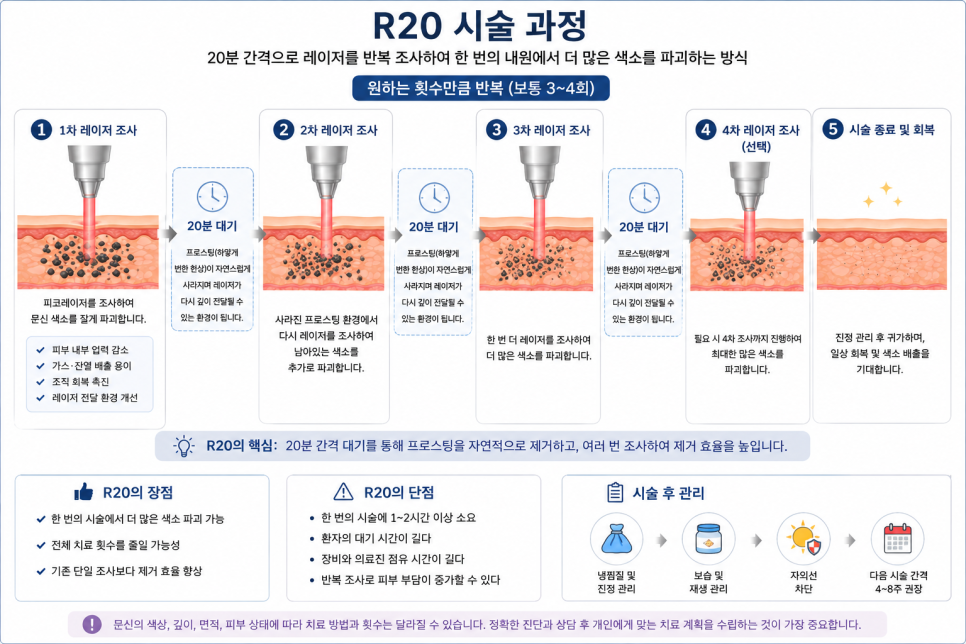
As the name suggests, R20 is a method of repeatedly applying the laser at 20-minute intervals.
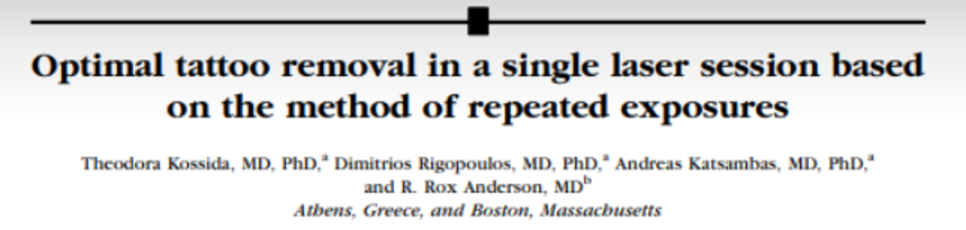
It was first introduced in a paper in 2012, published by Professor Rox Anderson, a well-known figure familiar to dermatologists around the world.
The treatment process is as follows:
1st application
↓
Wait 20 minutes
↓
2nd application
↓
Wait 20 minutes
↓
Repeat 3–4 times
After about 20 minutes, the frosting naturally disappears, allowing the laser to reach deep into the skin again.
Advantages of R20
-
Breaks down more pigment in a single procedure
-
May reduce the total number of treatment sessions
-
Improves removal efficiency compared with a conventional single application
Disadvantages of R20
-
Takes 1–2 hours or more for a single treatment
-
Requires a very long waiting period
-
Repeated applications over a long period may increase the burden on the skin
What Is the R0 Method?
The biggest disadvantage of R20 is its long waiting period.
The R0 method was developed to address this issue.
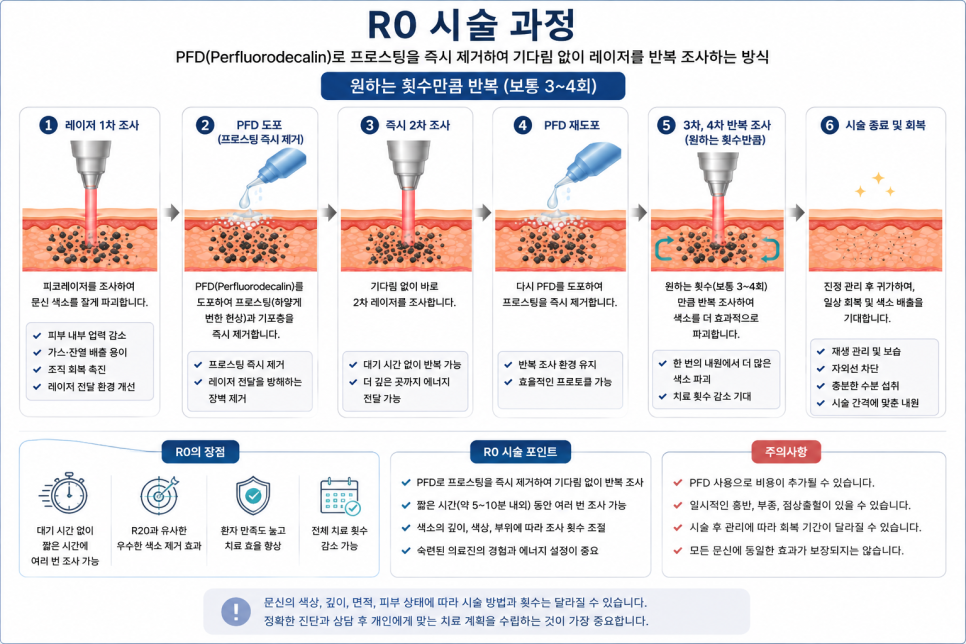
R0 uses a special solution called PFD (Perfluorodecalin) to quickly remove frosting.
This makes it possible to apply the laser again immediately, without waiting 20 minutes.
The treatment process is:
Laser application
↓
Apply PFD
↓
Immediate next application
↓
Repeat
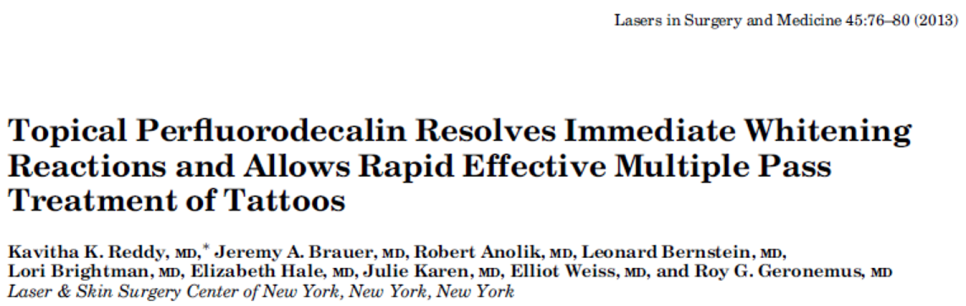
The R0 method was first introduced in a paper in 2013.
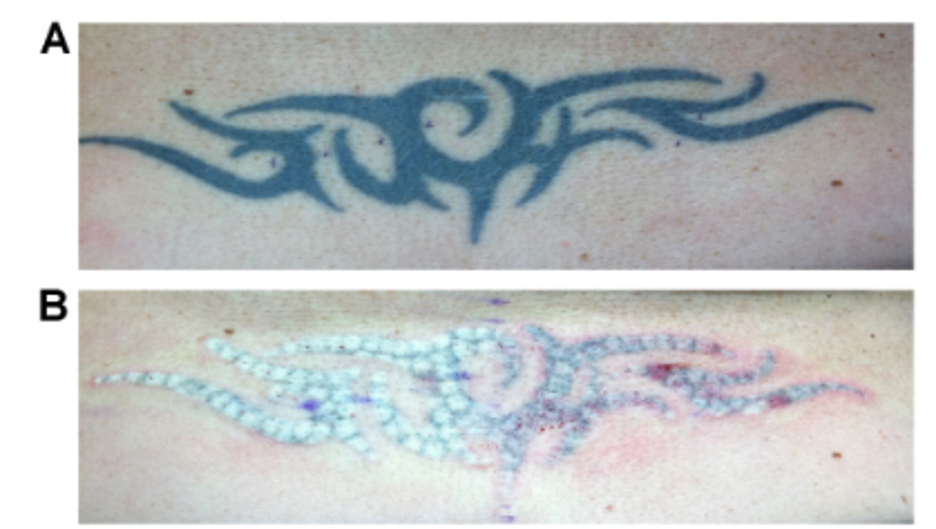
After applying the laser to the tattoo, the tattoo is divided into right and left sections. PFD solution is applied only to the right side to show the difference.
The frosting/bubbling effect caused by the laser treatment can be seen.
Because PFD solution was applied only to the right side, the bubbles have subsided more there than on the left!
Advantages of R0
-
Expected to provide removal effects similar to R20
-
Significantly shortens the treatment time
-
Allows multiple laser applications in a single treatment
-
Generally offers high patient satisfaction
Disadvantages of R0
Comparison of R20 and R0
| R20 | R0 |
|---|
| Repeated applications with a 20-minute wait between them | Immediate repeated applications using PFD |
| Longer treatment time | Shorter treatment time |
| No additional equipment required | Requires PFD |
| Improved removal efficiency | Improved removal efficiency + greater convenience |
Currently, the R0 method is being used more often in clinical practice than R20, which requires a long waiting period.
⸻
Conclusion
R20 and R0 are both treatments developed to remove more tattoo pigment in a single treatment.
More recently, fractional lasers have also been used together with these methods through Fractional-assisted Tattoo Removal, along with further-developed treatment protocols.
In the next post, I’ll explain in detail what Fractional-assisted Tattoo Removal is,
and how the “FRAC-ZERO” method performed at Jamsil ON Dermatology Clinic differs.