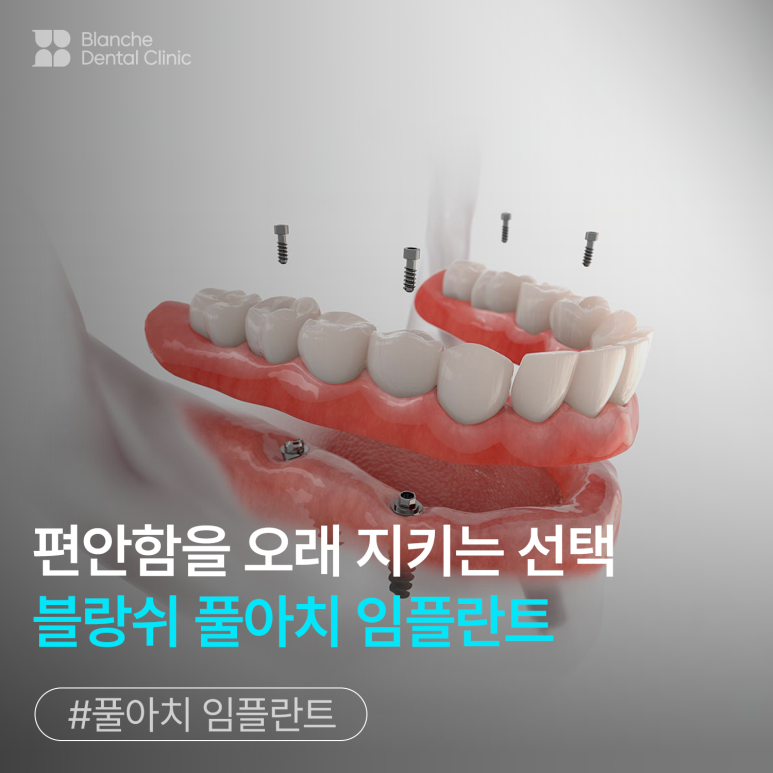
If you have lost many teeth..
Do you have to get full-arch implants no matter what?
Who are full-arch implants for?
This is a question that patients who are hoping to get implants ask very often.
When one or two teeth start to fall out,
you may only feel discomfort in that area,
but at some point,
you begin to notice that your overall chewing force and balance
are breaking down.
The remaining teeth take on more force,
dentures keep moving around,
and even your pronunciation and facial impression can change.
So today, before you visit the dentist,
we would like to share some useful treatment information
n
that you may want to know in advance:
what full-arch implants are,
and who they are suitable for.
We’ll explain in detail now.
What are full-arch implants?
Who are full-arch implants for?
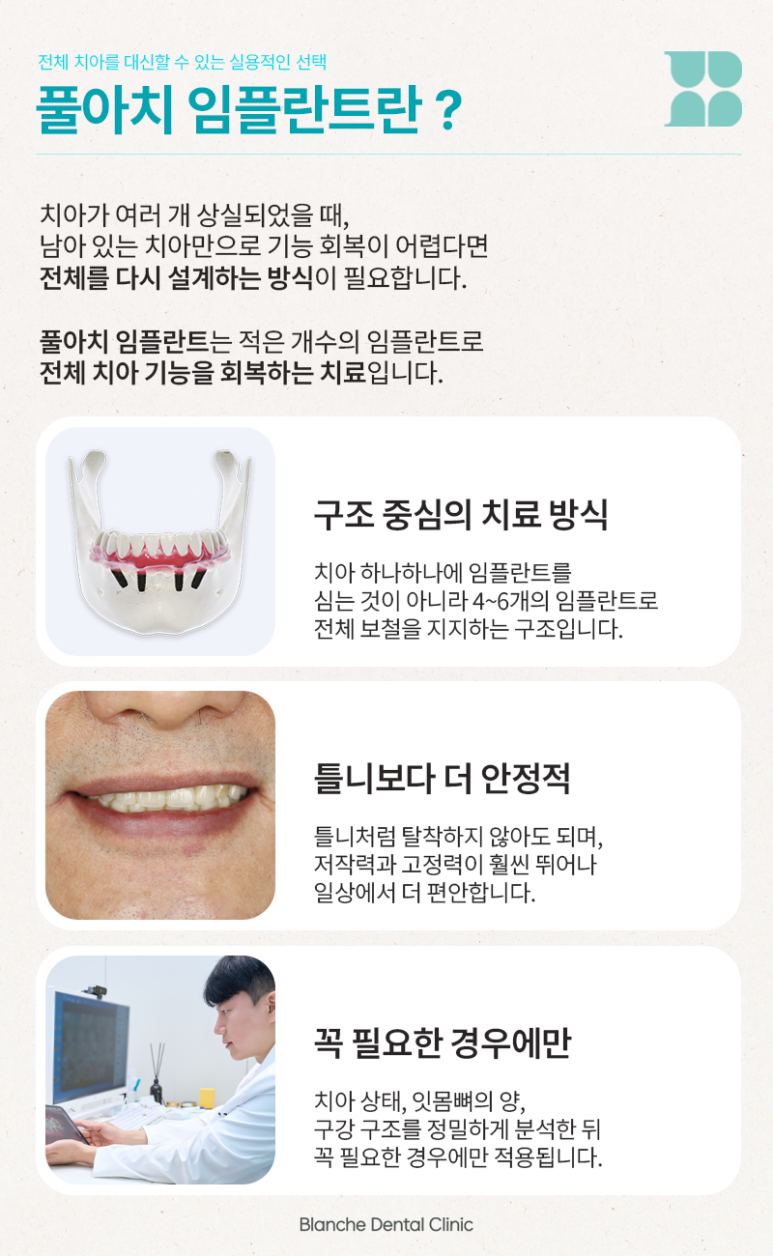
Full-arch implants are
not a method in which an implant is placed for each individual tooth,
as with conventional implants.
Instead, only 4 to 6 implants are placed
in the upper or lower jaw,
and a full prosthesis is connected on top of them.
This is a treatment method used when the entire set of teeth must be restored,
while minimizing the number of implants placed,
and it is a structure that can improve functional stability.
It is widely used because it is more comfortable than dentures
and places less burden on the patient than full-mouth implants.
How is it different from dentures?
Who are full-arch implants for?
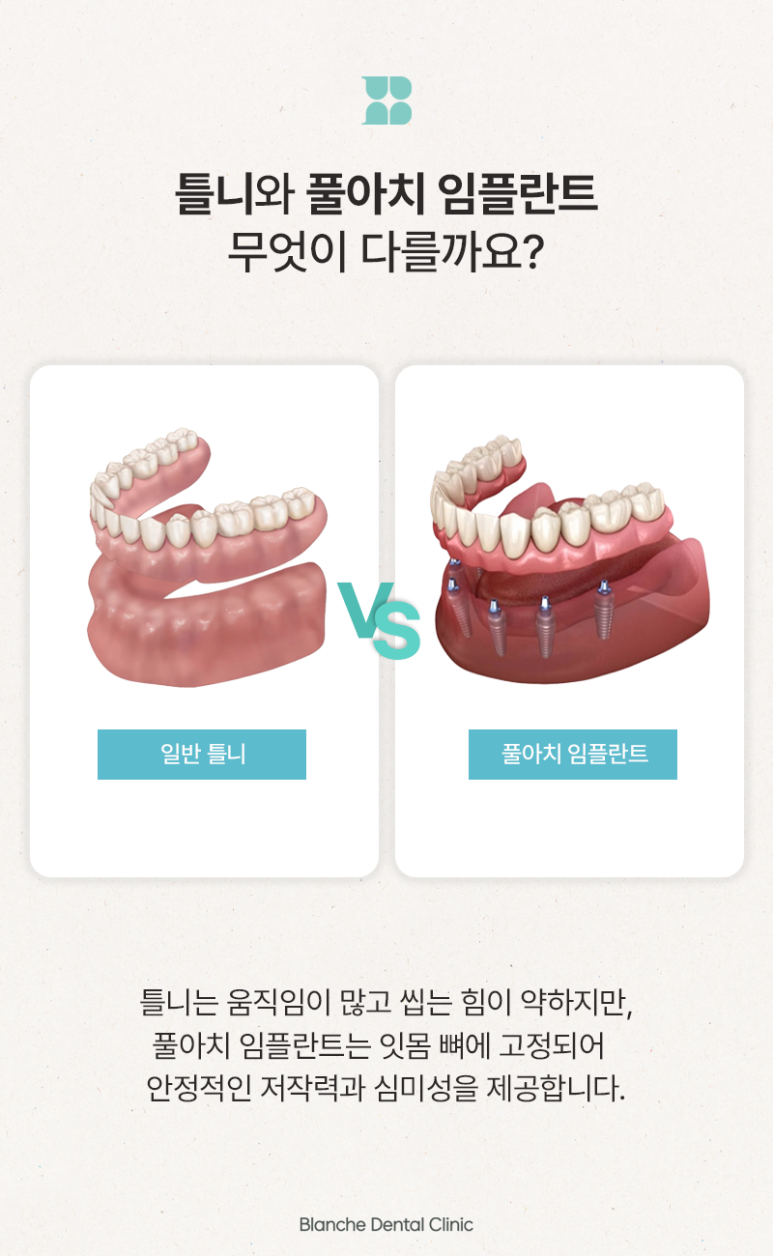
Dentures are prosthetics that sit on the gums,
so they move more and have weaker chewing force.
In contrast, full-arch implants are supported by implants fixed in the jawbone,
which improves chewing force, stability, pronunciation, and aesthetics overall.
Above all, the fact that you do not need to remove them every day
and can live with them like your own teeth
increases patient satisfaction.
Then,
is everyone a candidate?
Who are full-arch implants for?
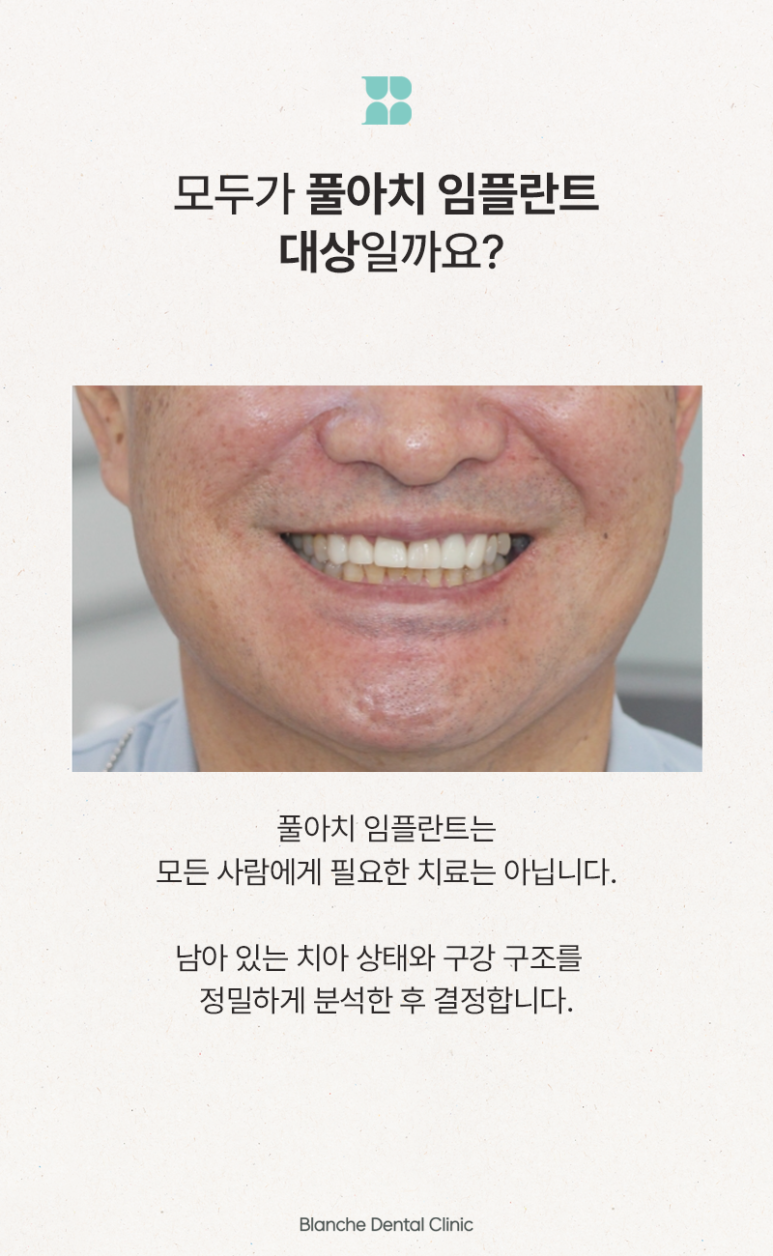
Full-arch implants are
a highly efficient treatment method,
but they cannot be applied indiscriminately.
The condition of the remaining teeth,
the oral structure, the amount and quality of bone,
and the state of functional balance
must all be analyzed
before deciding whether treatment is appropriate.
The need for treatment can be broadly divided into three categories.
- Cases where they are absolutely necessary
Who are full-arch implants for?
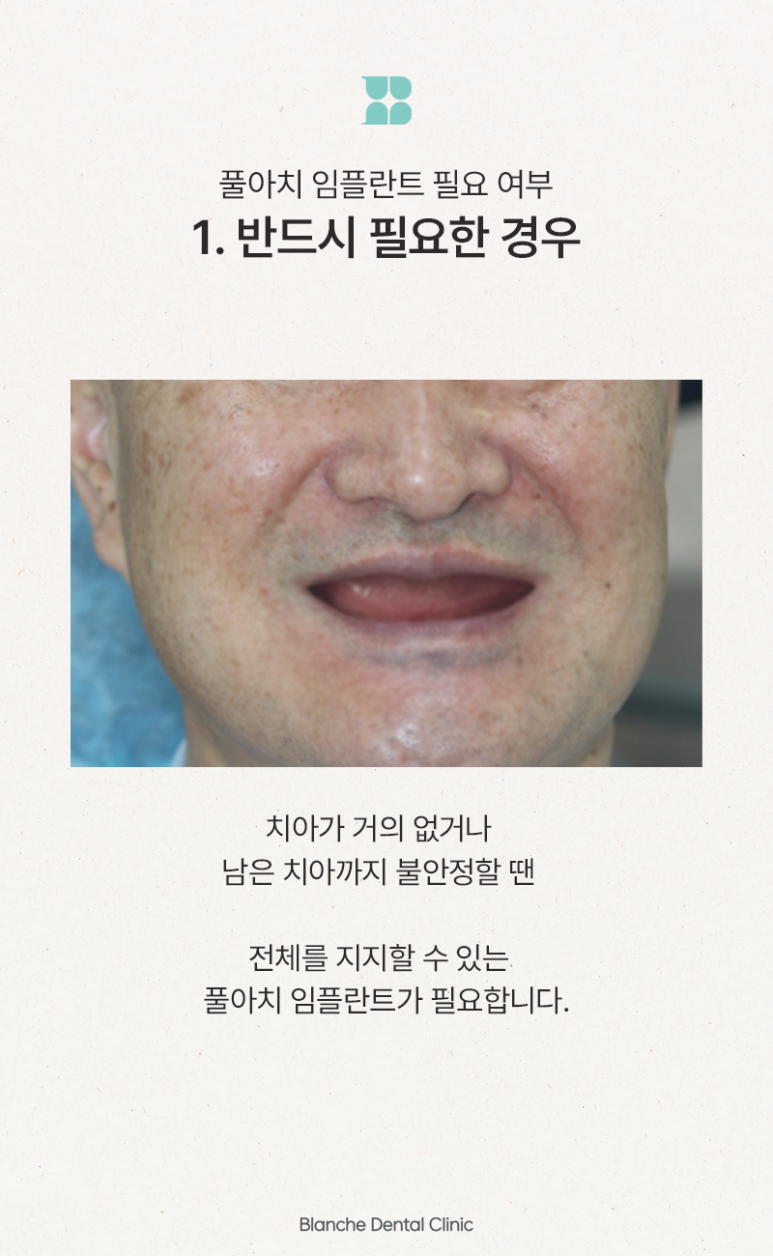
Cases where they are absolutely necessary include
situations in which most teeth have been lost,
or the remaining teeth are severely loose,
and periodontal disease has progressed extensively.
In such cases, there is not enough foundation
to maintain function,
so implants that can support a full prosthesis are appropriate.
- Cases where they can be considered selectively
Who are full-arch implants for?
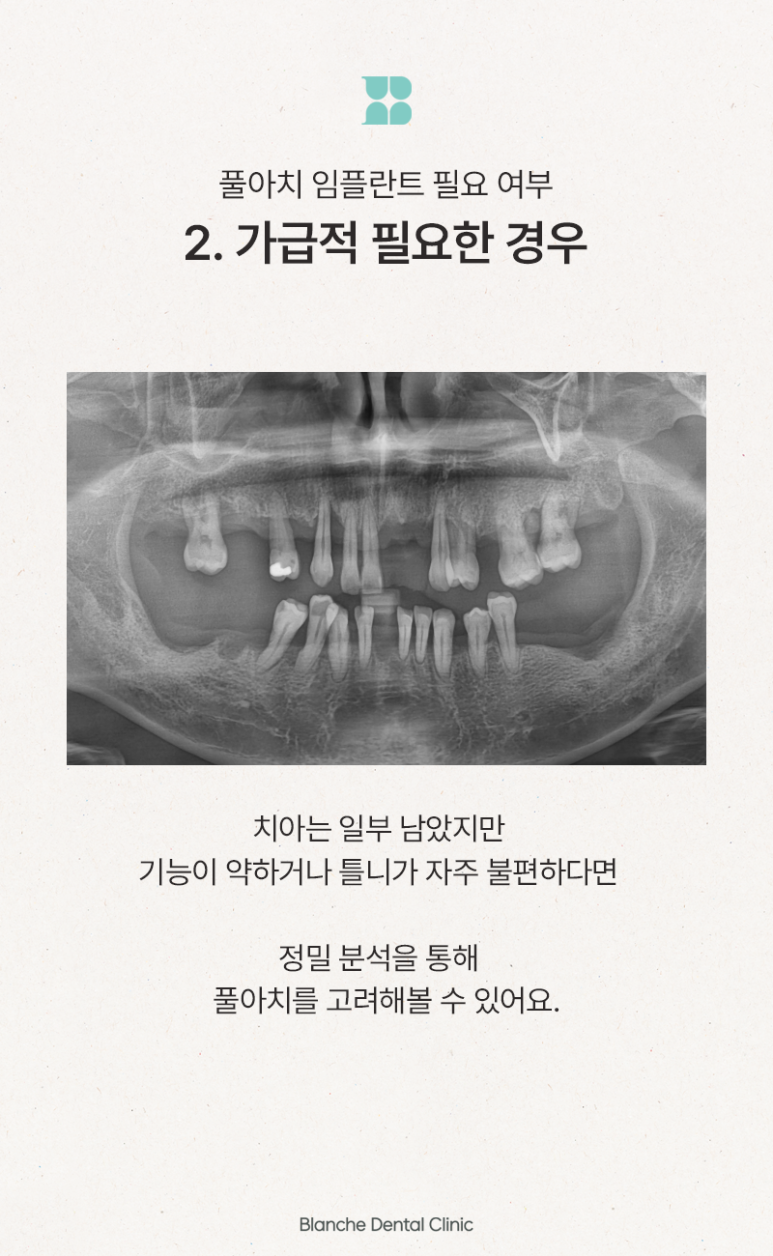
This applies when some teeth remain,
but they are functionally weak,
so they cannot handle the full chewing force,
or when an existing denture frequently comes loose,
causing repeated discomfort.
In such cases, whether full-arch treatment is appropriate
is carefully determined through structural analysis.
- Cases where they are not needed
Who are full-arch implants for?
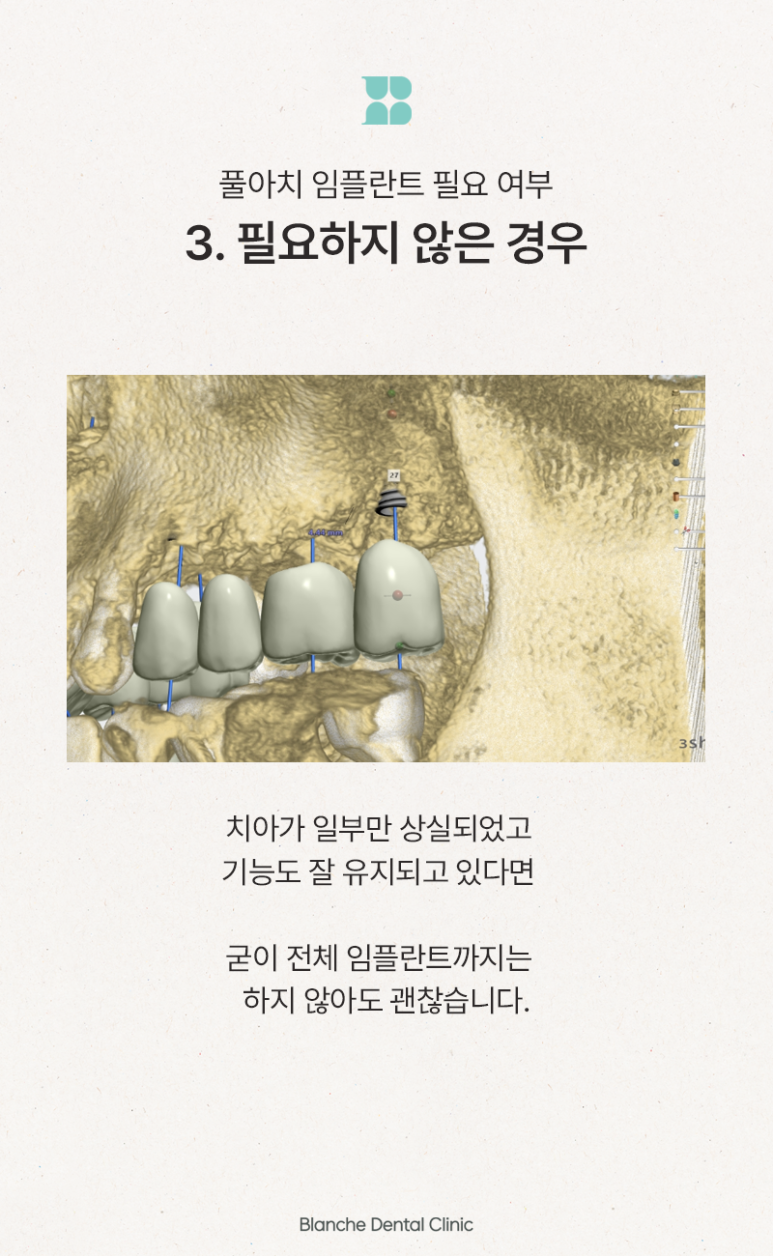
There are also cases where full-arch implants are not necessary.
Even if several teeth have been lost,
if the remaining teeth are stable
and the overall bite and function are relatively well maintained,
there is no need to unnecessarily alter the entire mouth,
and partial implants or prosthetic treatment alone
may be sufficient for recovery.
Diagnosis determines treatment.
Who are full-arch implants for?
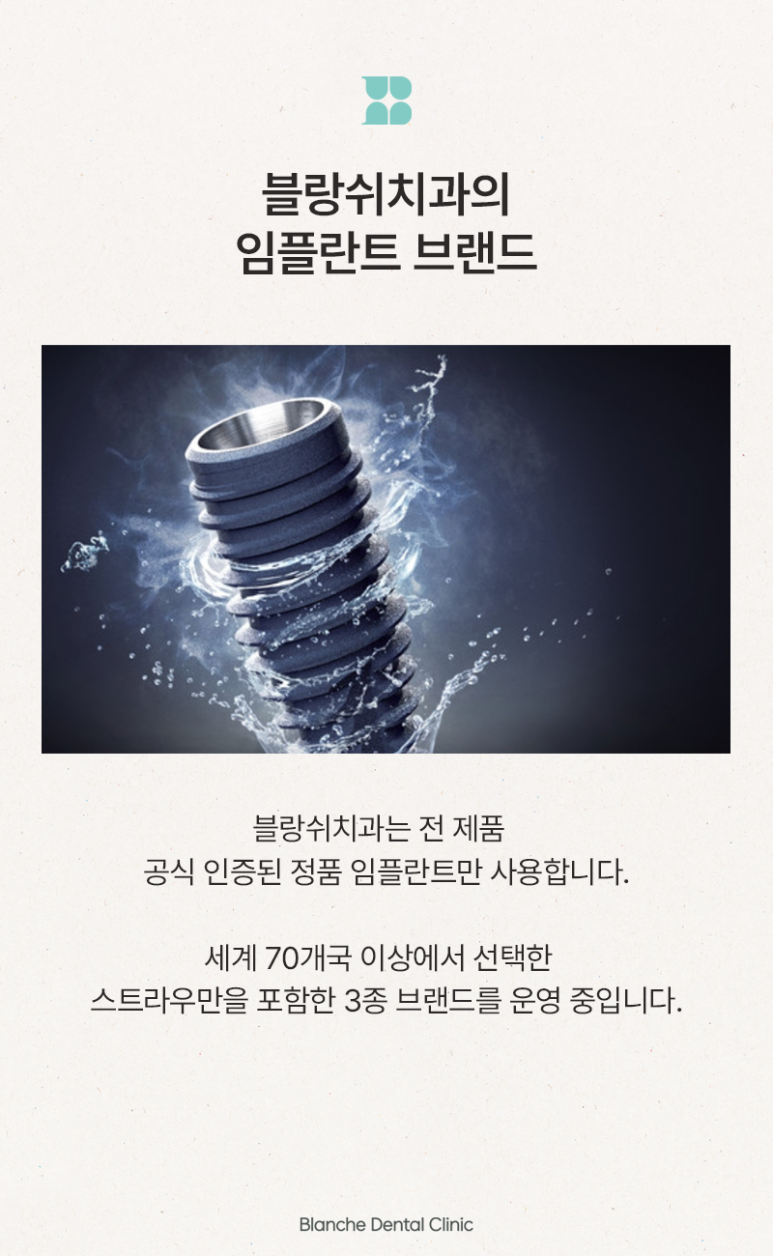
Whether full-arch implants are appropriate cannot be determined
simply by the number of teeth.
At Blanche,
we carefully assess the position and longevity of the remaining teeth,
the degree to which chewing force is distributed,
and the quality and quantity of bone.
Not placing as many as possible,
but precisely as many as needed.
That is Blanche’s standard.
As explained above,
full-arch implants are not a treatment to be decided based simply on the number of teeth,
but after accurately diagnosing the overall oral structure and function,
as well as the condition of the remaining teeth.
Therefore, if you are considering treatment,
please carefully check whether the clinic has medical staff with sufficient clinical experience,
whether it has equipment and systems capable of precise diagnosis,
and whether it proposes a design tailored to each patient’s structure,
rather than performing procedures indiscriminately.
Please make sure to review these points carefully before surgery.
Thank you for reading today.

Clicking the image will take you to the Kakao Channel inquiry