Explained by a dentist from Seoul National University
Brush your teeth like this.
Hello. I’m Kim Tae-hyung, the chief director of Gangnam Blanche Dental Clinic, where we study radiant smiles.
After spending all day in the clinic looking at patients’ teeth, what do you think is the first thing I do when I get home?
It’s checking my wife and children’s brushing.
These days, sweet snacks are popular because of the trend, so they end up eating them often, haha.
"Honey, you brushed sideways again today, didn’t you?"
"My princess, you missed the inside of your tongue again, didn’t you?"
Thanks to having a dentist dad, my family may be a little tired of me.
But the reason I nag them this much is simple:
because they brush hard but in the wrong way, right? haha
In fact, when I see patients at the clinic, there are so many people who brush three times a day without fail, yet still have swollen, bleeding gums or complain of sensitivity because the roots of their teeth (the cervical area) have worn down.
This is usually the result of decades of incorrect brushing habits.
Today, I’ll explain the proper brushing method that I only tell my own family—the one that helps reduce dental visits for life—here at Blanche Dental Clinic.
Read this to the end and 꼭 change your brushing habits!

Stop angry brushing
(Do not brush horizontally)
Many people, when brushing, want to feel "refreshed" and end up laying the toothbrush flat and scrubbing hard from side to side.
It’s the so-called angry brushing that often appears in dramas when the main character is upset.
But this does not clean the teeth; it is more like shaving them down as if sawing wood with a saw.
The boundary between the tooth and gum, the main area where cervical abrasion occurs, is where the enamel is thinnest.
If you keep rubbing this area horizontally, the tooth will wear away like axe marks,
which is called "cervical abrasion."
If you feel a sharp pain when drinking cold water,
it’s likely already progressed.
Blind spots occur: if you only brush horizontally,
The gaps between the teeth won’t be cleaned at all.
In the end, debris remains, turns into tartar,
and becomes a cause of gum inflammation.
The method dentists recommend,
the Bass Method
So how should you brush?
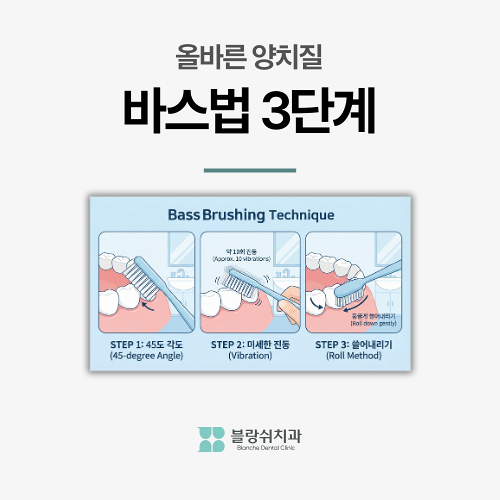
The method recommended as standard by dentists around the world is the "Bass Method."
At our clinic, we teach patients with poor gum health this method without exception.
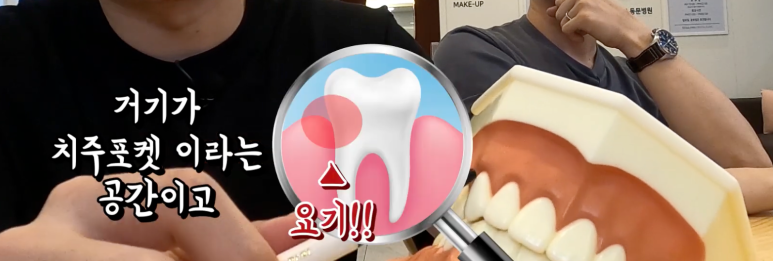
The key is cleaning the gum pocket.
There is a tiny 1–2 mm gap between the tooth and the gum, and this is a hiding place for bacteria.
If you don’t clean here,
it is no different from not brushing at all.
Proper brushing method,
3 steps of the Bass Method
STEP 1.
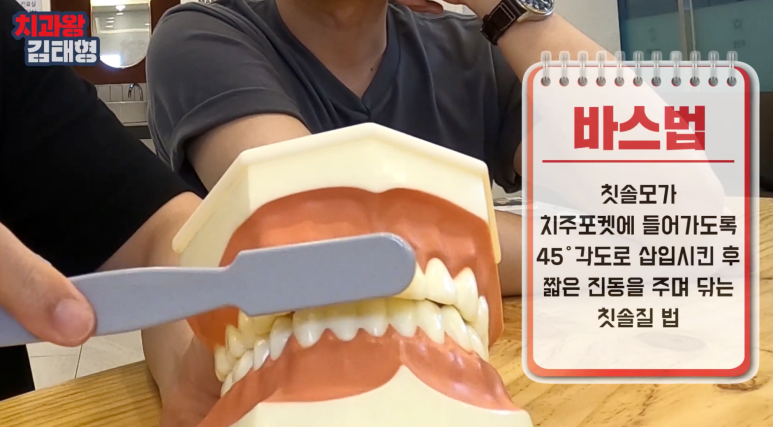
Maintain a 45-degree angle
Place the toothbrush bristles diagonally at a 45-degree angle to the boundary between the tooth and gum.
It is correct if part of the bristles feels like it gently slips into the inner gum crevice.
STEP 2. Fine vibration
(Vibration) In that position,
don’t move the toothbrush back and forth 크게;
apply a very short, quick vibration in place.
Brush about 10 times, trembling lightly,
with the feeling that you are shaking out debris from inside the gums.
(Do not scrub hard with force!)
STEP 3. Sweeping down/up
(Roll Method)
After vibrating, use a wrist snap to
sweep the toothbrush in a rounded motion toward the chewing surface.
Divide this process into sections of 2–3 teeth
and repeat it across the entire mouth.
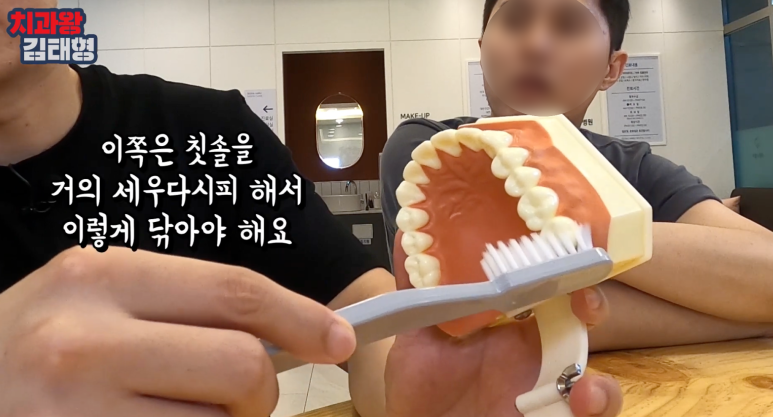

No matter how carefully you brush,
if there is always a spot where cavities form,
it’s probably because you’re missing this area.
This inner side of the lower front teeth is where the salivary glands are located,
so saliva tends to collect there.
When saliva and food debris meet, they quickly
turn into hard tartar.
Hold the toothbrush vertically and brush each tooth as if flicking debris away,
carefully enough that it could splatter onto the mirror.

The very back of the upper molars
When you open your mouth wide, the jawbone blocks the toothbrush and it doesn’t reach well.
With your mouth slightly closed, push the toothbrush toward the gums to clean it,
or hold the toothbrush upright and make sure it reaches all the way to the back.
The tongue side of the lower molars
Because the tongue gets in the way, this is an area that surprisingly often isn’t cleaned well.
Lift your tongue slightly and insert the toothbrush deeply,
then clean the gum line with vibration.
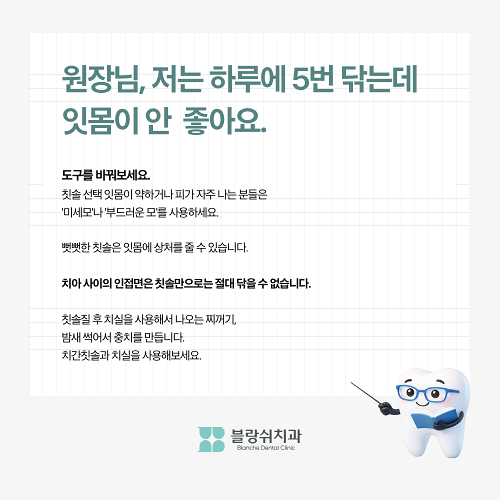
According to a study by the British Dental Association,
brushing properly even once a day is much more effective than brushing carelessly ten times.
Just increasing the number of times with the wrong habit
will only accelerate tooth wear.
At least once a day, before going to sleep, look in the mirror
and spend at least 3 minutes carefully brushing with the Bass Method I taught you.
Even if you practice for just one week,
when you wake up in the morning,
you may notice less bad breath,
and bleeding while brushing
will significantly decrease.
People say you shouldn’t blame the tools,
but in brushing, the tool is half the battle.
Choosing a toothbrush
If your gums are weak or bleed often,
use "fine bristles" or "soft bristles."
A stiff toothbrush can injure the gums.
You should use a toothbrush with a small head
to make it easier to reach deep into the molars.
Floss and interdental brushes are essential.
It is difficult to clean the contact surfaces between teeth 100% with a toothbrush alone.
For my own family, using floss once a day is a non-negotiable rule.
If you use floss after brushing,
you’ll be surprised and think, "Wait, I brushed, so how is this still coming out?"
Those bits of debris rot overnight and create cavities.
Changing habits is truly difficult.
I know it isn’t easy to change a brushing method
that you’ve used for decades overnight.
But this small habit today
will decide whether you get implants 10 years from now,
or whether you’re still able to bite into ribs with your own natural teeth.
Why not start practicing the Bass Method with your family tonight?
If it’s hard to manage on your own,
or if your gums are already swollen and uncomfortable,
feel free to leave a comment anytime.
This has been Gangnam Blanche Dental Clinic. Thank you.
🌿 Recommended reading


This post was written directly by Blanche Dental Clinic for the purpose of providing oral health information. Proper brushing methods may help prevent oral diseases, but periodontal disease or cavities that have already developed require dental treatment. For an accurate diagnosis, we recommend visiting a medical institution for consultation.